All species › Passerines › Tyrant flycatchers and allies › Black-capped Tyrannulet
Black-capped Tyrannulet | Tyranniscus nigrocapillus
Zwartkapvliegenpikker | Tiranolete gorrinegro | Piolhinho-de-boné-preto
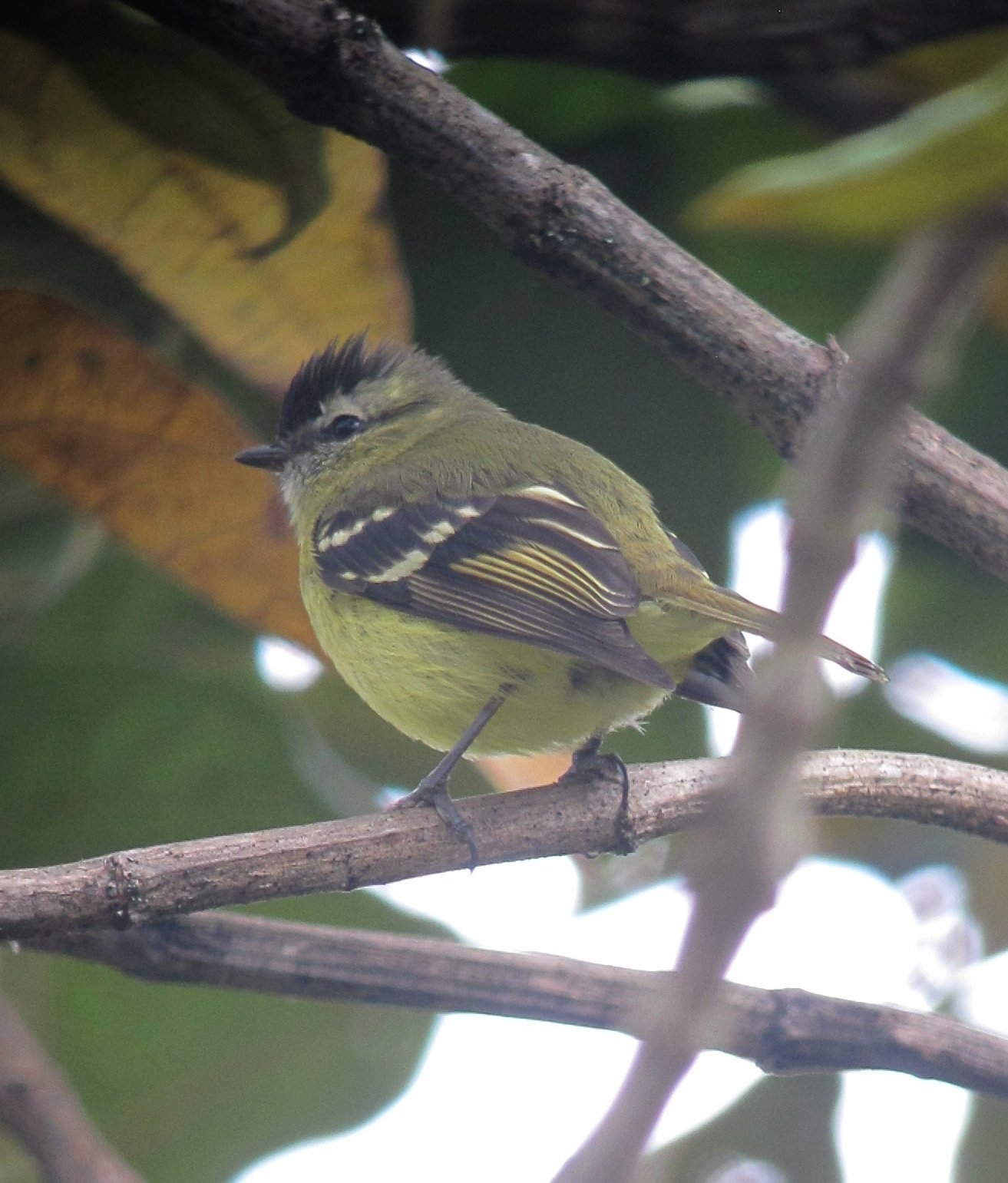
The Black-capped Tyrannulet is a small tyrannulet of upper cloud forest and treeline in the northern Andes. Its black cap with a short white eyebrow separates it from other small tyrannulets at that elevation. It often forages in the outermost twigs, also among flowers.
Voice
Short series of high, thin notes and a fast, dry trill.
No recording with a suitable Creative Commons licence is available for this species yet.
Identification
11 cm, with a short, black bill. The crown is black to dark grey, with a short white stripe above the eye. The upperparts are olive-green. The wings are blackish, with two distinct yellowish to whitish wing bars. The underparts are yellow, the breast olive-yellow. The sexes are alike.
Confusion species
White-banded Tyrannulet Mecocerculus stictopterus has a grey crown, a long white eyebrow and white wing bars, and is greyish white below. Ashy-headed Tyrannulet Tyranniscus cinereiceps lives lower and has a grey head with a black patch on the ear coverts. Tawny-rumped Tyrannulet Tyranniscus uropygialis has a brownish-grey crown, a tawny rump and a greyer breast.
Habitat
The uppermost montane forest, cloud forest, elfin forest at the treeline and forest edges, roughly between 2300 and 3500 m. It searches for small insects among the outer leaves and twigs, often in mixed flocks with tanagers and other tyrannulets. The nest has been little described.
Where the bird is most at home, classified by the vegetation units of the Andes and the west coast.


Range and movements
Colombia: in all three Andean ranges and in the Sierra Nevada de Santa Marta. Ecuador: on both slopes of the Andes. Peru: along the Andes south to the centre of the country. Absent from Bolivia and the Galápagos. Outside the guide area in the Andes of western Venezuela.
- Resident
- dark = core range, pale = thinly spread
How and when to look
Search mixed flocks at the upper edge of montane forest, for example near mountain passes, and look for a small yellow tyrannulet with a black cap in the outer twigs.
Conservation status
Least Concern. The uppermost montane forest is cleared or burned locally, but the species has a large range.
Scientific name
Tyranniscus nigrocapillus | (de Lafresnaye, 1845)
De Lafresnaye described the species in 1845 as T[yrannulus] nigro-capillus; because it was later moved to another genus, the author and year stand in brackets. The genus Tyranniscus was introduced in 1860 by Cabanis & Heine. The genus name is a diminutive of Ancient Greek tyrannos, 'tyrant', so 'little tyrant'. The specific name comes from Latin niger, 'black', and capillus, 'hair of the head': 'black-capped'. The specimen the first description was based on came from Bogotá, Colombia.