All species › Passerines › Tyrant flycatchers and allies › Black-billed Flycatcher
Black-billed Flycatcher | Aphanotriccus audax
Nelsons tiran | Mosquero piquinegro | Papa-moscas-de-bico-preto
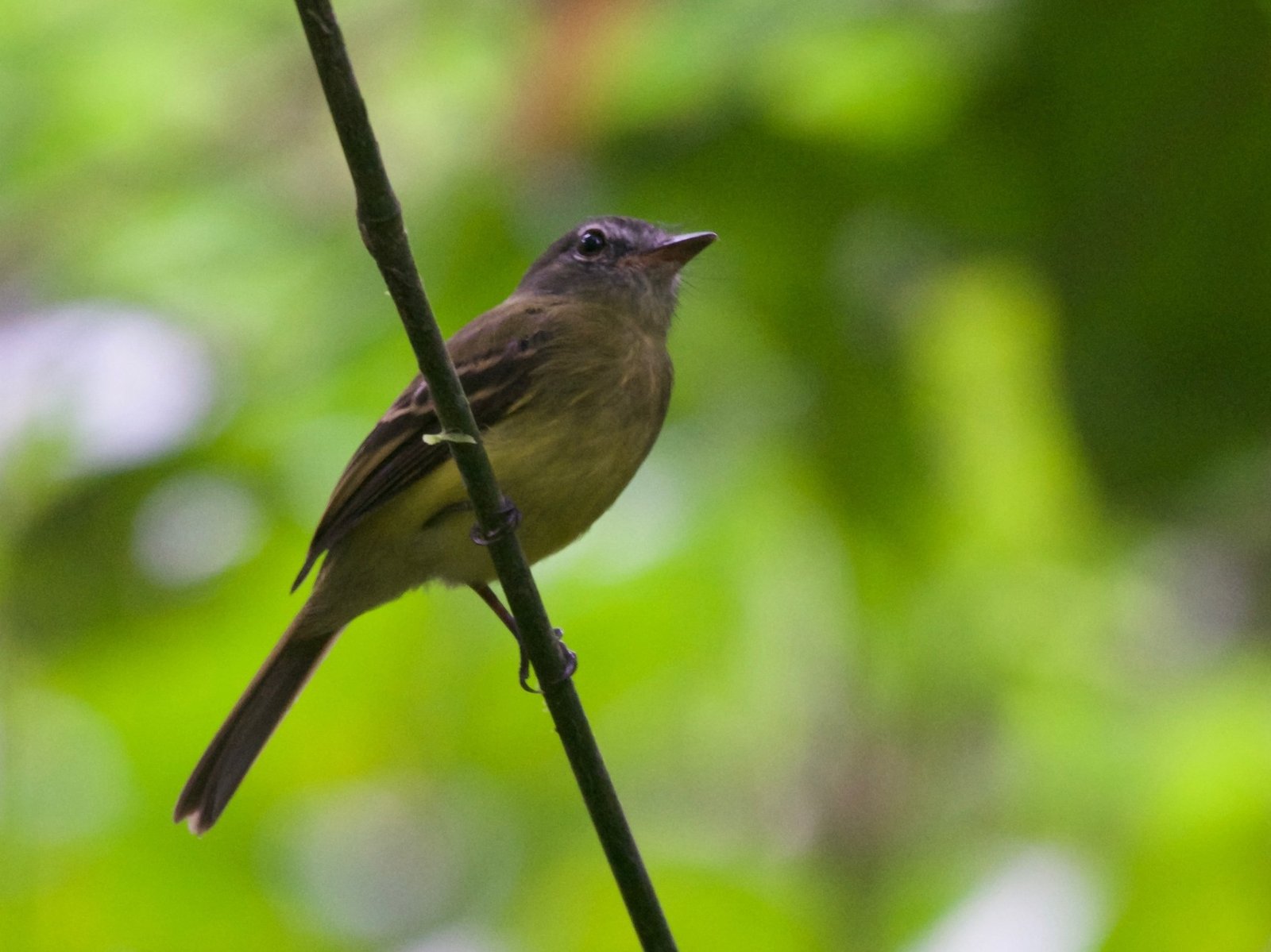
The Black-billed Flycatcher is a small, olive-green tyrant of the understorey of humid lowland forest in eastern Panama and northern Colombia. It keeps to the shady growth along streams and wet places. Its range is small and much of the forest in which it lives has been cleared.
Voice
A short, slightly hoarse series of notes, repeated in quick succession, and a dry pit. Little detail has been described about the song.
Recording: Ross Gallardy — CC BY-NC-SA 4.0 · xeno-canto
Identification
13 cm, with an all-black bill. The upperparts are olive-green, the crown slightly greyer. A white spot in front of the eye and a narrow, broken white eye-ring stand out in the dark face. The wings are dark with two pale, yellowish wing bars. The throat is whitish, the breast greyish olive and the belly pale yellow. The sexes are alike.
Confusion species
Acadian Flycatcher Empidonax virescens occurs only in the northern winter, is slightly larger, and has a pale lower mandible and longer primaries. Alder Flycatcher Empidonax alnorum is browner olive, with a pale lower mandible and a narrower eye-ring, and keeps more to open scrub. Bran-colored Flycatcher Myiophobus fasciatus is browner, with a streaked breast, and lives in open scrub. Whiskered Myiobius Myiobius barbatus has a conspicuous yellow rump and a black tail that it often fans.
Habitat
Understorey and lower mid-storey of humid, shady lowland forest and old secondary forest, especially along streams, in ravines and in wet places; from sea level to about 600 m. It sits quietly on a low branch and catches insects in short sallies to leaves. It lives alone or in pairs. Little is known about the nest.
Where the bird is most at home, classified by the vegetation units of the Andes and the west coast.


Range and movements
Colombia: in the north, from the Panama border east through the Caribbean lowlands into the middle Magdalena Valley. Absent from Ecuador, Peru, Bolivia and the Galápagos. Outside the guide area only in eastern Panama.
- Resident
- dark = core range, pale = thinly spread
How and when to look
Search the shady understorey along forest streams in the remaining lowland forests of northern Colombia for a quiet, olive-green tyrant with a white spot in front of the eye and a black bill.
Conservation status
Near Threatened. Its range is small and the lowland forest of northern Colombia and eastern Panama is largely being converted to pasture and fields.
Scientific name
Aphanotriccus audax | (Nelson, 1912)
Nelson described the species in 1912 as Praedo audax; because it was later moved to another genus, the author and year stand in brackets. The genus Aphanotriccus was introduced in 1905 by Ridgway. The genus name comes from Greek aphanēs, 'obscure, inconspicuous', and trikkos, an unidentified small bird (used in ornithology for tyrant flycatchers). The species name comes from Latin audax, 'bold, daring'. The specimen the first description was based on came from Cana, Darién, Panama.