All species › Passerines › Tyrant flycatchers and allies › Crowned Slaty Flycatcher
Crowned Slaty Flycatcher | Empidonomus aurantioatrocristatus
Gekroonde leitiran | Tuquito gris | Peitica-de-chapéu-preto
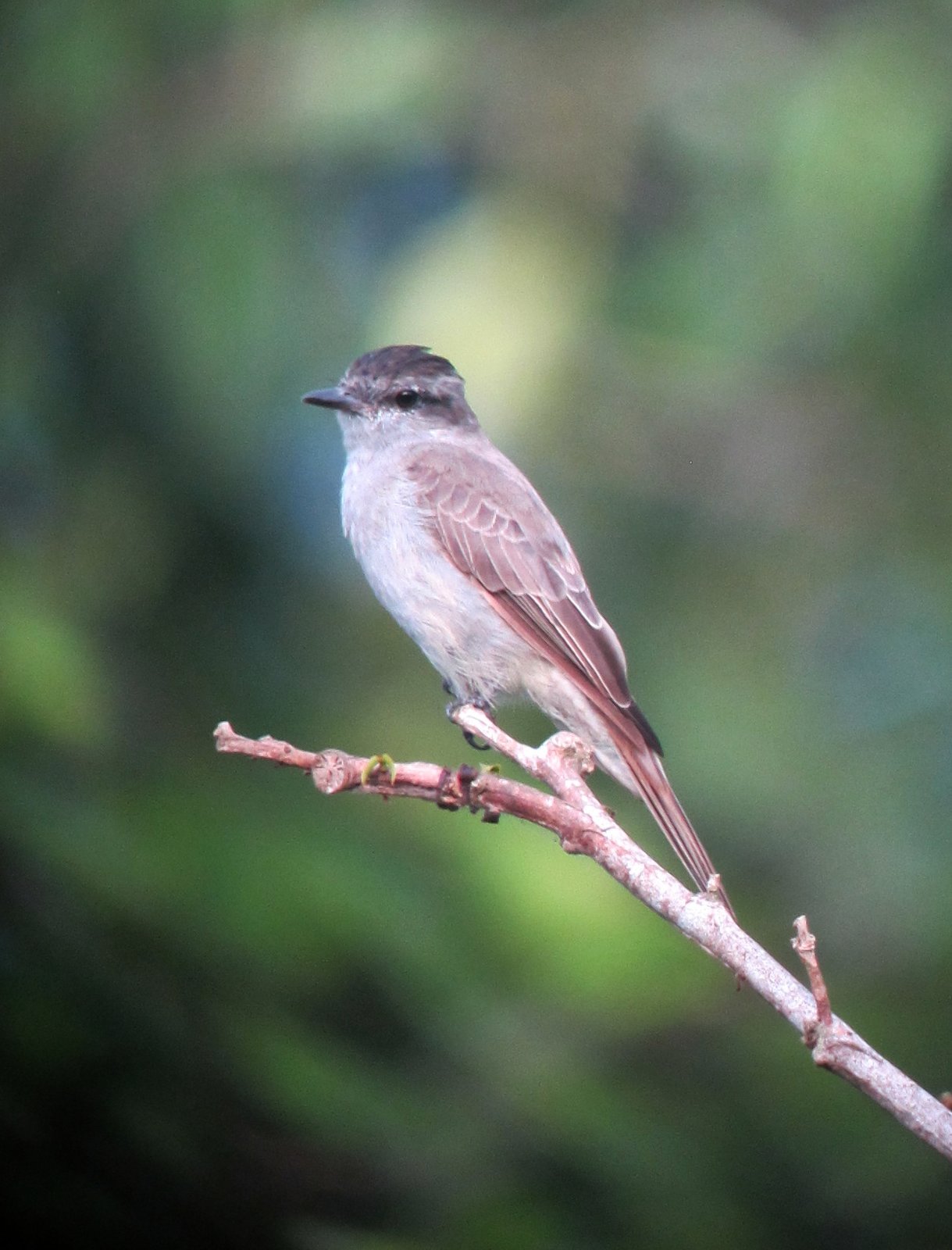
The Crowned Slaty Flycatcher is a dark grey flycatcher that breeds in southern South America and moves to the western Amazon in the austral winter. In the guide area it is then a fairly common winter visitor in the lowlands. It usually perches high and upright on bare branches above the canopy.
Voice
Mostly silent on the wintering grounds. A weak, high whistle, roughly tseeep; on the breeding grounds a short, hissing song.
No recording with a suitable Creative Commons licence is available for this species yet.
Identification
18 cm. A slender, dark grey flycatcher with a short black bill. Crown and sides of the head are black, with a usually concealed yellow crown patch and a pale grey supercilium. The upperparts are brownish-grey, wings and tail darker. The underparts are grey, paler on the belly and sometimes with a yellowish wash. Sexes alike; juveniles are browner.
Confusion species
Variegated Flycatcher Empidonomus varius has the same shape and posture, but is streaked, with rufous in the tail. Grey Kingbird Tyrannus dominicensis, only in northern Colombia, is larger and paler grey, with a heavy bill and white underparts. Smoke-colored Pewee Contopus fumigatus has a small crest and an entirely grey head without a supercilium, and lives in montane forest.
Habitat
Canopy and edges of humid lowland forest, várzea, secondary forest and semi-open country with tall trees, in the guide area mostly below 1200 m; on the breeding grounds also dry woodland and Chaco. It catches insects in short sallies from a high, bare branch and also eats fruit. It builds a shallow cup in a tree.
Where the bird is most at home, classified by the vegetation units of the Andes and the west coast.


Range and movements
Colombia: austral winter visitor east of the Andes, mainly in the south-east. Ecuador: fairly common austral winter visitor in the eastern lowlands, locally into the foothills. Peru: fairly common austral winter visitor in the Amazonian lowlands. Bolivia: breeds in the eastern and southern lowlands, including the Chaco, from September to March; in the austral winter also in the north. Absent from the Galápagos. Outside the guide area in Brazil, Paraguay, Uruguay and Argentina, and as a winter visitor in Venezuela.
- Resident
- Summer visitor (c. Apr–Sep)
- Winter visitor (c. Oct–Mar)
- Passage (Mar–Apr, Oct–Nov)
- dark = core range, pale = thinly spread
How and when to look
Search between May and September for a grey flycatcher on the highest bare branches along rivers, lakes and clearings in the Amazonian lowlands of Ecuador or Peru.
Conservation status
Least Concern. Widespread and fairly common.
Scientific name
Empidonomus aurantioatrocristatus | (d'Orbigny, ACVMD & de Lafresnaye, 1837)
D'Orbigny, ACVMD & de Lafresnaye described the species in 1837 as T[yrannus] aurantio-atrocristatus; because it was later moved to another genus, the author and year stand in brackets. The genus Empidonomus was introduced in 1860 by Cabanis & Heine. The genus name comes from Greek empis (genitive empidos), 'gnat', and -nomos, 'ruling over'. The species name comes from Latin aurantius, 'orange', ater, 'black', and cristatus, 'crested', referring to the black crown with a hidden orange-yellow patch. The specimen the first description was based on came from Valle Grande, Santa Cruz, Bolivia.