All species › Passerines › Cotingas › Black-chested Fruiteater
Black-chested Fruiteater | Pipreola lubomirskii
Zwartborstcotinga | Frutero pechinegro | Anambé-de-peito-preto
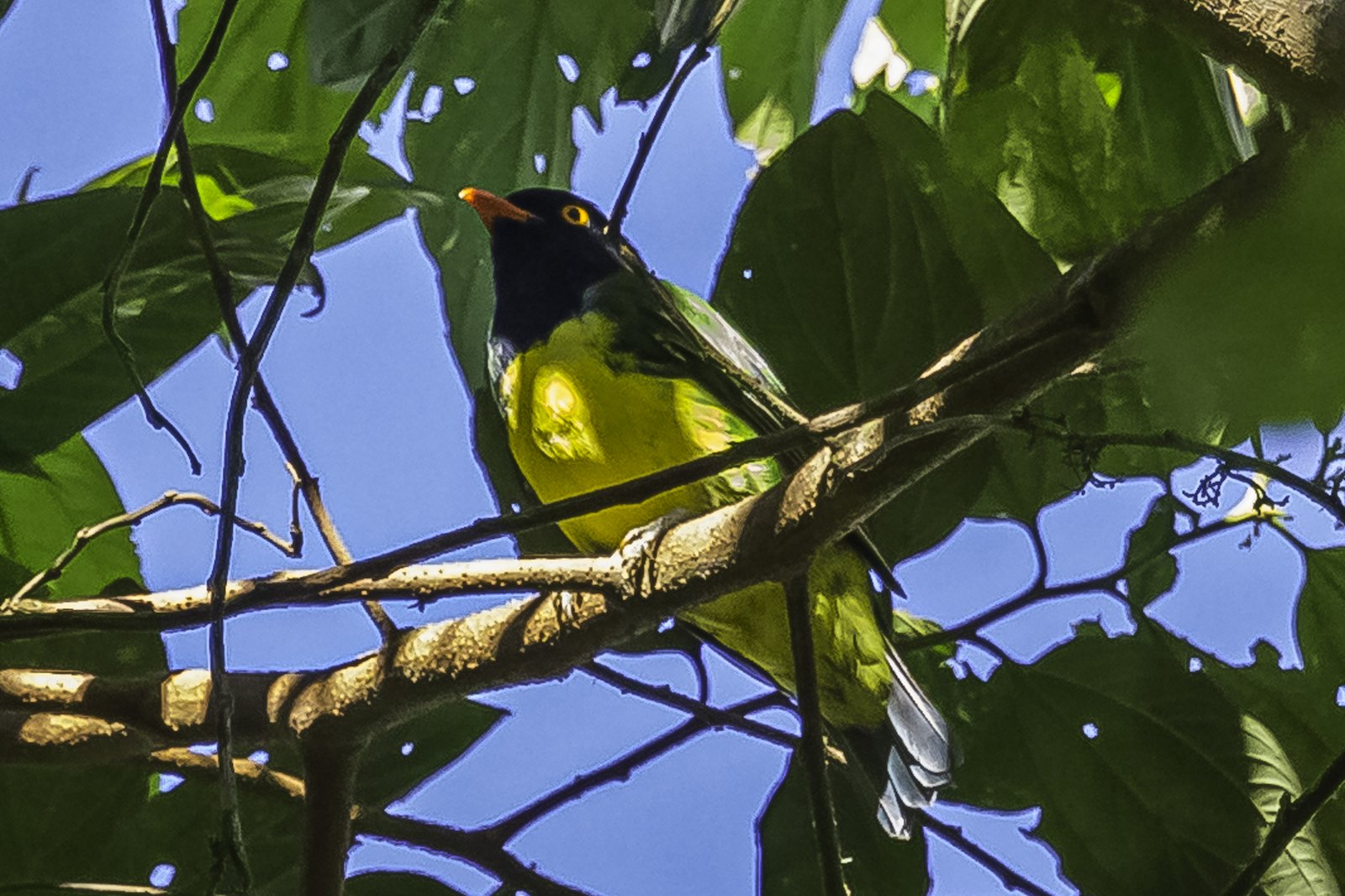
The Black-chested Fruiteater is a small fruit-eater of cloud forest on the eastern slope of the Andes, from southern Colombia to northern Peru. In the male the black hood extends far onto the breast. It often lives in pairs and sits still for long periods in the middle storey.
Voice
Very high, thin, hissing tseeee notes, repeated at intervals.
Recording: Diana Carolina Macana — CC BY-NC-SA 4.0 · xeno-canto
Identification
17 cm, with a short tail, a red bill and, in the male, a yellow iris. The male has a glossy black head, throat and upper breast, without a yellow border below; the upperparts are grass green. The rest of the underparts is yellow with green flanks. The female has a green head and upperparts and yellow underparts densely streaked green.
Confusion species
The male Green-and-black Fruiteater Pipreola riefferii has a narrow yellow border below the black throat and green-streaked underparts. The male Masked Fruiteater Pipreola pulchra has a green crown, a black mask and an orange-red breast patch; that species lives further south. Barred Fruiteater Pipreola arcuata is much larger and has barred underparts.
Habitat
Humid montane forest and cloud forest on the eastern slope, also forest edges, at roughly 1500 to 2500 m. It eats mainly fruit and berries, and also insects. It sometimes joins mixed flocks.
Where the bird is most at home, classified by the vegetation units of the Andes and the west coast.


Range and movements
In Colombia in the south, on the eastern slope in Nariño and Putumayo and locally at the head of the Magdalena valley. In Ecuador on the eastern slope of the Andes from north to south. In Peru in the north, in Cajamarca and Amazonas. Absent from Bolivia and the Galápagos. Does not occur outside the guide area.
- Resident
- dark = core range, pale = thinly spread
How and when to look
In cloud forest on the eastern slope in Ecuador, for example in the Cordillera de Guacamayos, in pairs or in mixed flocks. Listen for the high call and scan the middle storey patiently.
Conservation status
Least Concern. Rather scarce and patchily distributed within a narrow range; montane forest on the eastern slope is being cleared locally.
Scientific name
Pipreola lubomirskii | Taczanowski, 1879
Taczanowski described the species in 1879 and placed it straight away in the genus where it still stands. The genus Pipreola was introduced in 1838 by Swainson. The genus name is a Latin diminutive of the genus Pipra (manakins). The species name honours Prince Władysław Lubomirski (1824–1882), Polish malacologist, botanist and collector, patron of the Warsaw Zoological Cabinet and sponsor of natural-history expeditions. The specimen the first description was based on came from Quebrada de Sance, Tambillo, Peru.