All species › Passerines › Cotingas › Orange-breasted Fruiteater
Orange-breasted Fruiteater | Pipreola jucunda
Oranjebuikcotinga | Frutero pechinaranja | Anambé-de-peito-laranja
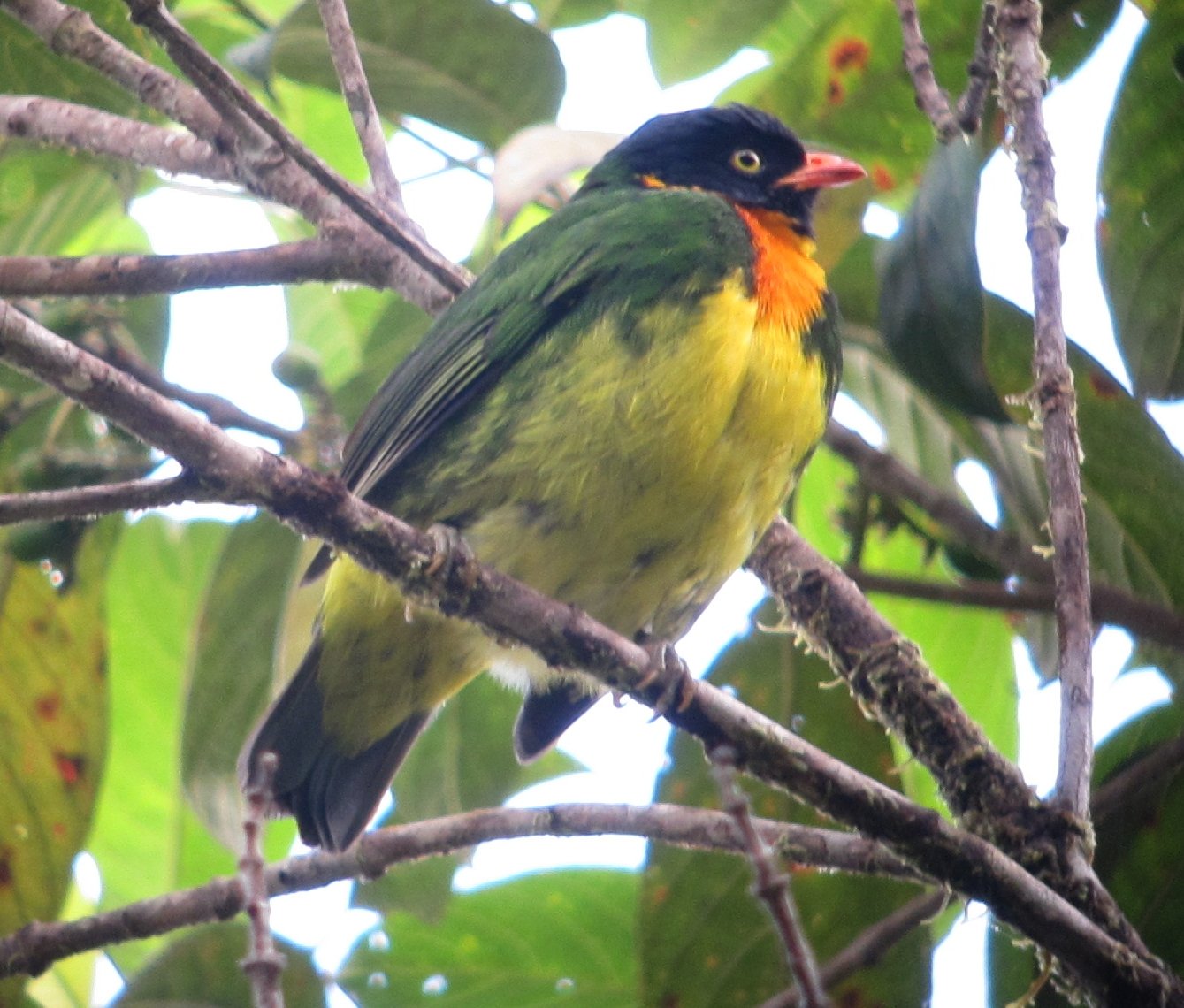
The Orange-breasted Fruiteater is a small fruit-eater of subtropical forest on the Pacific slope of the Andes in Colombia and Ecuador. The male combines a black head with a bright orange breast patch. The species replaces Golden-breasted Fruiteater there and lives lower than most other Pipreola species.
Voice
Very high, thin, rising seeeee notes, repeated at intervals.
Recording: Jaime Suárez — CC BY-NC-SA 4.0 · xeno-canto
Identification
17–18 cm, with a short tail, a red bill and orange-red legs. The male has a glossy black head and throat and an orange patch on the breast that grades into yellow at the sides; the upperparts are grass green. The belly is yellow, the flanks green. The female has a green head and upperparts and yellow underparts densely streaked green.
Confusion species
The male Golden-breasted Fruiteater Pipreola aureopectus has a green head and a golden-yellow breast without black or orange; that species lives further north and east. The male Green-and-black Fruiteater Pipreola riefferii has no orange on the breast and has green-streaked underparts; that species lives higher up. Females of related species are best separated by elevation and range.
Habitat
Humid subtropical montane forest and the upper parts of the Chocó rainforest, also forest edges and older secondary forest, at roughly 600 to 2000 m. It eats mainly fruit and berries, and also insects. It often sits quietly in the middle storey and joins mixed flocks.
Where the bird is most at home, classified by the vegetation units of the Andes and the west coast.


Range and movements
In Colombia on the Pacific slope of the Western Cordillera. In Ecuador on the western slope of the Andes, mainly in the north and centre. Absent from Peru, Bolivia and the Galápagos. Does not occur outside the guide area.
- Resident
- dark = core range, pale = thinly spread
How and when to look
In subtropical forest around Mindo and in the lower parts of the Tandayapa valley in Ecuador, often at fruiting trees and in mixed flocks. Listen for the high, thin call.
Conservation status
Least Concern. Fairly common in suitable forest; forest clearance on the western slope of the Andes is, however, considerable.
Scientific name
Pipreola jucunda | Sclater, 1860
Sclater described the species in 1860 and placed it straight away in the genus where it still stands. The genus Pipreola was introduced in 1838 by Swainson. The genus name is a Latin diminutive of the genus Pipra (manakins). The species name is Latin iucundus, 'pleasant, delightful'. The specimen the first description was based on came from Cachillacta, Pichincha, Ecuador.