All species › Passerines › Antbirds › Black-chinned Antbird
Black-chinned Antbird | Hypocnemoides melanopogon
Zwartkinmierkruiper | Hormiguero barbinegro | Solta-asa-do-norte
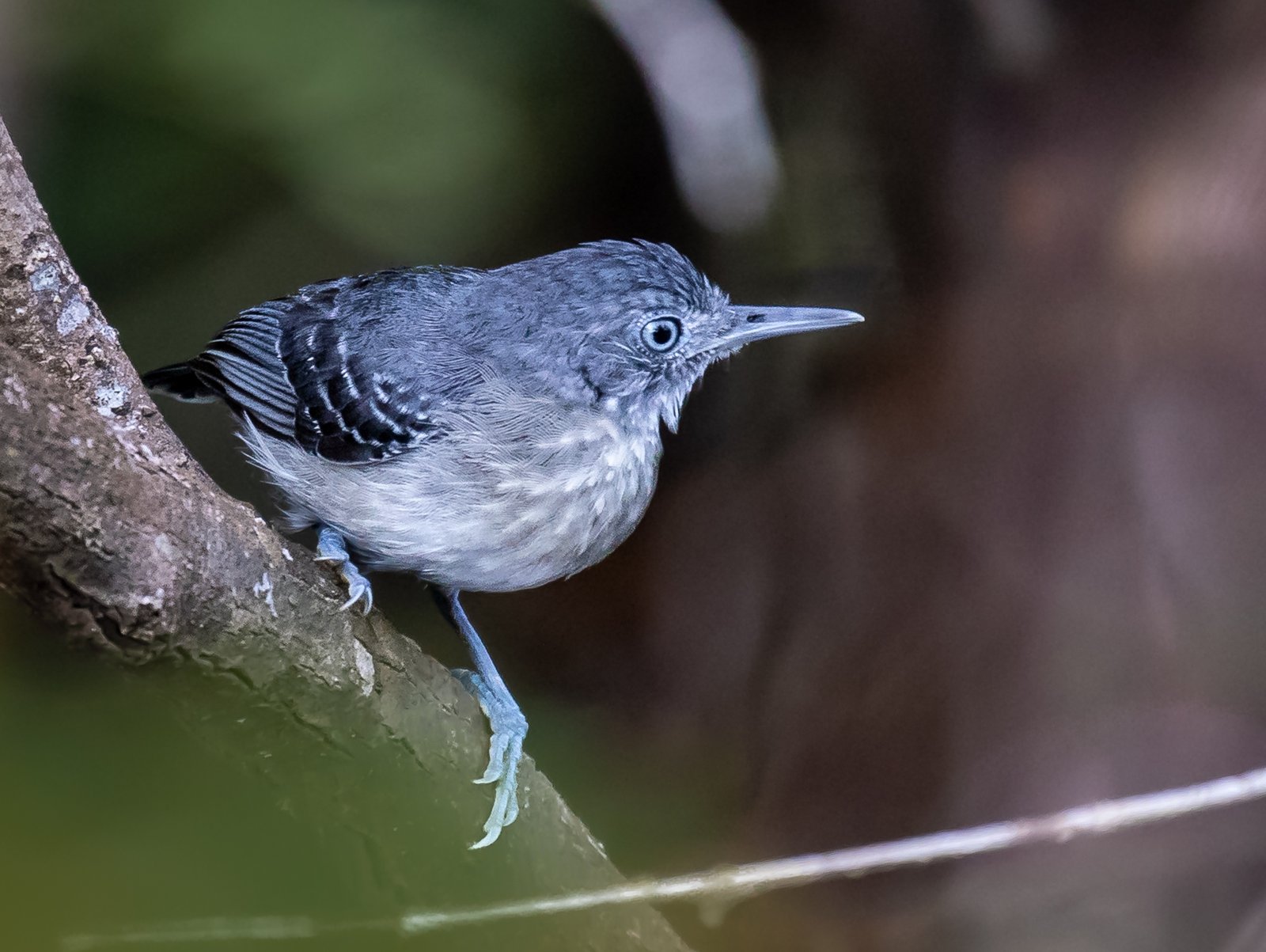
The Black-chinned Antbird is a small grey antbird of flooded forest along streams and lakes in northern and western Amazonia. Pairs keep low over the water and often sing in duet. South of the Amazon it is replaced by the Band-tailed Antbird.
Voice
The song is an accelerating series of nasal notes that first rises and then turns into a descending rattle, similar to that of the Band-tailed Antbird. Calls are a short, nasal chup and a dry rattle.
Recording: Dante Buzzetti — CC BY-NC-SA 4.0 · xeno-canto
Identification
12 cm, with a thin bill and a short tail. The male is grey, with a black chin and throat, black wing coverts with white tips and a blackish tail with narrow white tips. The female is paler grey, with a whitish, grey-mottled throat and breast and the same white wing pattern. Young birds are browner.
Confusion species
Band-tailed Antbird Hypocnemoides maculicauda lives south of the Amazon and the Marañón and has a broad white terminal tail band. Silvered Antbird Sclateria naevia has a longer bill, pink legs and whiter underparts. Plumbeous Antbird Myrmelastes hyperythrus is larger and darker, with bare blue skin around the eye. Ash-breasted Antbird Myrmoborus lugubris has a red eye, white underparts and lives on river islands.
Habitat
Understorey and shrub layer of várzea, igapó and swamp forest, especially along forest streams, creeks and lake shores, usually close to the water, up to about 500 m. It forages in pairs for insects on twigs, leaves and roots above the water. The nest is an open cup, low over or close to the water.
Where the bird is most at home, classified by the vegetation units of the Andes and the west coast.


Range and movements
Colombia: east of the Andes, from Meta and Vichada south to Amazonas. Ecuador: in the eastern lowlands. Peru: in the north, north of the Amazon and the Marañón, in Loreto. Bolivia: absent. Absent from the Galápagos. Outside the guide area in southern Venezuela, the Guianas and Amazonian Brazil.
- Resident
- dark = core range, pale = thinly spread
How and when to look
Travel by boat along forest streams and lake shores in eastern Ecuador or north-eastern Peru, for example at Cuyabeno or near Iquitos north of the Amazon, and listen for the nasal song low over the water.
Conservation status
Least Concern. The species is common in suitable habitat.
Scientific name
Hypocnemoides melanopogon | (Sclater, 1857)
Sclater described the species in 1857 as Hypocnemis melanopogon; because it was later moved to another genus, the author and year stand in brackets. The genus Hypocnemoides was introduced in 1918 by Bangs & Penard. The genus name combines the genus name Hypocnemis with Greek -oidēs, 'resembling'. The species name comes from Greek melas, 'black', and pōgōn, 'beard', after the black chin. The specimen the first description was based on came from Chamicuros, Loreto, Peru.