All species › Passerines › Antbirds › Band-tailed Antbird
Band-tailed Antbird | Hypocnemoides maculicauda
Oevermierkruiper | Hormiguero colibandeado | Solta-asa
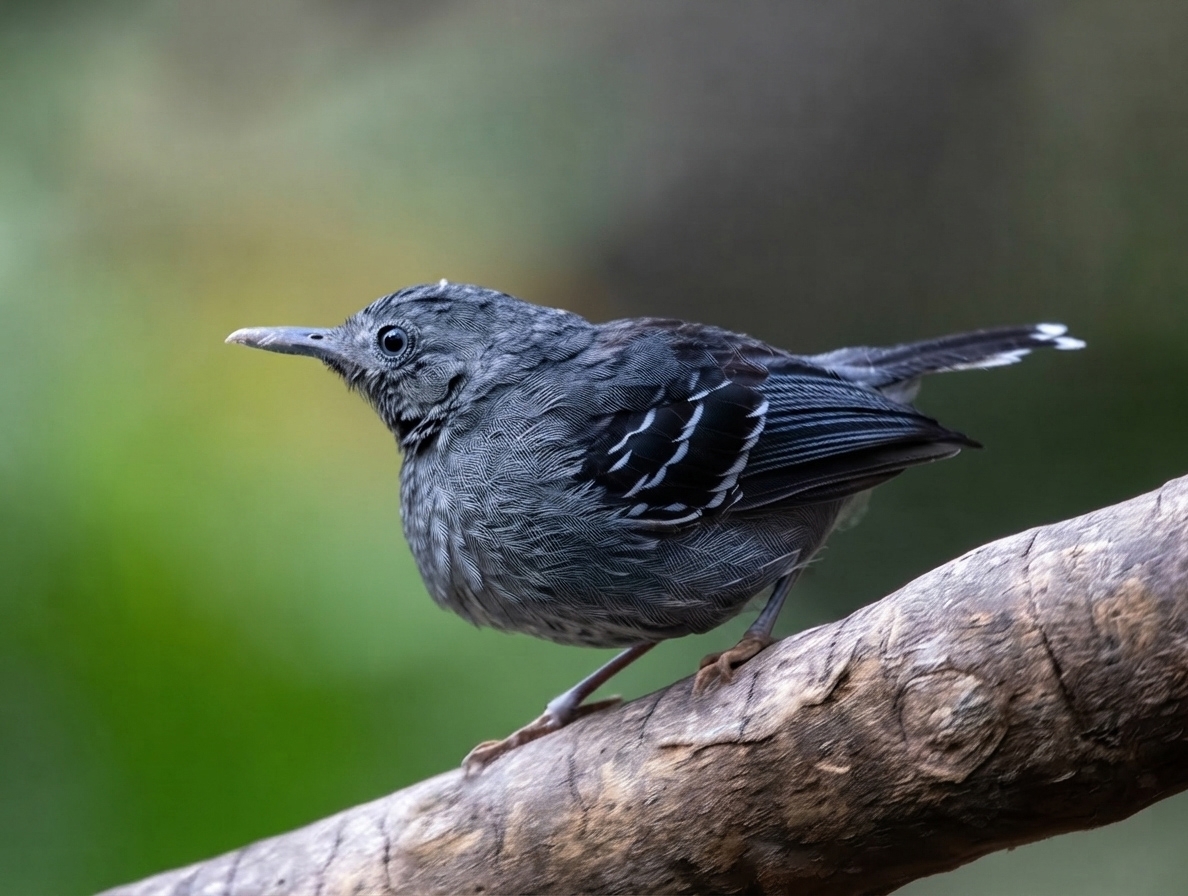
The Band-tailed Antbird is a small grey antbird of flooded forest along streams, creeks and lakes in southern Amazonia. It lives in pairs just above the water and often sings from branches overhanging the water. It is the southern counterpart of the Black-chinned Antbird.
Voice
The song is an accelerating series of nasal notes that first rises and then turns into a descending rattle. Calls are a short, nasal chup and a dry rattle.
Recording: JAYRSON ARAUJO DE OLIVEIRA — CC BY-NC-SA 4.0 · xeno-canto
Identification
12 cm, with a thin bill and a short tail. The male is grey, with a black throat, black wing coverts with white tips and a blackish tail with a broad white terminal band. The female is paler grey, with a whitish, grey-mottled throat and breast and the same white wing and tail pattern. Young birds are browner.
Confusion species
Black-chinned Antbird Hypocnemoides melanopogon lives north of the Amazon and the Marañón and has only narrow white tail tips instead of a broad band. Silvered Antbird Sclateria naevia has a longer bill, pink legs and whiter underparts. Plumbeous Antbird Myrmelastes hyperythrus is larger and darker, with bare blue skin around the eye. Black-and-white Antbird Myrmochanes hemileucus is bright white below and lives on river islands.
Habitat
Understorey and shrub layer of várzea, igapó and swamp forest, especially along forest streams, creeks and the shores of oxbow lakes, usually within a few metres of the water, up to about 500 m. It forages in pairs for insects on twigs, leaves and roots above the water. The nest is an open cup, low over or close to the water.
Where the bird is most at home, classified by the vegetation units of the Andes and the west coast.


Range and movements
Colombia: absent. Ecuador: absent. Peru: south of the Amazon and the Marañón, in Loreto, Ucayali, Madre de Dios and adjacent Cusco and Puno. Bolivia: in the northern and central lowlands (Pando, Beni, La Paz, Cochabamba and Santa Cruz). Absent from the Galápagos. Outside the guide area in Amazonian Brazil south of the Amazon.
- Resident
- dark = core range, pale = thinly spread
How and when to look
Travel by boat or walk along forest streams and the edges of oxbow lakes in south-eastern Peru, for example at Tambopata and Manu, and listen for the accelerating nasal song low over the water.
Conservation status
Least Concern. The species is common in suitable habitat.
Scientific name
Hypocnemoides maculicauda | (Pelzeln, 1868)
Pelzeln described the species in 1868 as Hypocnemis maculicauda; because it was later moved to another genus, the author and year stand in brackets. The genus Hypocnemoides was introduced in 1918 by Bangs & Penard. The genus name combines the genus name Hypocnemis with Greek -oidēs, 'resembling'. The species name comes from Latin macula, 'spot', and cauda, 'tail', after the pale-tipped tail. The specimen the first description was based on came from Mato Grosso, Brazil.