All species › Passerines › Antbirds › Banded Antbird
Banded Antbird | Dichrozona cincta
Bandrugmiervogel | Hormiguero bandeado | Tovaquinha
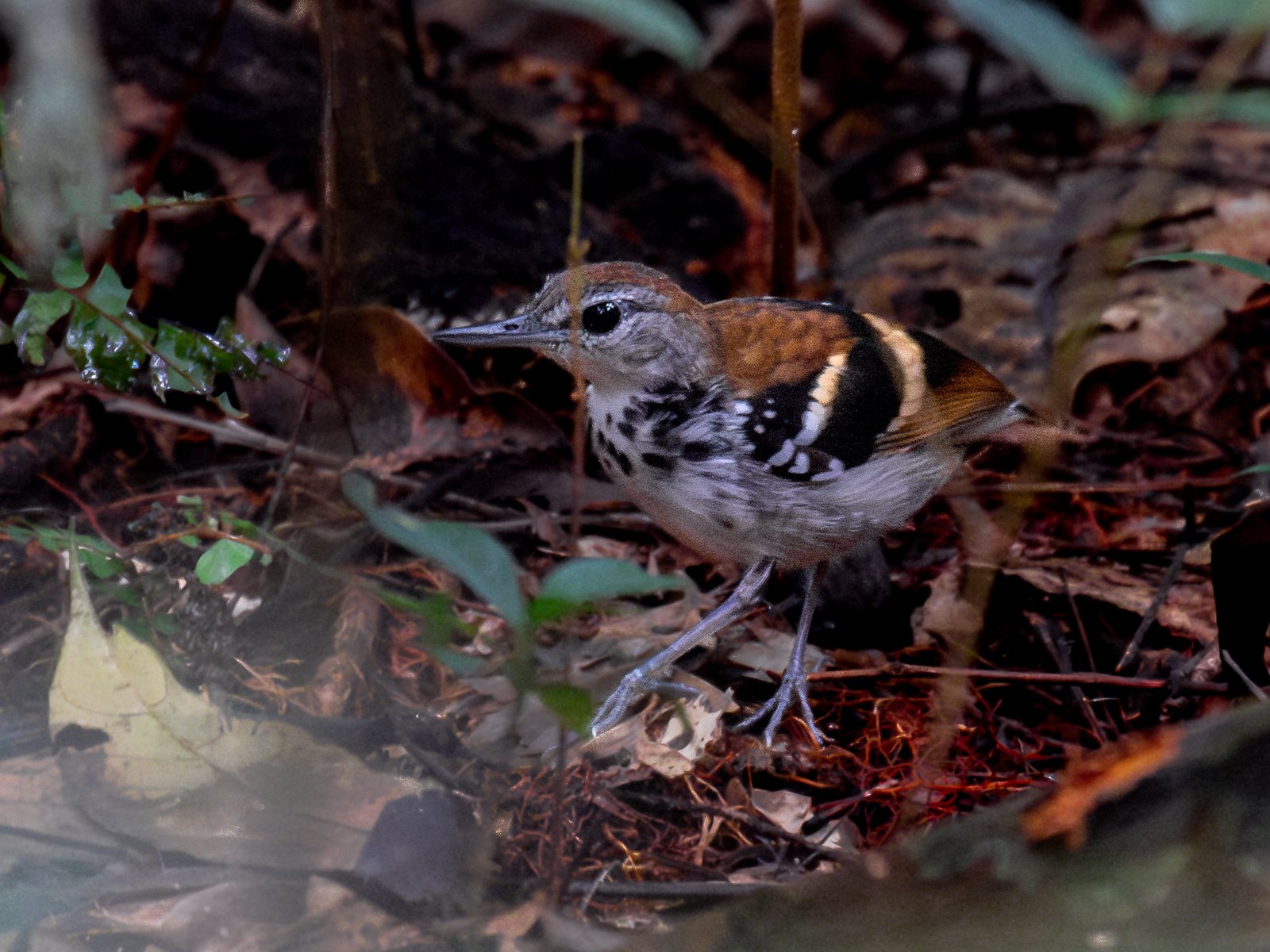
The Banded Antbird is a small, short-tailed antbird that walks on the forest floor rather than hopping. It is the only species in the genus Dichrozona. The combination of a pale band across the rump, two broad wing bars and a band of black spots on the breast separates it from other small antbirds.
Voice
The song is a fairly long series of high, thin, upslurred whistles that gradually become slightly louder.
Recording: Guilherme Melo — CC BY-NC-SA 4.0 · xeno-canto
Identification
10 cm, with a long, thin bill, a very short tail and long, pale legs. The crown and back are rufous-brown; the wings are blackish with two broad pale wing bars, and a pale band crosses the rump, white in the male and buff in the female. The underparts are white, with a band of black spots across the breast. In the female the wing bars are buff.
Confusion species
Spot-backed Antbird Hylophylax naevius and Dot-backed Antbird Hylophylax punctulatus perch on low twigs, have a longer tail and pale spots on the back and lack the rump band. Common Scale-backed Antbird Willisornis poecilinotus has a scaled back and a longer tail. Wing-banded Antbird Myrmornis torquata also walks on the ground, but is much larger, with a scaled throat and cinnamon wing bars.
Habitat
Leaf litter and open understorey of humid terra firme lowland forest, often on sandy soils, mostly below 500 m. It walks on the forest floor, swaying its rear body from side to side, and picks insects and spiders from the litter and low leaves. Usually alone or in pairs, sometimes at the edge of mixed flocks. Little is known about its breeding.
Where the bird is most at home, classified by the vegetation units of the Andes and the west coast.

Range and movements
Colombia: in the south-east, in the Amazonian lowlands. Ecuador: in the eastern lowlands. Peru: in the Amazonian lowlands, from Loreto to Madre de Dios. Bolivia: in the north (Pando and La Paz). Absent from the Galápagos. Outside the guide area in southern Venezuela and Amazonian Brazil.
- Resident
- dark = core range, pale = thinly spread
How and when to look
In terra firme forest, listen for the high, rising whistles and then search low in the leaf litter for a small bird walking on the ground, for example at Tambopata or around Iquitos.
Conservation status
Least Concern. Rather scarce and dependent on undisturbed terra firme forest; deforestation is the main threat.
Scientific name
Dichrozona cincta | (Pelzeln, 1868)
Pelzeln described the species in 1868 as Cyphorhinus (Microcerculus) cinctus; because it was later moved to another genus, the author and year stand in brackets. The genus Dichrozona was introduced in 1888 by Ridgway. The genus name combines Greek dikhroos, 'two-coloured', and zōnē, 'band, girdle'. The species name cincta is Latin for 'girdled, banded'. The specimen the first description was based on came from São Joaquim, Rio Negro, Brazil.