All species › Passerines › Antbirds › Dot-winged Antwren
Dot-winged Antwren | Microrhopias quixensis
Spikkelvleugelmiersluiper | Hormiguerito alipunteado | Papa-formiga-de-bando
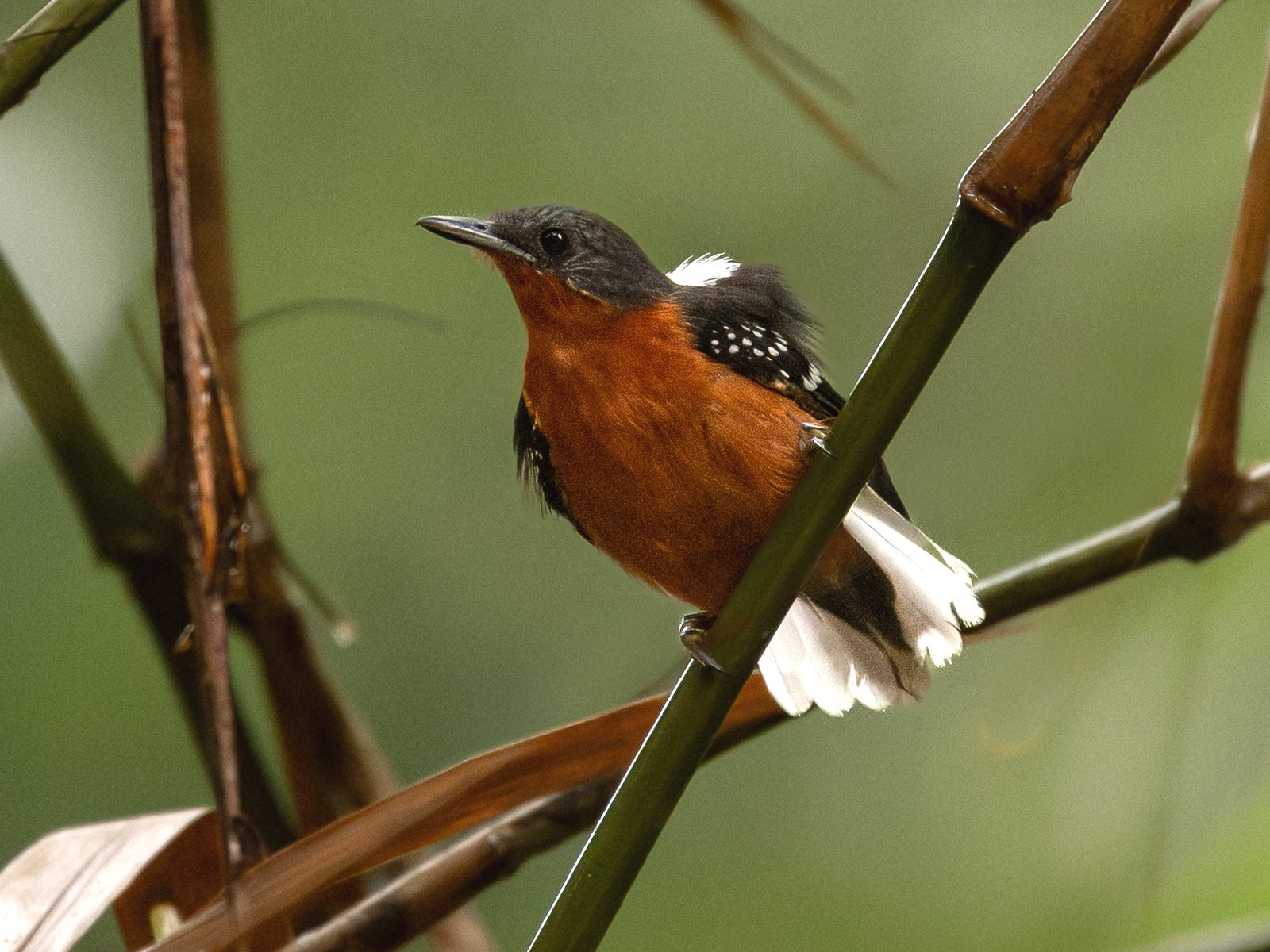
The Dot-winged Antwren is a small, long-tailed antwren that moves through the vines and foliage of lowland forest in pairs or family groups, often with mixed flocks. It constantly moves its long, white-tipped tail. In the guide area it lives both west and east of the Andes, with differences in female plumage between regions.
Voice
The song is a series of rising, thin whistles that follow each other faster and faster. The call is a sharp chip and a falling tseeu; groups keep in contact with short calls.
Recording: Juan Freile — CC BY-NC-SA 4.0 · xeno-canto
Identification
11–12 cm, slender, with a long, graduated tail with broad white tips. The male is black, with a usually concealed white interscapular patch, white dots on the wing coverts and a white wing bar. The female has the same black, white-dotted wings and the same tail, but is slaty to blackish above and warm chestnut below; in some Amazonian subspecies her throat is black. Young males at first resemble the female.
Confusion species
White-flanked Antwren Myrmotherula axillaris has a short tail and white flank plumes; the female is brown and buff, without a chestnut belly. Long-winged Antwren Myrmotherula longipennis is grey, with a shorter tail without broad white tips. The female is told from other rufous antbirds by the combination of black, white-dotted wings and the long, white-tipped tail.
Habitat
The lower and middle levels of humid lowland forest and older secondary forest, especially in dense vines and lianas along forest edges and in clearings, up to about 1000 m; east of the Andes also in riverine forest. It searches for insects and spiders in the foliage and on the undersides of leaves, in pairs or family groups that join mixed flocks. The nest is a deep cup low in the vegetation.
Where the bird is most at home, classified by the vegetation units of the Andes and the west coast.


Range and movements
In Colombia in the Pacific lowlands, in the north and in the Amazonian south-east. In Ecuador in the western lowlands and in the Amazonian lowlands in the east. In Peru in the Amazonian lowlands east of the Andes. In Bolivia in the northern and central lowlands. Absent from the Galápagos. Outside the guide area from southern Mexico to Panama and in Amazonian Brazil and the Guianas.
- Resident
- dark = core range, pale = thinly spread
How and when to look
Look for a group of small black birds with moving, white-tipped tails in vines along a forest edge or trail. They often travel with mixed flocks of tanagers and antwrens.
Conservation status
Least Concern. The species has a large range and also occurs in secondary forest, but disappears where forest is completely cleared.
Scientific name
Microrhopias quixensis | (Cornalia, 1849)
Cornalia described the species in 1849 as Thamnophilus quixensis; because it was later moved to another genus, the author and year stand in brackets. The genus Microrhopias was introduced in 1862 by Sclater. The genus name comes from Greek mikros, 'small', and the genus name Rhopias (Cabanis, 1859), an antbird genus. The species name refers to the type locality on the Río Quijos (formerly 'Quixos'), in Napo-Pastaza in eastern Ecuador. The specimen the first description was based on came from Eastern Ecuador.