All species › Passerines › Antbirds › Speckled Antshrike
Speckled Antshrike | Xenornis setifrons
Vlekborstmierklauwier | Batará moteado | Choca-salpicada
The Speckled Antshrike is a little-known antshrike of humid lowland and foothill forest on both sides of the Panama–Colombia border; it is the only species in its genus. In the guide area it is known only from the far north-west of Colombia, where there are few records. Pairs live in the undergrowth and often travel with mixed flocks.
Voice
The song is a series of evenly spaced, high whistles rising steadily in pitch. The female sings slower, shorter and slightly lower.
Recording: Wouter Halfwerk — CC BY-NC-SA 3.0 · xeno-canto
Identification
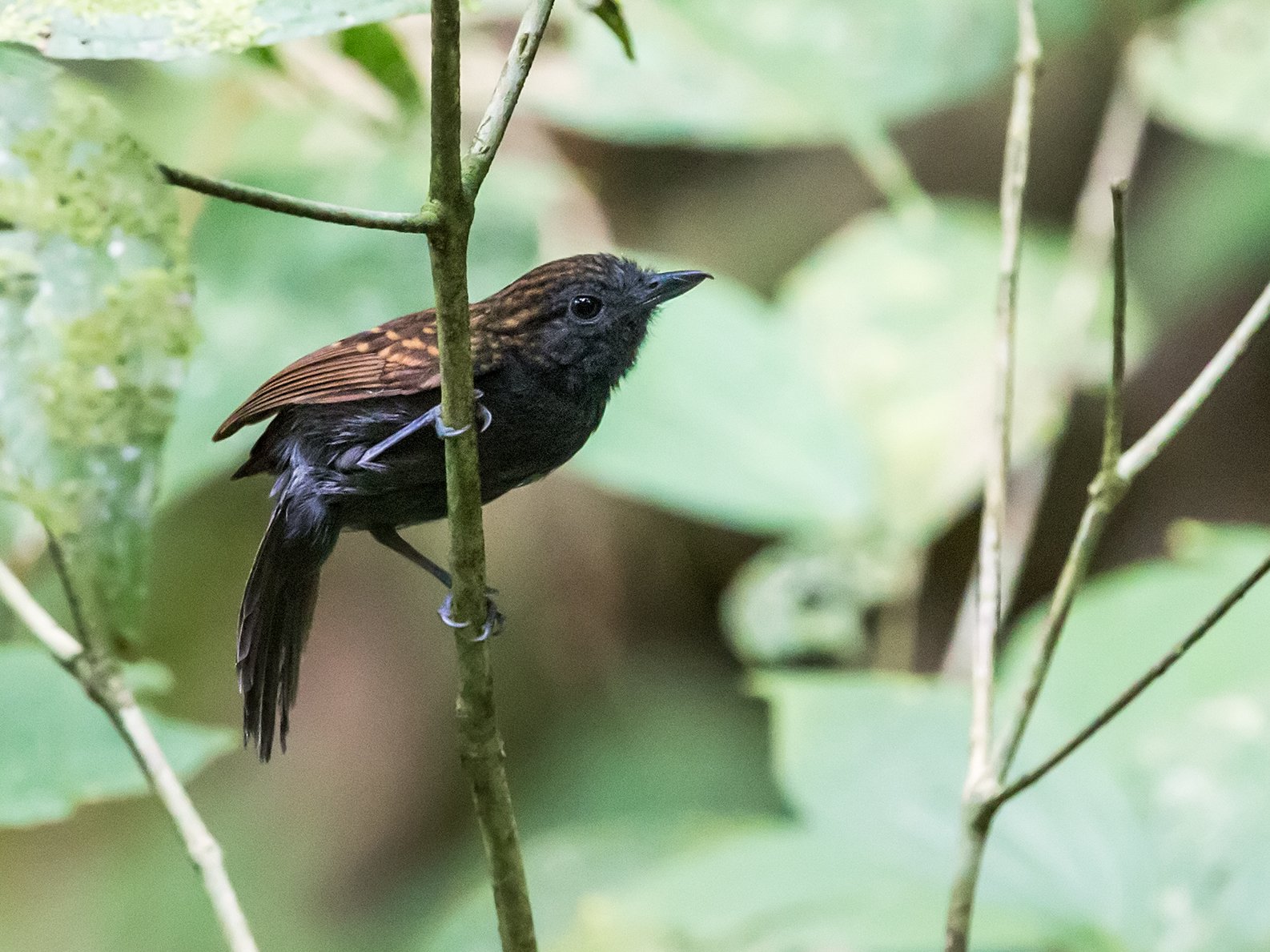
15–16 cm, with a fairly long tail and a stout, hook-tipped bill. The male is olive to buffy brown on the crown, nape and back, with fine pale speckles on the back and wing coverts and two buff wing bars; forehead, face, throat and underparts are slate-grey. The female has the same upperparts, a dull white chin, a whitish throat with small blackish-brown spots and a pale olive-brown breast and flanks.
Confusion species
Black-crowned Antshrike Thamnophilus atrinucha lacks the pale speckles on the back; the male has a black crown and the female a rufous crown and upperparts. Spot-crowned Antvireo Dysithamnus puncticeps is smaller and shorter-tailed, with a spotted crown and finely streaked, pale underparts.
Habitat
Undergrowth of humid lowland and foothill forest, especially on steep slopes with dense vegetation, in Colombia up to about 600 m. It takes small arthropods, mostly up to about 2 m above the ground, by searching foliage and making short sallies from a perch. Pairs often join mixed understorey flocks.
Where the bird is most at home, classified by the vegetation units of the Andes and the west coast.

Range and movements
Colombia: only in the far north-west, in northern Chocó on the Caribbean slope of the Serranía del Darién near the Panama border, with a few records from the Pacific slope. Absent from Ecuador, Peru, Bolivia and the Galápagos. Outside the guide area in eastern Panama, mainly in Guna Yala and Darién.
- Resident
- dark = core range, pale = thinly spread
How and when to look
In the guide area the species is known from only a few sites; most records come from adjacent eastern Panama. Listen in the undergrowth of foothill forest for the rising series of high whistles.
Conservation status
Near Threatened. The range is small and the population is estimated at a few thousand mature birds, probably declining because of deforestation in the lowlands and foothills of Darién and the Chocó.
Scientific name
Xenornis setifrons | Chapman, 1924
Chapman described the species in 1924 and placed it straight away in the genus where it still stands. He introduced the genus Xenornis in that same work. The genus name comes from Greek xenos, 'strange', and ornis, 'bird'. The species name comes from Latin seta, 'bristle', and frons, 'forehead'. The specimen the first description was based on came from Cerro Tacarcuna, Darién, Panama.