All species › Passerines › Gnateaters › Slaty Gnateater
Slaty Gnateater | Conopophaga ardesiaca
Leigrijze muggeneter | Jejenero pizarroso | Chupa-dente-ardósia
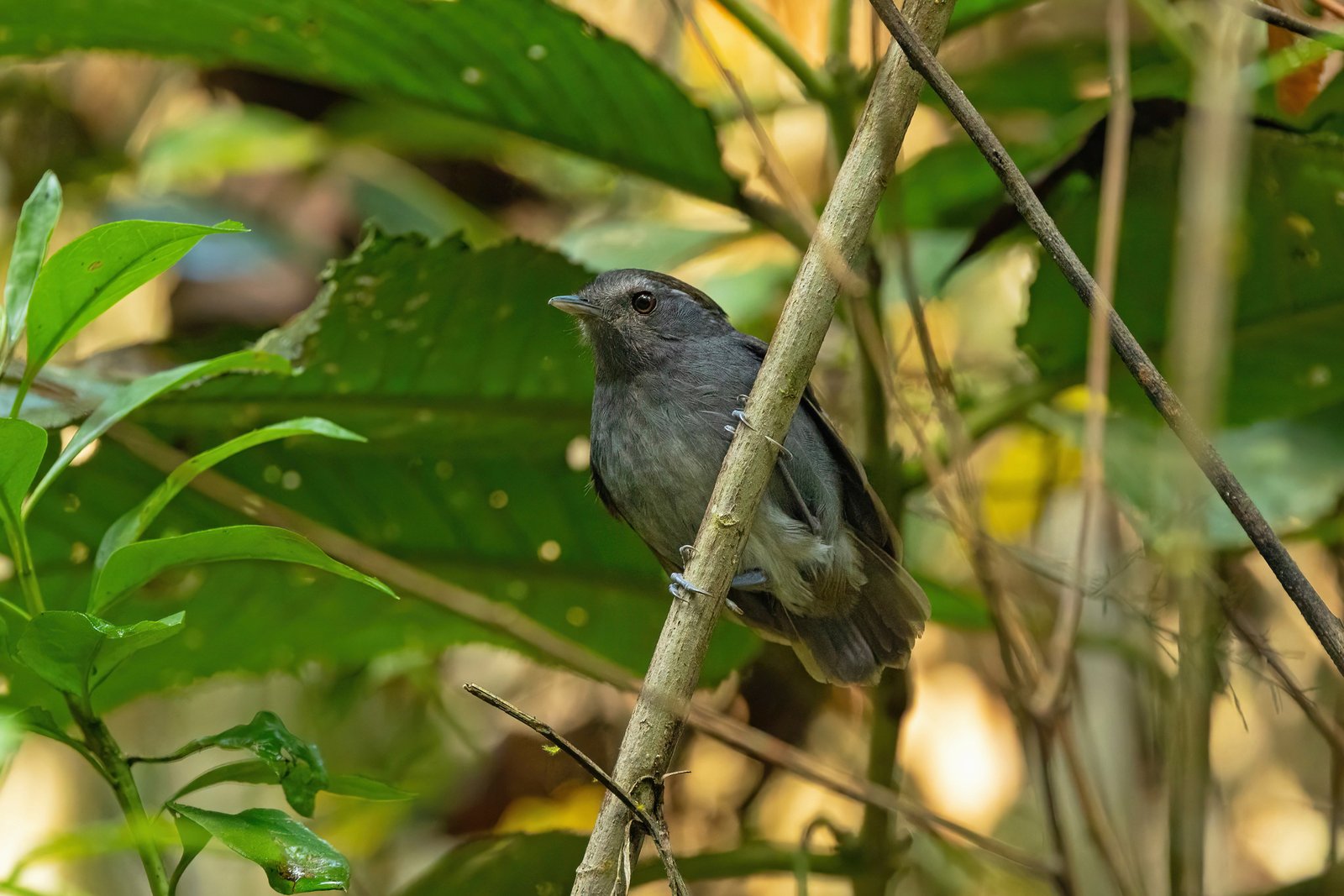
The Slaty Gnateater is the gnateater of the Yungas, the montane forests on the eastern slope of the Andes in southern Peru and Bolivia. It lives in dense growth at openings in the forest and along roads. The plumage varies considerably, from dark grey to almost black or browner.
Voice
The song is a frog-like g-reep or w-reeep, repeated at intervals. The call heard most often is a thin tseet.
Recording: Dan Lane — CC BY-NC-SA 3.0 · xeno-canto
Identification
13–14 cm, round and short-tailed, on long legs. The male has a mainly dark grey head and underparts, a brown crown and brown upperparts, brownish-grey flanks and lower belly and a white tuft behind the eye. Birds in Cochabamba are much darker. The female has more brown on the face, a much smaller tuft and a white belly patch; her upperparts vary from dark brown to olive-brown or rufous-brown.
Confusion species
Chestnut-crowned Gnateater Conopophaga castaneiceps occurs further north, to Cusco; the male has an orange-red forehead or crown and is less dark. Small antpittas of the genus Grallaricula have an ochre or rusty breast and no white tuft, and perch upright on thin twigs.
Habitat
Dense growth in rainforest on the eastern slope of the Andes, in a narrow band of Yungas, especially at treefalls, road edges and other openings. Mostly between 800 and 1800 m, locally up to 2450 m in Peru. It searches for arthropods in the leaf litter and foliage on or just above the ground. Little is known about its breeding; fledglings have been seen in Peru in November.
Where the bird is most at home, classified by the vegetation units of the Andes and the west coast.


Range and movements
In Peru on the eastern slope in south-eastern Cusco and in Puno. In Bolivia on the eastern slope of the Andes from La Paz south to Tarija. Absent from Colombia, Ecuador and the Galápagos. Does not occur outside the guide area.
- Resident
- dark = core range, pale = thinly spread
How and when to look
Listen along roads through the Yungas, for example in La Paz and Cochabamba, for the frog-like g-reep, and look low in dense regrowth along the verge and at treefalls.
Conservation status
Least Concern. Fairly common, locally uncommon, and present in several protected areas; it may benefit from dense regrowth along roads and in clearings.
Scientific name
Conopophaga ardesiaca | d'Orbigny, ACVMD & de Lafresnaye, 1837
D'Orbigny, ACVMD & de Lafresnaye described the species in 1837 and placed it straight away in the genus where it still stands. The genus Conopophaga was introduced in 1816 by Vieillot. The genus name comes from Ancient Greek kōnōps, 'gnat', and -phagos, '-eating': 'gnat-eater'. The species name comes from Latin ardesiacus, 'slate-coloured', for the slate-grey plumage. The specimen the first description was based on came from Yungas, Bolivia.