All species › Passerines › Gnateaters › Chestnut-crowned Gnateater
Chestnut-crowned Gnateater | Conopophaga castaneiceps
Roodkruinmuggeneter | Jejenero coronicastaño | Chupa-dente-de-coroa-castanha
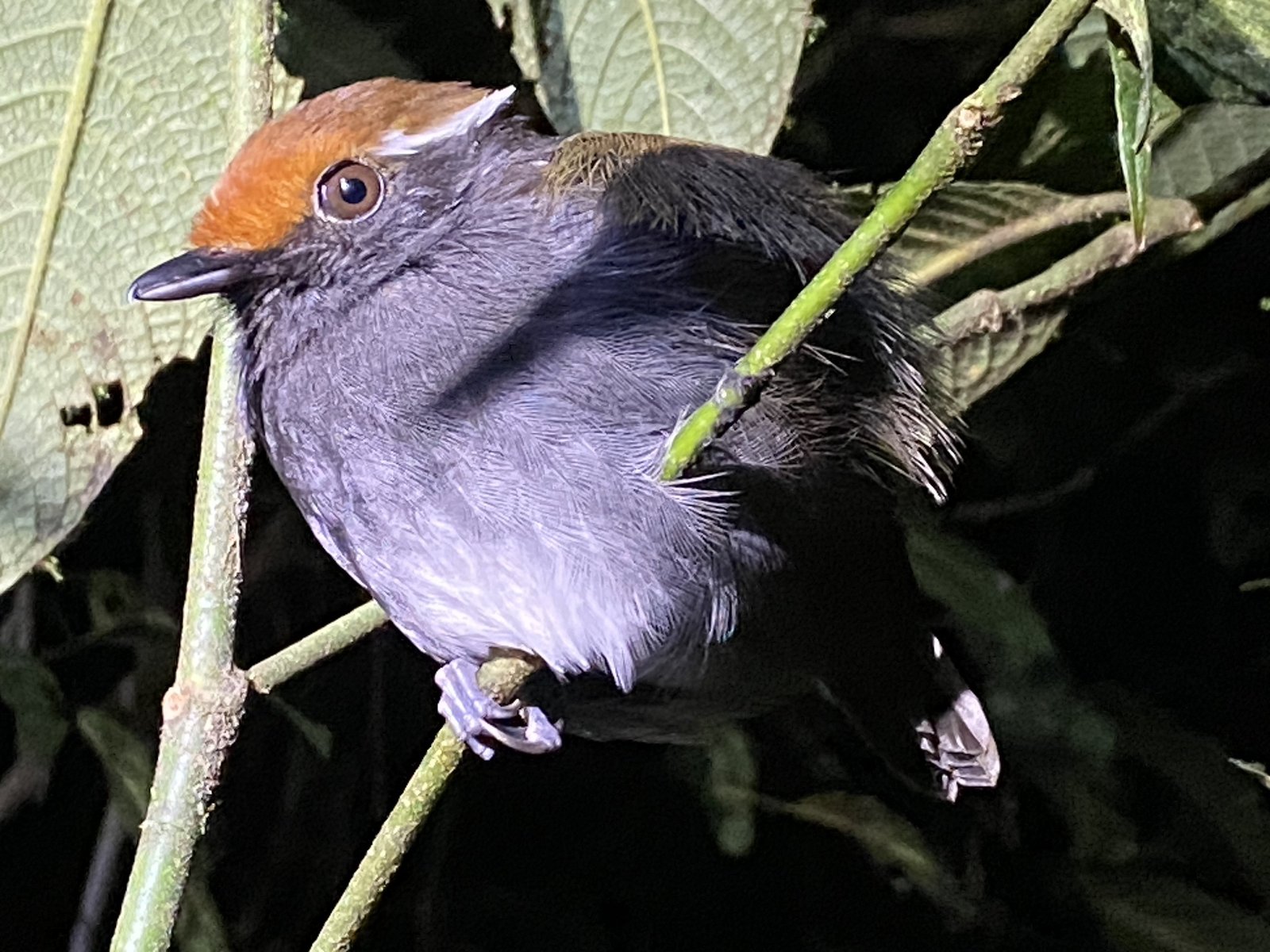
The Chestnut-crowned Gnateater is a gnateater of the montane forests on the slopes of the Andes, with an orange-red crown and a white tuft behind the eye. It favours dense, young growth in forest openings, such as overgrown landslides. Its frog-like song gives it away more often than its appearance.
Voice
The song is a series of frog-like, slightly two-syllabled notes that speed up and grow louder after the first one or two notes. Calls are a harsh zhiek and a lower schek.
Recording: Carlos Delgado JUMABITA — CC BY-NC-SA 4.0 · xeno-canto
Identification
13–14 cm, round and short-tailed, on long legs. The male has brown upperparts, an orange-red crown, a grey face, grey throat and breast, orange-brown flanks and a white tuft behind the eye. In southern Peru only the forehead is orange-red and the male is darker, with a white belly patch; in the Colombian Chocó the back is more olive. The female has an orange-red head and breast, a whitish belly and a smaller tuft.
Confusion species
Slaty Gnateater Conopophaga ardesiaca replaces it in south-eastern Peru and Bolivia; the male is darker grey, without an orange-red crown. Small antpittas such as Rusty-breasted Antpitta Grallaricula ferrugineipectus and Ochre-breasted Antpitta Grallaricula flavirostris have an orange-brown or ochre breast but no white tuft, and perch upright on thin twigs.
Habitat
The undergrowth of humid foothill and montane forest, especially in dense, young growth in openings such as old landslides and treefalls, mostly between 1000 and 2000 m, locally from 500 m and in Peru up to about 2200 m. It searches for arthropods in the leaf litter and foliage just above the ground. The nest is a hidden cup less than a metre above the ground.
Where the bird is most at home, classified by the vegetation units of the Andes and the west coast.


Range and movements
In Colombia locally on the western slope of the Western Andes and in the Serranía de Baudó, and in the Central and Eastern Andes. In Ecuador on the eastern slope. In Peru on the eastern slope, from San Martín in the north and from Huánuco to Cusco. Absent from Bolivia and the Galápagos. Does not occur outside the guide area.
- Resident
- dark = core range, pale = thinly spread
How and when to look
Listen along forest edges, roadsides and overgrown landslides in montane forest for the accelerating frog-like song. The male often sings from a low, horizontal stem and stays long in the same spot.
Conservation status
Least Concern. Locally uncommon, but the species may benefit from dense regrowth in disturbed forest.
Scientific name
Conopophaga castaneiceps | Sclater, 1857
Sclater described the species in 1857 and placed it straight away in the genus where it still stands. The genus Conopophaga was introduced in 1816 by Vieillot. The genus name comes from Ancient Greek kōnōps, 'gnat', and -phagos, '-eating': 'gnat-eater'. The species name comes from Latin castaneus, 'chestnut', and -ceps, '-headed', for the chestnut crown. The specimen the first description was based on came from Bogotá, Colombia.