All species › Passerines › Crows, jays and magpies › Black-collared Jay
Black-collared Jay | Cyanolyca armillata
Zwartkraaggaai | Urraca negricollareja | Gralha-de-colar-preto
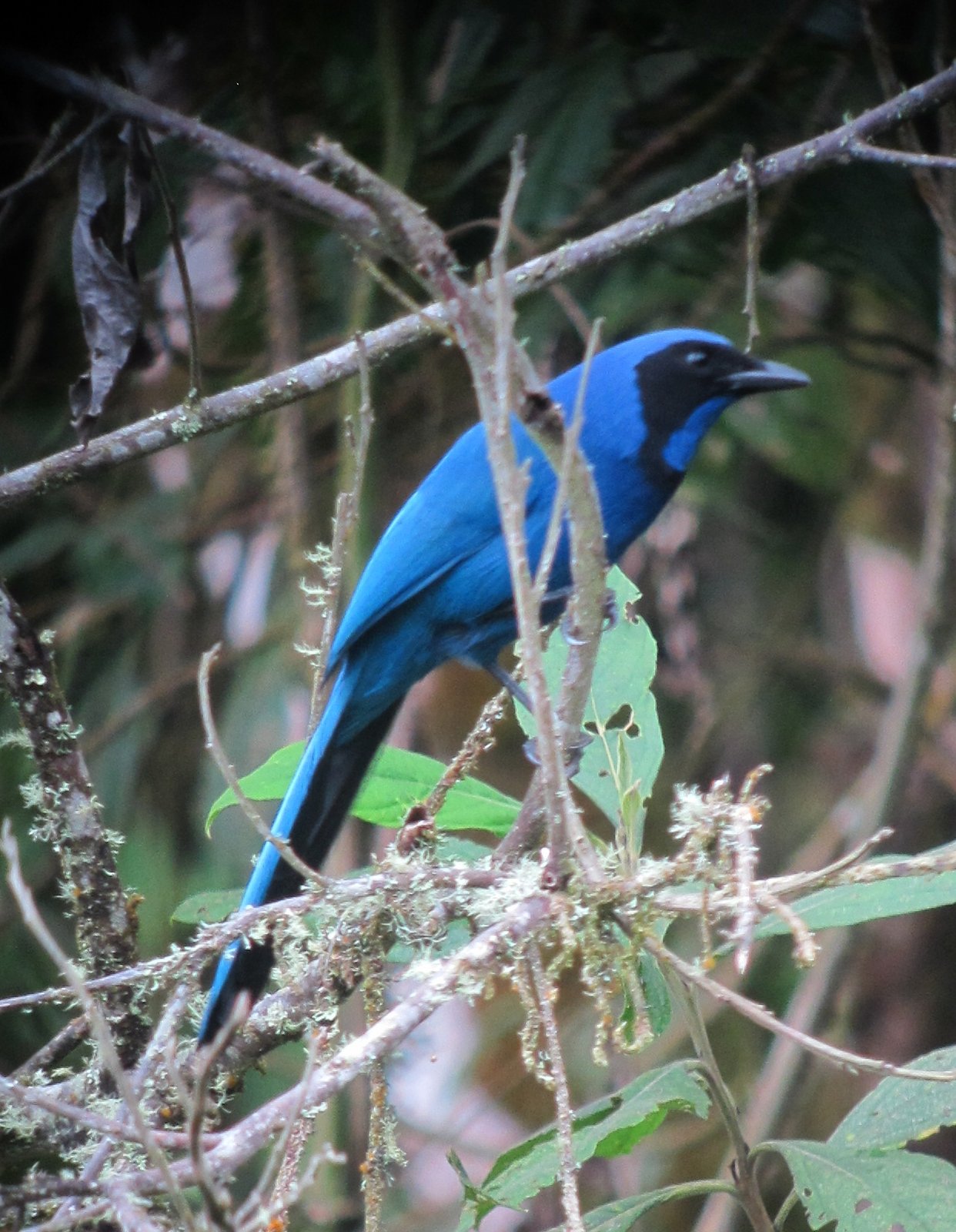
The Black-collared Jay is a dark ultramarine-blue jay with a black mask and a narrow black collar, of the upper montane forest of the northern Andes. It moves through the forest in pairs or family groups, often together with other species. It was formerly included in White-collared Jay; with that species and Turquoise Jay it forms a chain of closely related jays along the Andes.
Voice
Loud, hoarse and rasping calls, often a rapid series chaa-chaa-chaa or a single cheerr; also clear, whistled notes.
Recording: Jaime Suárez — CC BY-NC-SA 4.0 · xeno-canto
Identification
33 cm, with a long tail. Almost entirely dark ultramarine to violet blue, the crown paler and brighter blue. A black mask covers the forehead, lores and ear-coverts, and a narrow black collar separates the blue throat from the breast. The bill, legs and iris are black. The sexes are alike; young birds are duller, with a less bright crown.
Confusion species
Turquoise Jay Cyanolyca turcosa is much paler, turquoise blue with a whitish throat; it occurs nearby in southern Colombia and northern Ecuador. White-collared Jay Cyanolyca viridicyanus has a white instead of a black collar and lives only in Peru and Bolivia. Beautiful Jay Cyanolyca pulchra is smaller, with a whitish crown and no collar, and lives lower on the Pacific slope.
Habitat
Humid montane forest and cloud forest, forest edges and old secondary forest, at roughly 1600 to 3000 m. It forages mainly in the middle and upper levels of the forest, among moss and epiphytes, and eats insects, other invertebrates and fruit. Little is known about its breeding.
Where the bird is most at home, classified by the vegetation units of the Andes and the west coast.


Range and movements
In Colombia in the Eastern and Central Andes. In Ecuador only in the far north, mainly on the eastern slope. Absent from Peru, Bolivia and the Galápagos. Outside the guide area in the Andes of western Venezuela.
- Resident
- dark = core range, pale = thinly spread
How and when to look
In cloud-forest reserves on the slopes of the Central and Eastern Andes in Colombia, where groups travel with mixed-species tanager flocks. The rasping calls usually give them away first.
Conservation status
Not evaluated by the IUCN as a separate species. Locally fairly common, but dependent on continuous montane forest, which is strongly fragmented in the northern Andes.
Scientific name
Cyanolyca armillata | (Gray, 1845)
Gray described the species in 1845 as Cyanocorax armillatus; because it was later moved to another genus, the author and year stand in brackets. The genus Cyanolyca was introduced in 1851 by Cabanis. The genus name combines Ancient Greek kuanos, 'dark blue', with lukos, a kind of crow (possibly the jackdaw) mentioned by Aristotle and Hesychius. The species name comes from Latin armillatus, 'wearing a bracelet', for the black collar. The specimen the first description was based on came from Bogotá, Colombia.