All species › Passerines › Crows, jays and magpies › Turquoise Jay
Turquoise Jay | Cyanolyca turcosa
Turkooisgaai | Urraca turquesa | Gralha-turquesa
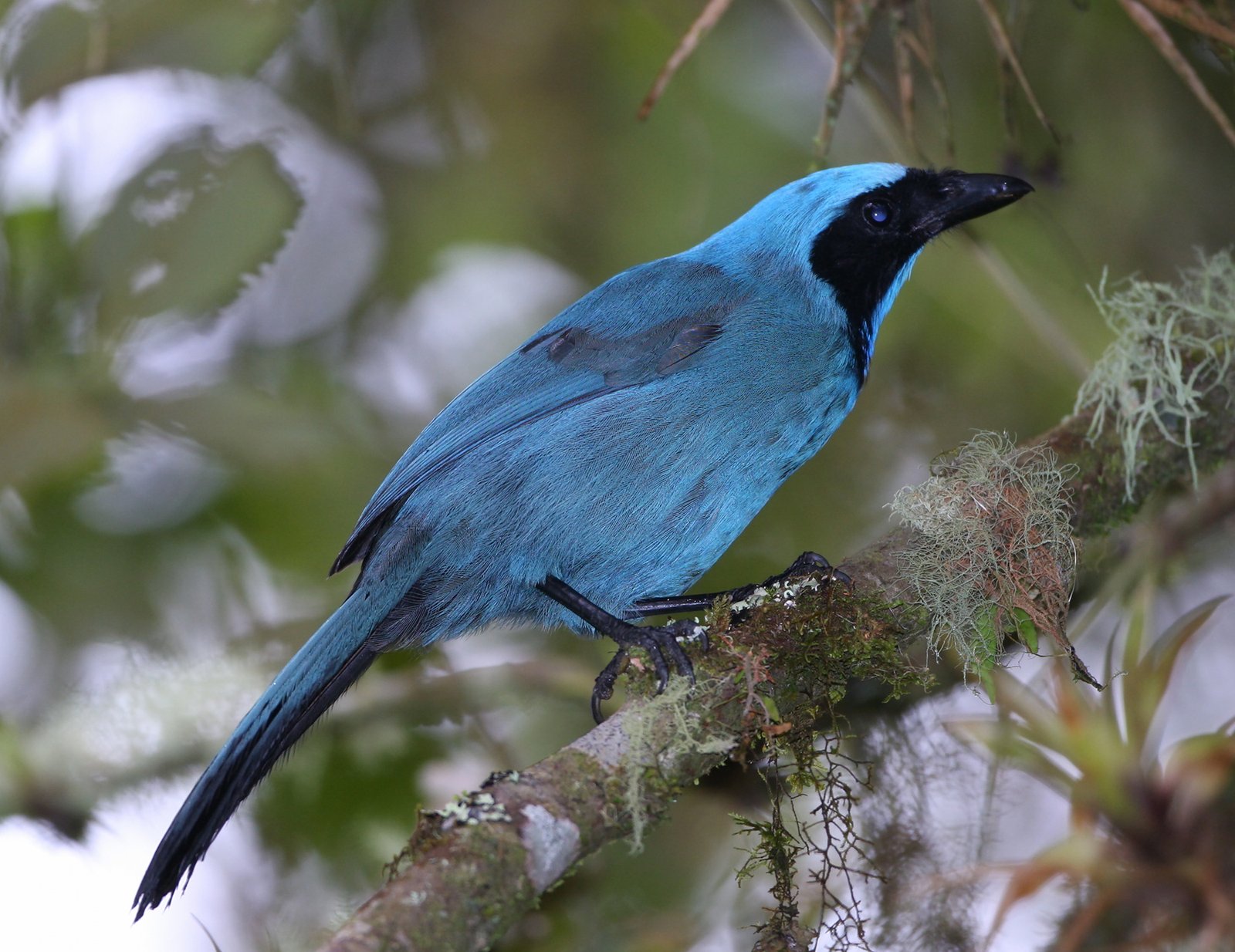
The Turquoise Jay is a pale blue jay with a black mask and a narrow black breast band, of the upper montane forest of southern Colombia, Ecuador and northern Peru. Groups of three to six birds move noisily through the canopy and along the forest edge. In Ecuador it is the most widespread jay of high montane forest.
Voice
A loud, clear, repeated cheer or choo, often in series; also hoarse, rasping calls and soft notes within the group.
Recording: Juan Freile — CC BY-NC-SA 4.0 · xeno-canto
Identification
30–33 cm, with a long tail. The plumage is pale turquoise blue, the crown and forehead paler still, almost whitish blue. A black mask runs from the bill through the eye to the ear-coverts; the throat is whitish blue and bordered by a narrow black band across the upper breast. The wings and tail are slightly darker blue. The bill and legs are black. The sexes are alike; young birds are duller.
Confusion species
Black-collared Jay Cyanolyca armillata is dark ultramarine blue, with a blue throat, and occurs only in Colombia and the far north of Ecuador. White-collared Jay Cyanolyca viridicyanus is darker violet blue, with a white collar, and replaces Turquoise Jay in Peru east of the Marañón and further south. Beautiful Jay Cyanolyca pulchra is smaller and deep blue, with a whitish crown, and lives lower on the western slope.
Habitat
Humid montane forest, cloud forest, forest edges and slopes with woodlots and scrub, at roughly 1800 to 3400 m, also in fragmented forest at the edge of pasture. It eats insects, other invertebrates, small vertebrates, eggs and fruit, at all levels of the forest but mainly in the canopy.
Where the bird is most at home, classified by the vegetation units of the Andes and the west coast.


Range and movements
In Colombia in the south-west, mainly in Nariño. In Ecuador on both slopes of the Andes and locally in the inter-Andean valleys, along the whole length of the country. In Peru only in the far north, west and north of the Marañón. Absent from Bolivia and the Galápagos. Does not occur outside the guide area.
- Resident
- dark = core range, pale = thinly spread
How and when to look
Around Quito, such as in the montane forest of Yanacocha on the slope of Pichincha, and along the roads to the eastern slope; groups are usually heard before they appear at the forest edge.
Conservation status
Least Concern. Fairly common and persists in fragmented forest as long as woodlots remain.
Scientific name
Cyanolyca turcosa | (Bonaparte, 1853)
Bonaparte described the species in 1853 as Cyanocitta turcosa; because it was later moved to another genus, the author and year stand in brackets. The genus Cyanolyca was introduced in 1851 by Cabanis. The genus name combines Ancient Greek kuanos, 'dark blue', with lukos, a kind of crow (possibly the jackdaw) mentioned by Aristotle and Hesychius. The species name comes from Medieval Latin turcosa, 'turquoise', for the turquoise-blue colour. The specimen the first description was based on came from Puerres, Nariño, Colombia.