All species › Passerines › Tanagers and allies › Black-cowled Saltator
Black-cowled Saltator | Saltator nigriceps
Roodsnavelsaltator | Pepitero capuchinegro | Trinca-ferro-de-capuz-preto
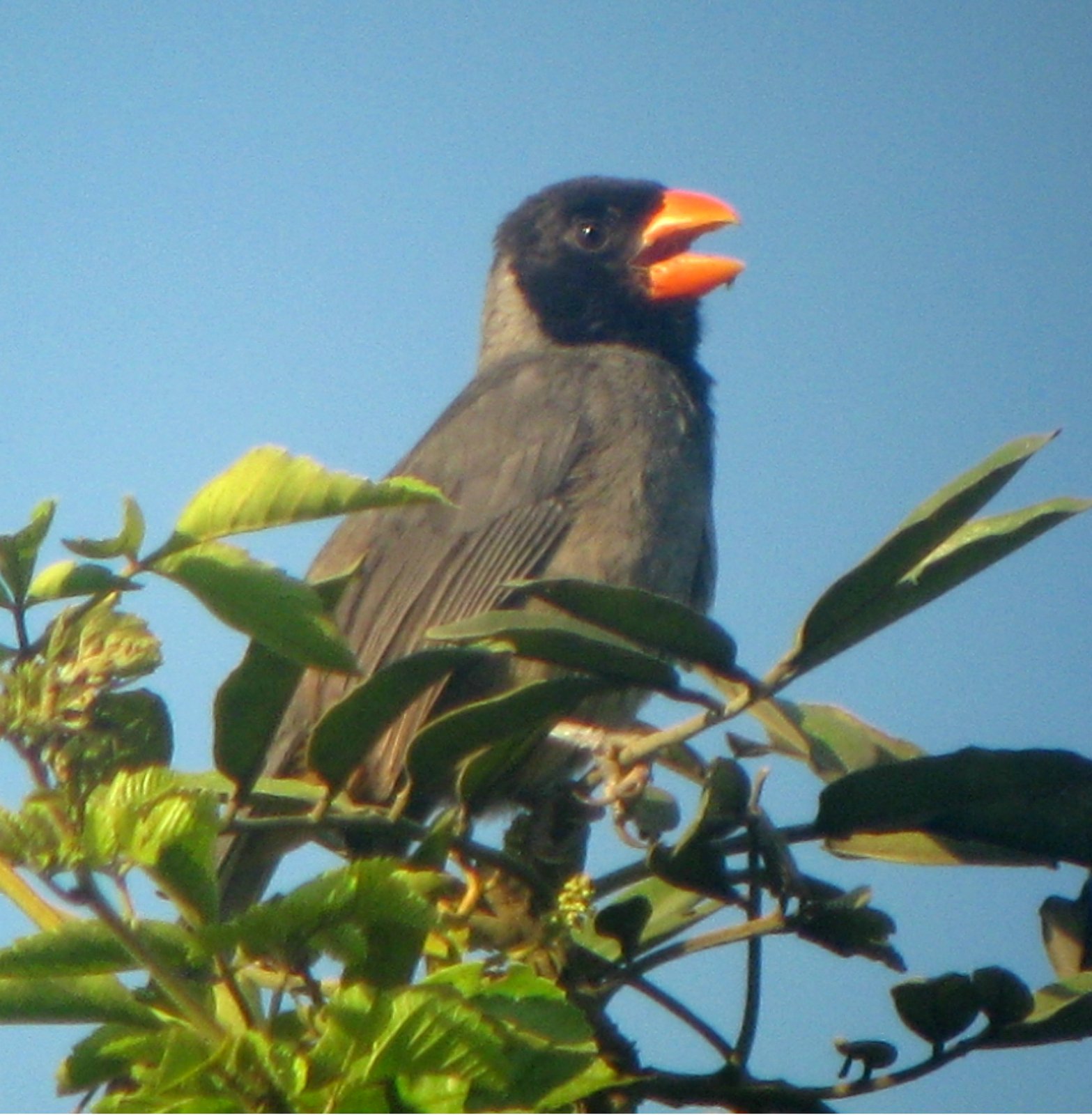
The Black-cowled Saltator is a large grey saltator with a black hood and a red bill, of the mountains of south-western Ecuador and north-western Peru. It belongs to the birds of the Tumbesian region, with a small range. It lives in scrub and forest edge on the slopes.
Voice
The song is a series of loud, whistled notes and short phrases, repeated from a perch. The call is a sharp, metallic tick.
Recording: Peter de Rouw — CC BY-NC-SA 4.0 · xeno-canto
Identification
22 cm, with a heavy, red to orange-red bill and a fairly long tail. The whole head, the throat and the upper breast are black and form a hood. The upperparts are grey, the underparts grey, grading into ochre-brown to cinnamon on the belly and undertail coverts. The sexes are alike. Young birds are duller, with a darker bill and a less sharply defined hood.
Confusion species
Golden-billed Saltator Saltator aurantiirostris has an orange bill, but a grey crown, a white stripe behind the eye and only a black mask; it occurs further south in Peru. Black-winged Saltator Saltator atripennis has a black head with white stripes, a white throat, a green back and a dark bill. Streaked Saltator Saltator striatipectus is olive-green with streaked underparts.
Habitat
Scrub, forest edge, wooded ravines, riparian growth and semi-humid montane forest in a mainly dry landscape, also hedgerows and gardens, roughly between 800 and 3000 m. It forages in the lower and middle levels for fruit, flowers, buds and insects. The nest is a cup in a shrub or small tree.
Where the bird is most at home, classified by the vegetation units of the Andes and the west coast.


Range and movements
In Ecuador only in the mountains of the south-west, mainly in El Oro and Loja. In Peru in the north-west, on the western slope of the Andes in Tumbes, Piura, Lambayeque and Cajamarca. Absent from Colombia, Bolivia and the Galápagos. Does not occur outside the guide area.
- Resident
- dark = core range, pale = thinly spread
How and when to look
Search shrubby ravines and forest edges on the slopes above the dry forest in Loja or Piura; the red bill can be seen against the foliage even at a distance.
Conservation status
Least Concern. The range is small and montane forest in the Tumbesian region is affected by clearance and grazing, but the species tolerates scrub and farmland.
Scientific name
Saltator nigriceps | (Chapman, 1914)
Chapman described the species in 1914 as Pitylus nigriceps; because it was later moved to another genus, the author and year stand in brackets. The genus Saltator was introduced in 1816 by Vieillot. The genus name comes from Latin saltator, 'dancer'. The species name combines Latin niger, 'black', and -ceps, 'headed'. The specimen the first description was based on came from Loja, Ecuador.