All species › Passerines › Tanagers and allies › Green-winged Saltator
Green-winged Saltator | Saltator similis
Groenvleugelsaltator | Pepitero verdoso | Trinca-ferro
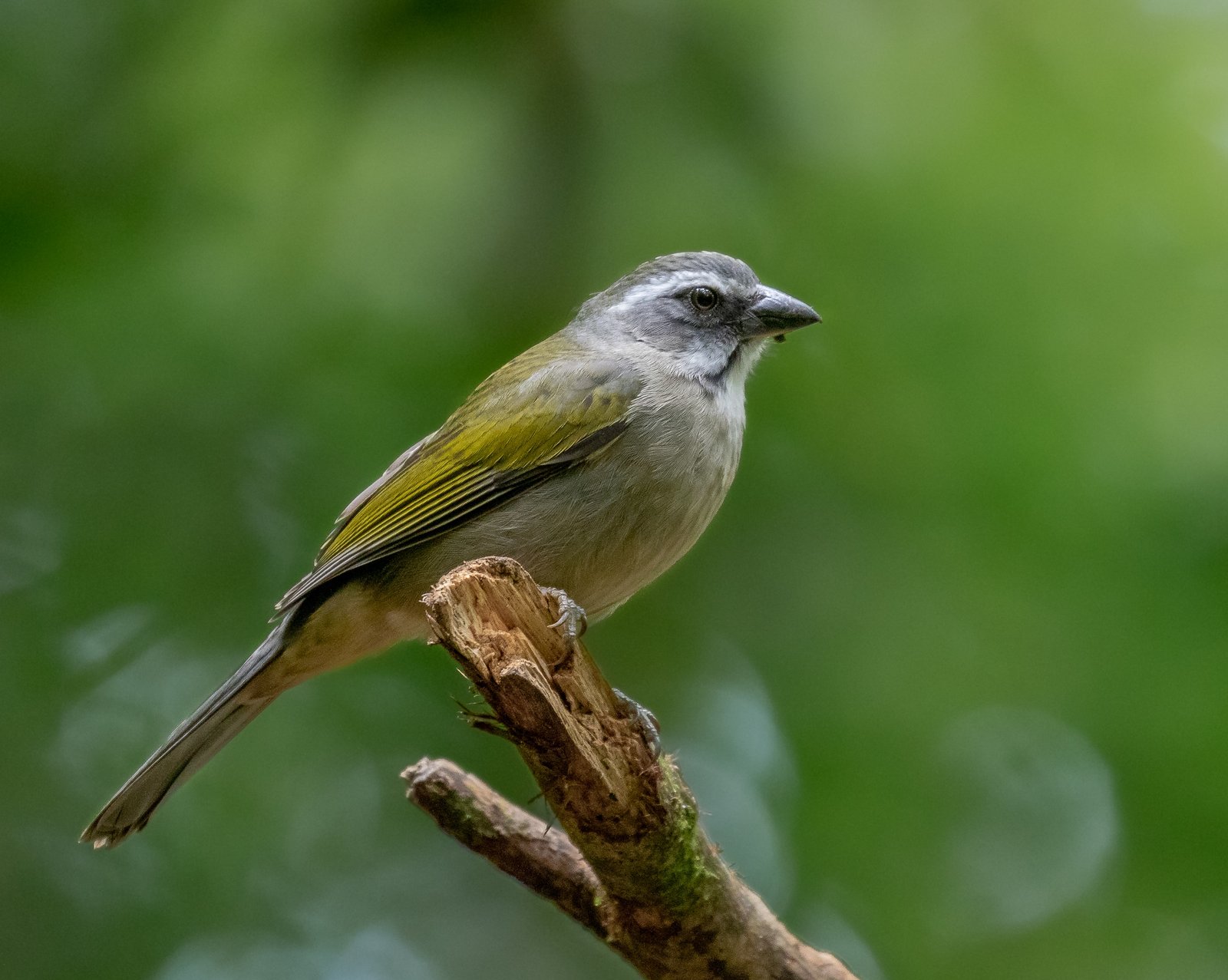
The Green-winged Saltator is a large saltator with a long white supercilium and olive-green-edged wings, of forest edge and scrub in south-eastern South America. In the guide area it reaches only eastern and south-eastern Bolivia. In Brazil it is a well-known cagebird because of its loud, whistled song.
Voice
The song is a loud, clear series of whistled phrases, often from a high perch and varying between birds. The call is a sharp, metallic tick.
Recording: Fabrício Grigolin — CC BY-NC-SA 4.0 · xeno-canto
Identification
20 cm, with a heavy, blackish bill and a fairly long tail. The head and nape are grey, the back olive-green to olive-grey, and the wing feathers have broad olive-green edges. A long white supercilium extends well behind the eye; the throat is white, bordered by a black malar stripe. The breast is grey, the belly and undertail coverts ochre to pale cinnamon. The sexes are alike. Young birds are duller, with a yellowish supercilium.
Confusion species
Bluish-grey Saltator Saltator coerulescens lacks the green wing edges, has a shorter supercilium and is bluer grey above. Buff-throated Saltator Saltator maximus has an ochre throat centre and an entirely green back. Golden-billed Saltator Saltator aurantiirostris has an orange bill, a black mask and a black breast band.
Habitat
Edges of humid and semi-humid forest, secondary woodland, scrub, gallery forest, pasture with trees and gardens, in the lowlands and foothills up to about 1500 m. It forages in the lower and middle levels for fruit, flowers, buds, leaves and insects. The nest is a cup in a shrub or small tree.
Where the bird is most at home, classified by the vegetation units of the Andes and the west coast.


Range and movements
In Bolivia only in the east and south-east, in the lowlands and foothills. Absent from Colombia, Ecuador, Peru and the Galápagos. Outside the guide area in eastern and southern Brazil, Paraguay, Uruguay and north-eastern Argentina.
- Resident
- dark = core range, pale = thinly spread
How and when to look
Search forest edges and scrub in the foothills and lowlands of south-eastern Bolivia; the bird sings in the early morning from a projecting branch.
Conservation status
Least Concern. Common and tolerant of partly cleared land. In Brazil it is heavily trapped for the cagebird trade, which locally leads to lower numbers.
Scientific name
Saltator similis | d'Orbigny, ACVMD & de Lafresnaye, 1837
D'Orbigny, ACVMD & de Lafresnaye described the species in 1837 and placed it straight away in the genus where it still stands. The genus Saltator was introduced in 1816 by Vieillot. The genus name comes from Latin saltator, 'dancer'. The species name comes from Latin similis, 'similar', for its resemblance to related saltators. The specimen the first description was based on came from Corrientes, Argentina.