All species › Passerines › Tanagers and allies › Streaked Saltator
Streaked Saltator | Saltator striatipectus
Gestreepte saltator | Saltador listado | Trinca-ferro-listrado
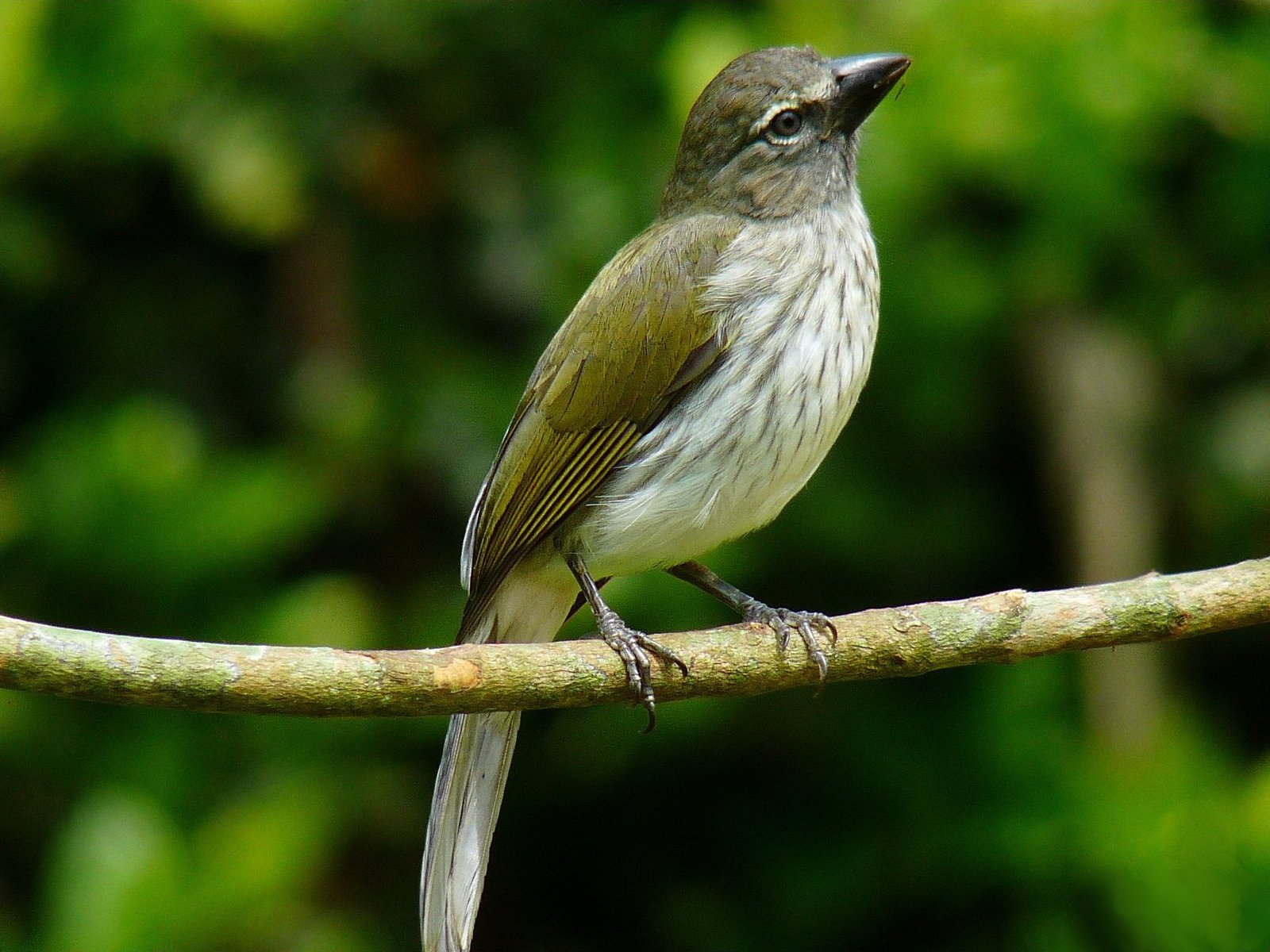
The Streaked Saltator is an olive-green saltator with streaked, pale underparts, of dry and semi-open country west of the Andes and in the valleys of the north. It lives in scrub, forest edge and gardens and sings from a perch. It used to be lumped with Lesser Antillean Saltator Saltator albicollis of the Lesser Antilles.
Voice
The song consists of short, whistled phrases of a few clear notes, often ending in a longer, slurred note, repeated with short pauses. The call is a sharp, metallic tick.
Recording: Mauricio Cuellar Ramirez (@Birding.travel) — CC BY-NC-SA 4.0 · xeno-canto
Identification
19 cm, with a stout bill that is dark with a pale, yellowish tip; the amount of yellow varies between individuals and subspecies. The upperparts are olive-green, greyer on the head. A short white supercilium runs from the bill to above the eye, and there is a narrow white eye-ring. The underparts are whitish to yellowish, with olive-brown streaks on the breast and flanks. The sexes are alike. Young birds are yellower and more diffusely streaked.
Confusion species
Olive-grey Saltator Saltator olivascens is grey and unstreaked, with a cinnamon lower belly. Buff-throated Saltator Saltator maximus has an ochre throat centre with a black border and an unstreaked grey breast. Black-winged Saltator Saltator atripennis has a black head with white stripes and black wings. Black-cowled Saltator Saltator nigriceps has a black hood and a red bill.
Habitat
Dry and semi-humid scrub, dry forest and its edges, riparian growth in dry valleys, coffee and fruit plantations, hedgerows and gardens, from sea level to about 2000 m, locally higher. It forages in the lower and middle levels for fruit, flowers, buds and insects. The nest is a cup in a shrub or small tree.
Where the bird is most at home, classified by the vegetation units of the Andes and the west coast.


Range and movements
In Colombia in the Caribbean lowlands and in the dry valleys and slopes of the Andes, such as the Magdalena and Cauca valleys. In Ecuador in the western lowlands, the foothills and the dry valleys of the south. In Peru west of the Andes, along the coast and the western slope, and in the dry Marañón valley. Absent from Bolivia and the Galápagos. Outside the guide area in Costa Rica, Panama, Venezuela and on Trinidad.
- Resident
- dark = core range, pale = thinly spread
How and when to look
Search dry scrub and gardens in western Ecuador and Peru or in the dry valleys of Colombia; the bird often sings from an exposed branch at the top of a shrub.
Conservation status
Least Concern. Common and tolerant of small-scale farmland; it also lives in gardens and plantations.
Scientific name
Saltator striatipectus | de Lafresnaye, 1847
De Lafresnaye described the species in 1847 and placed it straight away in the genus where it still stands. The genus Saltator was introduced in 1816 by Vieillot. The genus name comes from Latin saltator, 'dancer'. The species name combines Latin striatus, 'streaked', and pectus, 'breast'. The specimen the first description was based on came from Cali, Valle del Cauca, Colombia.