All species › Passerines › Tanagers and allies › Bluish-grey Saltator
Bluish-grey Saltator | Saltator coerulescens
Grijze saltator | Pepitero grisáceo | Sabiá-gongá
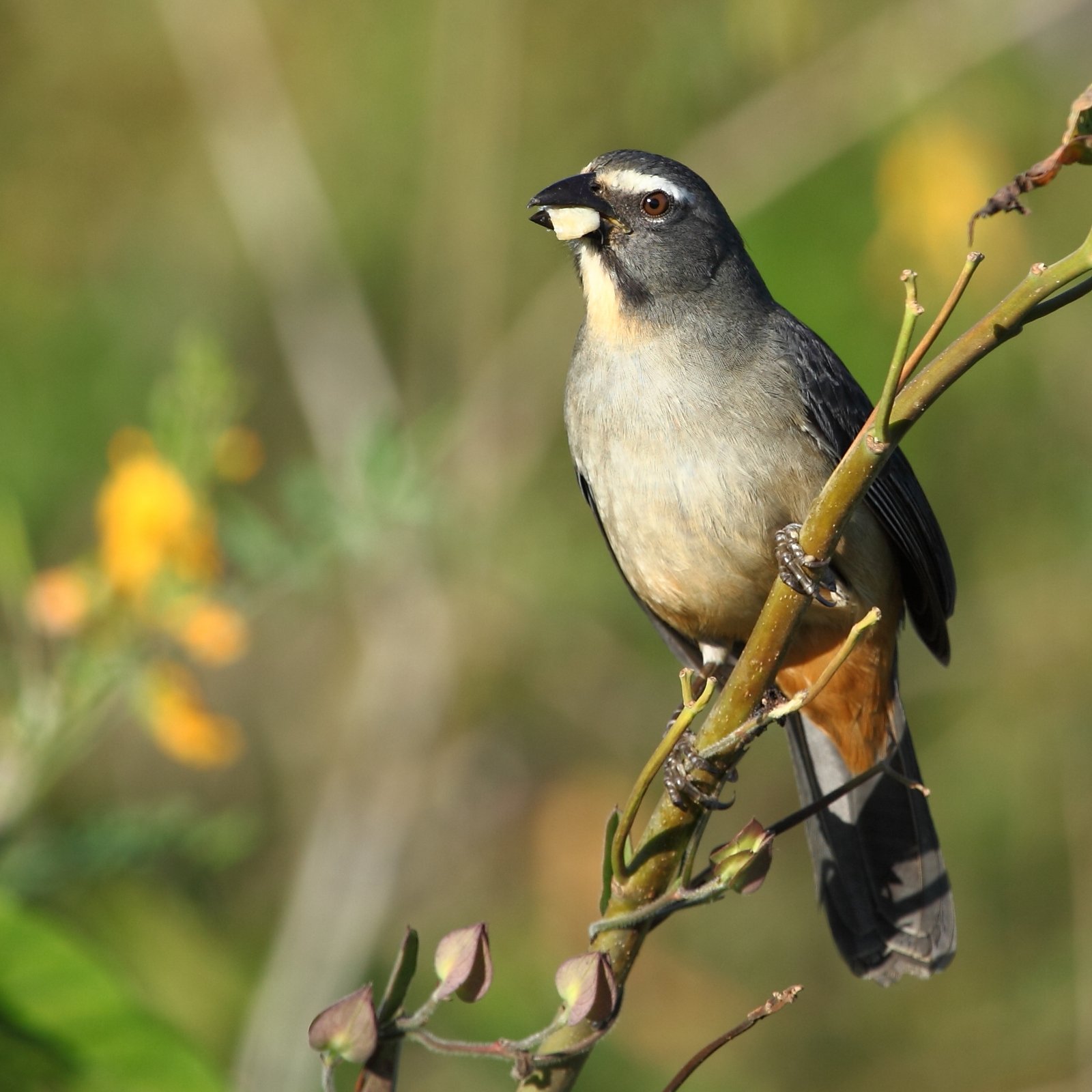
The Bluish-grey Saltator is a large grey saltator of semi-open country, riverbanks and forest edge in the lowlands east of the Andes. It often sits in view in shrubs and delivers its whistled song from a perch. Since the split of the old, broad species, the name covers only the birds of Amazonia and southern South America.
Voice
The song is a short, clear series of whistled notes, nasal to mellow, often with a rising final note, repeated from a perch. A frequently heard call is a long, upslurred whistle; also a sharp tick.
Recording: JAYRSON ARAUJO DE OLIVEIRA — CC BY-NC-SA 4.0 · xeno-canto
Identification
20 cm, with a heavy black bill and a fairly long tail. The upperparts are bluish grey. A short white supercilium runs from the bill to just behind the eye; the throat is white, bordered by a black malar stripe. The breast is grey, the belly and undertail coverts cinnamon to ochre-brown. The sexes are alike. Young birds are more olive, with a yellowish supercilium and throat.
Confusion species
Olive-grey Saltator Saltator olivascens of northern Colombia is more olive-grey above and paler below. Buff-throated Saltator Saltator maximus has a green back and an ochre centre to the throat. Green-winged Saltator Saltator similis in Bolivia has green edges to the wing feathers and a longer white supercilium. Golden-billed Saltator Saltator aurantiirostris has an orange bill and a black mask.
Habitat
Forest edge, riverbanks and river islands with scrub, secondary woodland, savanna with trees, pasture with hedgerows and gardens, mainly below 1000 m, locally higher in the foothills. It avoids the interior of closed forest. It eats fruit, flowers, buds and leaves, supplemented by insects, in the lower and middle levels, sometimes with mixed flocks. The nest is a cup in a shrub or small tree.
Where the bird is most at home, classified by the vegetation units of the Andes and the west coast.


Range and movements
In Colombia in the lowlands of the south-east, east of the Andes. In Ecuador and Peru in the Amazonian lowlands and the foothills of the eastern slope. In Bolivia widespread in the lowlands east of the Andes, including the savannas of the Beni and the east. Absent from the Galápagos. Outside the guide area in most of Brazil, Paraguay, western Uruguay and northern Argentina.
- Resident
- dark = core range, pale = thinly spread
How and when to look
Search riverbanks, river islands and shrubby forest edges in the Amazonian lowlands; the bird often sings from an exposed branch in the early morning.
Conservation status
Least Concern. Common; the species benefits from forest edge and open, partly cleared landscapes.
Scientific name
Saltator coerulescens | Vieillot, 1817
Vieillot described the species in 1817 and placed it straight away in the genus where it still stands. The genus Saltator was introduced in 1816 by Vieillot. The genus name comes from Latin saltator, 'dancer'. The species name comes from Latin coerulescens, 'bluish'. The specimen the first description was based on came from Paraguay.