All species › Passerines › Tanagers and allies › Olive-grey Saltator
Olive-grey Saltator | Saltator olivascens
Caribische grijze saltator | Pepitero oliváceo | Sabiá-gongá-do-norte
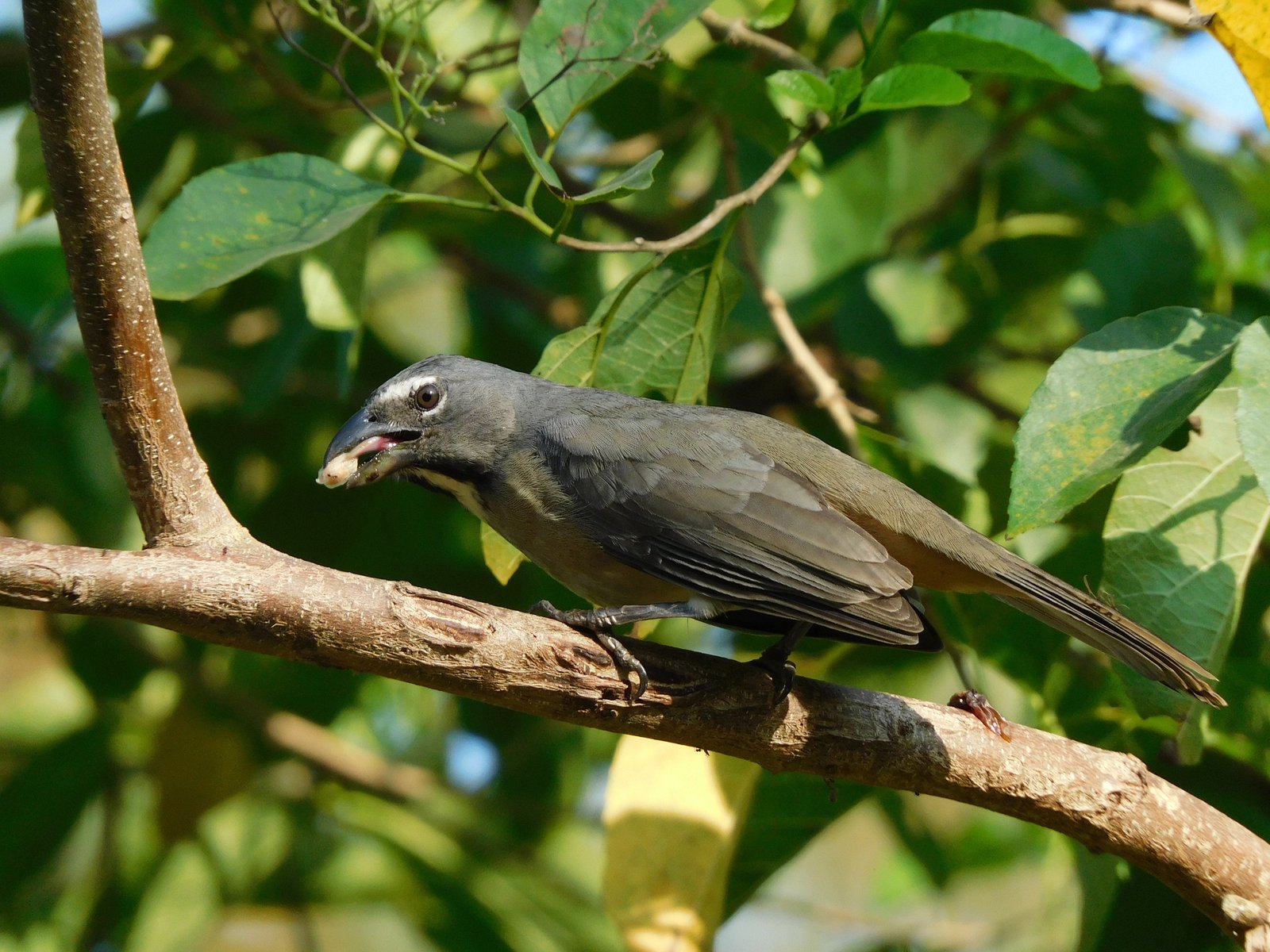
The Olive-grey Saltator is a grey saltator with a white eyebrow and a white throat, of forest edges, scrub and gardens in northern South America. Until recently it was treated as one species with the Bluish-grey Saltator of Amazonia and the Central American form. Both male and female sing, sometimes in duet.
Voice
The song is stuttering, with harsh, downslurred notes alternating high and low; male and female both sing, sometimes in duet. The call is a short, high note that also appears in the song.
Recording: A Edwar H Guarín — CC BY-NC-SA 4.0 · xeno-canto
Identification
20–22 cm, with a thick, black bill with a small hook at the tip. The upperparts are dark grey with a slight olive tinge. A white eyebrow and a narrow white crescent below the eye stand out. The white throat is framed by black malar stripes. The underparts are pale grey, with buff tones on the flanks and undertail coverts. The sexes are alike. Juveniles have an olive and yellow wash, especially below.
Confusion species
Bluish-grey Saltator Saltator coerulescens of Amazonia is similar, but often has a warmer cinnamon belly and lives south of this species. Orinoco Saltator Saltator orenocensis is smaller, with black sides to the head and buff underparts. Buff-throated Saltator Saltator maximus has an olive-green back and a buff lower throat. Streaked Saltator Saltator striatipectus is greenish brown, with streaked underparts.
Habitat
Forest edges, scrub, secondary forest, riverside vegetation, orchards, gardens and parks, also in towns, mainly in the lowlands. It forages in pairs in shrubs and trees. It eats mainly fruit, flowers, buds and leaves, as well as insects. The nest is a cup in a shrub or tree.
Where the bird is most at home, classified by the vegetation units of the Andes and the west coast.


Range and movements
In Colombia in the north: along the Caribbean coast from the Sinú to the Magdalena valley and in the north-east of the country. Absent from Ecuador, Peru, Bolivia and the Galápagos; in Amazonia it is replaced by the Bluish-grey Saltator. Outside the guide area in Venezuela, on Trinidad, in the Guianas and in the far north of Brazil.
- Resident
- dark = core range, pale = thinly spread
How and when to look
Search the Caribbean lowlands of Colombia in shrubby gardens, parks and forest edges, where pairs sing from an exposed perch.
Conservation status
Least Concern. Common and tolerant of human-modified landscapes.
Scientific name
Saltator olivascens | Cabanis, 1849
Cabanis described the species in 1849 and placed it straight away in the genus where it still stands. The genus Saltator was introduced in 1816 by Vieillot. The genus name comes from Latin saltator, 'dancer'. The species name comes from Latin olivascens, 'olive-tinged'. The specimen the first description was based on came from Guyana.