All species › Passerines › Antbirds › Black-crested Antshrike
Black-crested Antshrike | Sakesphorus canadensis
Zwartkuifmierklauwier | Batará crestinegro | Choca-de-crista-preta
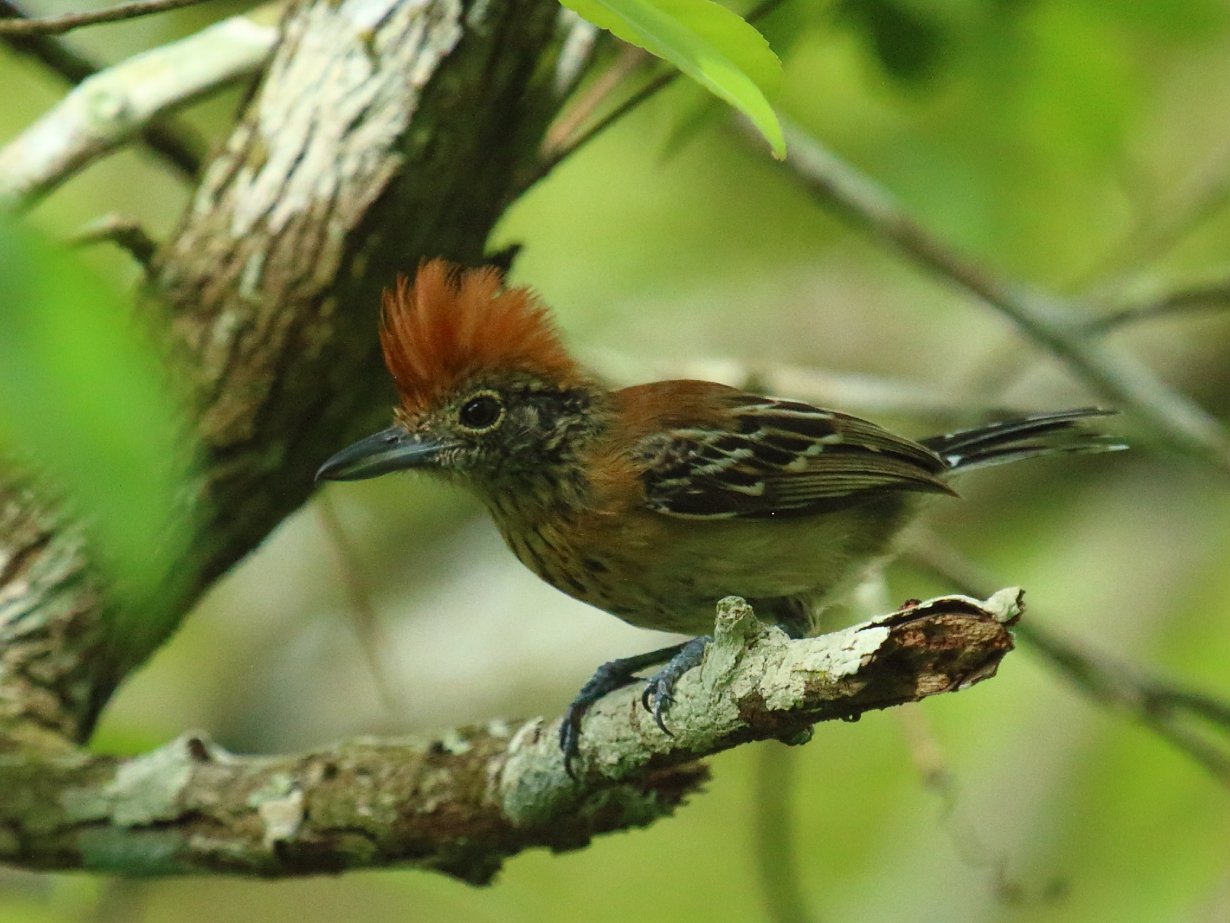
The Black-crested Antshrike is a medium-sized antshrike with a spiky crest of dry and semi-humid woodland, scrub and mangroves in northern South America. The male has a black head and breast, the female a rufous crest. In the guide area it lives mainly in northern and eastern Colombia, with a small, isolated population along the Amazon in north-eastern Peru.
Voice
The song is a series of clear, whistled notes that accelerates and rises in pitch, sometimes with a short nasal ending. Also short, grating calls.
Recording: Tristan Guillebot de Nerville — CC BY-NC-SA 4.0 · xeno-canto
Identification
16 cm, with a spiky crest and a fairly heavy, hooked bill. The male has a black head, crest, throat and central breast; the back is cinnamon-brown, the wings are black with white edges to the coverts and the tail is black with white tips. The sides of the breast and the belly are greyish white. The female has a rufous crest, a black-and-white streaked face, rufous upperparts and wings and pale buff underparts with fine streaks on the throat.
Confusion species
Barred Antshrike Thamnophilus doliatus is finely barred black and white (male) or plain cinnamon (female), without a black head. Great Antshrike Taraba major is larger, with white underparts in both sexes. The female Bar-crested Antshrike Thamnophilus multistriatus is barred black and white below.
Habitat
Dry and semi-humid woodland, thorn scrub, gallery forest in the llanos, mangroves and the edges of várzea and river islands; from sea level to about 1000 m. Pairs search the mid-storey and lower canopy for insects. The nest is a small cup in a fork.
Where the bird is most at home, classified by the vegetation units of the Andes and the west coast.


Range and movements
Colombia: in the Caribbean lowlands, the Magdalena valley, the eastern llanos and along the Orinoco, and locally along the Amazon near Leticia. Peru: only in the far north-east, along the Amazon in Loreto near the Colombian border. Absent from Ecuador, Bolivia and the Galápagos. Outside the guide area in Venezuela, the Guianas and northern Brazil.
- Resident
- dark = core range, pale = thinly spread
How and when to look
Search forest edges, scrub and gallery forest in the llanos and the Caribbean lowlands for pairs moving through the mid-storey; the whistled, rising song carries far.
Conservation status
Least Concern. Locally common and tolerates degraded woodland and scrub.
Scientific name
Sakesphorus canadensis | (Linnaeus, 1766)
Linnaeus described the species in 1766 as Lanius canadensis; because it was later moved to another genus, the author and year stand in brackets. The genus Sakesphorus was introduced in 1918 by Chubb. The genus name comes from Greek sakesphoros, 'shield-bearing', from sakos, 'shield', and -phoros, 'bearing'. The species name refers to Canada, an error by Linnaeus: the species does not occur there. The specimen the first description was based on came from Cayenne, French Guiana.