All species › Passerines › Antbirds › White-bellied Antbird
White-bellied Antbird | Myrmeciza longipes
Witbuikmiervogel | Hormiguero ventriblanco | Formigueiro-de-barriga-branca
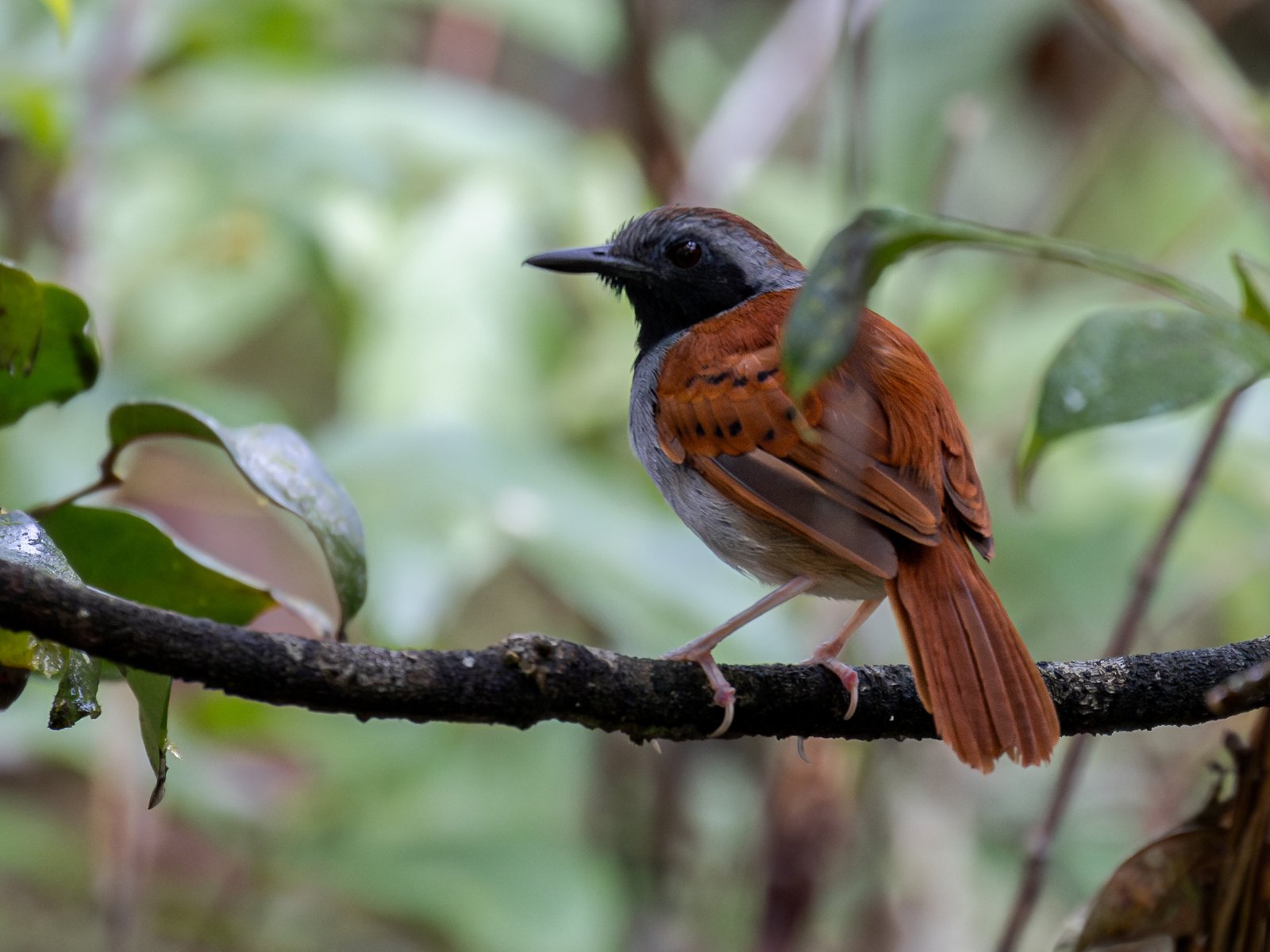
The White-bellied Antbird is a ground-loving antbird of drier forests and scrub in northern South America. In the guide area it lives only in Colombia. It walks and hops over the forest floor, tosses leaves aside and regularly follows army-ant swarms.
Voice
The male's song is a loud, rapid, descending series of notes ending in a few chew notes; the female sings a shorter version. Calls are a short, liquid rattle and a thin, descending whistle.
Recording: Sue Riffe — CC BY-NC-SA 4.0 · xeno-canto
Identification
15 cm, with long, pinkish-grey legs and a fairly short tail. The male is cinnamon-rufous on the crown, upperparts, wings and tail, with black sides of the head, throat and upper breast, a white lower breast and belly and tawny flanks and undertail coverts. The female has similar upperparts, with black bars on the wing coverts, dark brown sides of the head, a white chin and an ochre-buff throat, breast and flanks. Subspecies differ in the amount of black below; in the upper Magdalena valley males have a grey crown, in Meta large black spots on the wing coverts.
Confusion species
Chestnut-backed Antbird Poliocrania exsul lives west of the Andes in wetter forest; it is dark chestnut, with blue bare skin around the eye and no white belly. Dull-mantled Antbird Sipia laemosticta has a grey head, a red iris and white spots on the wing. Dusky Antbird Cercomacroides tyrannina is grey (male) or brown with buff underparts (female), lives higher in the vegetation and lacks the black throat and white belly.
Habitat
Floor and understorey of moderately humid, semi-deciduous forest, also dry forest, gallery forest and shrubby secondary forest; up to about 1800 m, mostly lower. It forages alone, in pairs or in family groups on the ground and up to about 1 m above it; it tosses litter aside and picks prey from the undersides of leaves. It regularly follows army ants but does not depend on them. The nest is a cup of twigs and rootlets lined with finer fibres; the clutch is probably two eggs.
Where the bird is most at home, classified by the vegetation units of the Andes and the west coast.


Range and movements
Colombia: in the north, from the far north of Chocó to La Guajira; in the upper Magdalena valley; on the eastern slope of the northern part of the Eastern Andes; and east of the Andes in Meta. Absent from Ecuador, Peru and Bolivia and the Galápagos. Outside the guide area in Venezuela, Trinidad, Guyana and northern Brazil (Roraima), and in eastern Panama.
- Resident
- dark = core range, pale = thinly spread
How and when to look
Search dry and gallery forest in the Caribbean lowlands of Colombia or at the edge of the Llanos in Meta; the loud, descending song comes from the ground. At an army-ant swarm the chance of seeing it is greatest.
Conservation status
Least Concern. It tolerates secondary forest and forest edge, but dry forest in Colombia is heavily fragmented.
Scientific name
Myrmeciza longipes | (Swainson, 1825)
Swainson described the species in 1825 as Drymophila longipes; because it was later moved to another genus, the author and year stand in brackets. The genus Myrmeciza was introduced in 1841 by Gray. The genus name comes from Greek murmēx, murmēkos, 'ant', and izō, 'to lie in ambush'. The species name comes from Latin longus, 'long', and pes, 'foot', after the long legs. The specimen the first description was based on came from Trinidad.