All species › Passerines › Antbirds › White-browed Antbird
White-browed Antbird | Myrmoborus leucophrys
Witbrauwmierkruiper | Hormiguero cejiblanco | Papa-formiga-de-sobrancelha
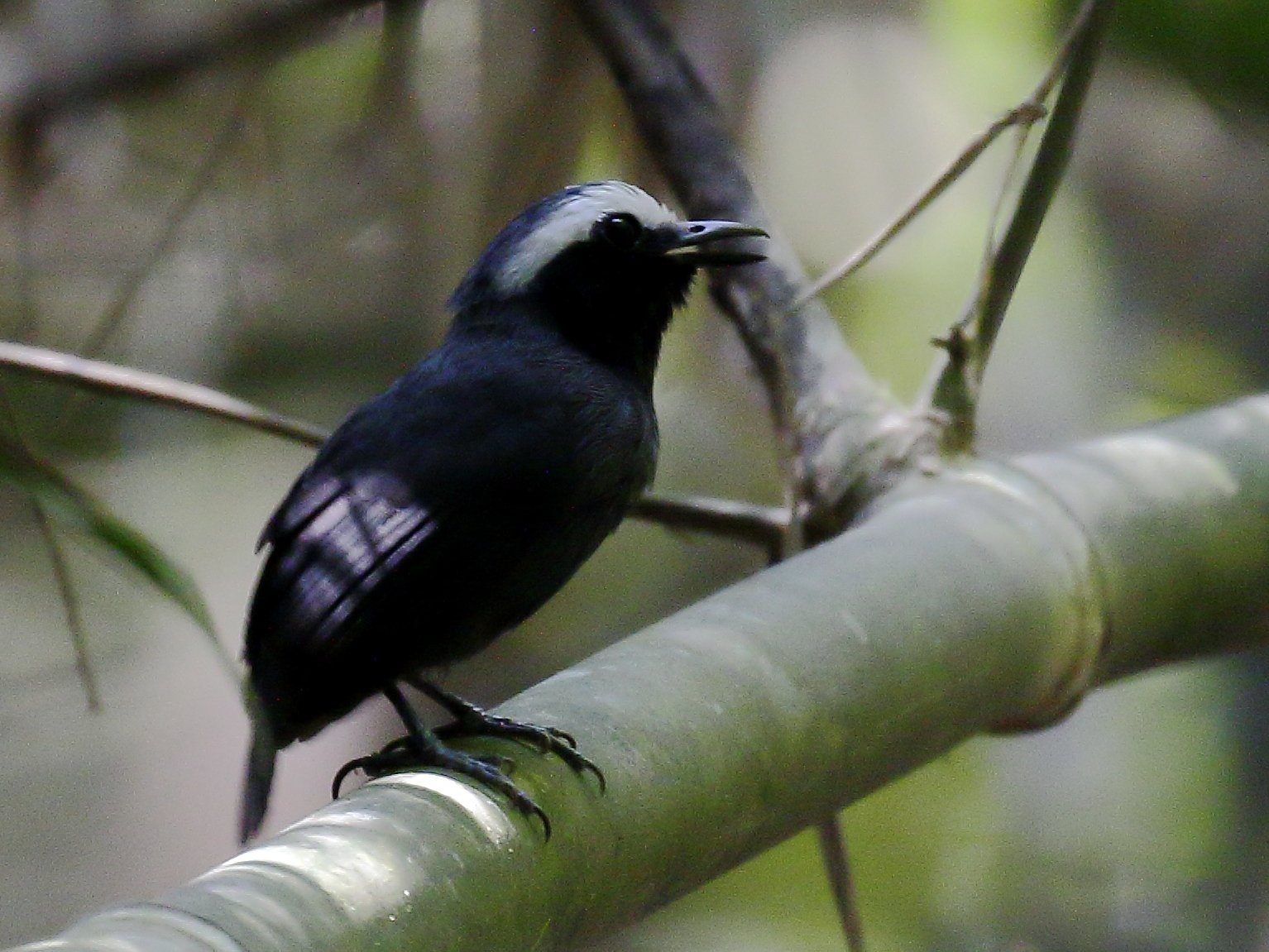
The White-browed Antbird is an antbird of dense undergrowth at forest edges, in river forest and bamboo in Amazonia and at the foot of the Andes. The male stands out with a white forehead band and eyebrow above a black face. It lives close to the ground, bobs its tail and regularly follows army ants.
Voice
The male's song is a long trill of about four seconds that increases in strength and pace and drops slightly at the end; the female's song is shorter, often rising at first. Calls are a short whistle, a single chip and a rapid, high rattle.
Recording: JAYRSON ARAUJO DE OLIVEIRA — CC BY-NC-SA 4.0 · xeno-canto
Identification
12–13.5 cm. The male is dark bluish grey, darkest on the wings and tail, with a white forehead band and broad white eyebrow and a black face, chin and throat. The female has a cinnamon to yellowish-buff forehead band and eyebrow, an olive-brown crown and upperparts, a black mask, dark yellowish-brown wings and tail and a mostly white throat and underparts, with greyish sides and olive-grey flanks. In the subspecies of the upper Huallaga valley the male has an entirely white crown and the black of the throat extends onto the breast.
Confusion species
Black-faced Antbird Myrmoborus myotherinus lives in the understorey of terra firme forest; the male lacks a white eyebrow but has white fringes to the wing coverts, and the female has buff underparts and pale wing spots. Ash-breasted Antbird Myrmoborus lugubris lives on river islands; the male is pale grey below, without a white eyebrow. Black-tailed Antbird Myrmoborus melanurus lives in várzea in north-eastern Peru and is darker, with a black tail.
Habitat
Dense undergrowth at forest edges, in várzea and transitional forest, in Heliconia thickets, in overgrown clearings and sometimes in bamboo; up to about 400 m in Colombia, 1100 m in Ecuador and 1400 m in Peru. It forages alone, in pairs or in family groups on the ground or within 1 m of it, rarely above 3 m; it hops, makes short flights and bobs its tail. It regularly follows army ants and seldom joins mixed flocks. The only known nest was on the ground, made of bamboo leaves, with two eggs.
Where the bird is most at home, classified by the vegetation units of the Andes and the west coast.


Range and movements
Colombia: on the eastern slope of the Andes and in the adjacent lowlands, from the north to the Putumayo. Ecuador: in the eastern lowlands and at the foot of the Andes. Peru: in the eastern lowlands and on the lower eastern slope, with a separate subspecies in the upper Huallaga valley (Huánuco). Bolivia: in the north and north-east. Absent from the Galápagos. Outside the guide area in Venezuela, the Guianas and Amazonian Brazil.
- Resident
- dark = core range, pale = thinly spread
How and when to look
Walk along forest edges, riverbanks and overgrown clearings and listen for the long trill from the undergrowth; the birds often show briefly on low branches and then bob their tail.
Conservation status
Least Concern. Fairly common; the population is thought to be decreasing. Populations at the foot of the Andes are most sensitive to deforestation.
Scientific name
Myrmoborus leucophrys | (Tschudi, 1844)
Tschudi described the species in 1844 as Pithys leucophrys; because it was later moved to another genus, the author and year stand in brackets. The genus Myrmoborus was introduced in 1860 by Cabanis & Heine. The genus name combines Greek murmos, 'ant', and -boros, 'devouring': ant-devourer. The species name comes from Greek leukos, 'white', and ophrus, 'eyebrow', for the white brow. The specimen the first description was based on came from Vitoc, Junín, Peru.