All species › Passerines › Antbirds › Ash-breasted Antbird
Ash-breasted Antbird | Myrmoborus lugubris
Asborstmierkruiper | Hormiguero pechicinéreo | Formigueiro-liso
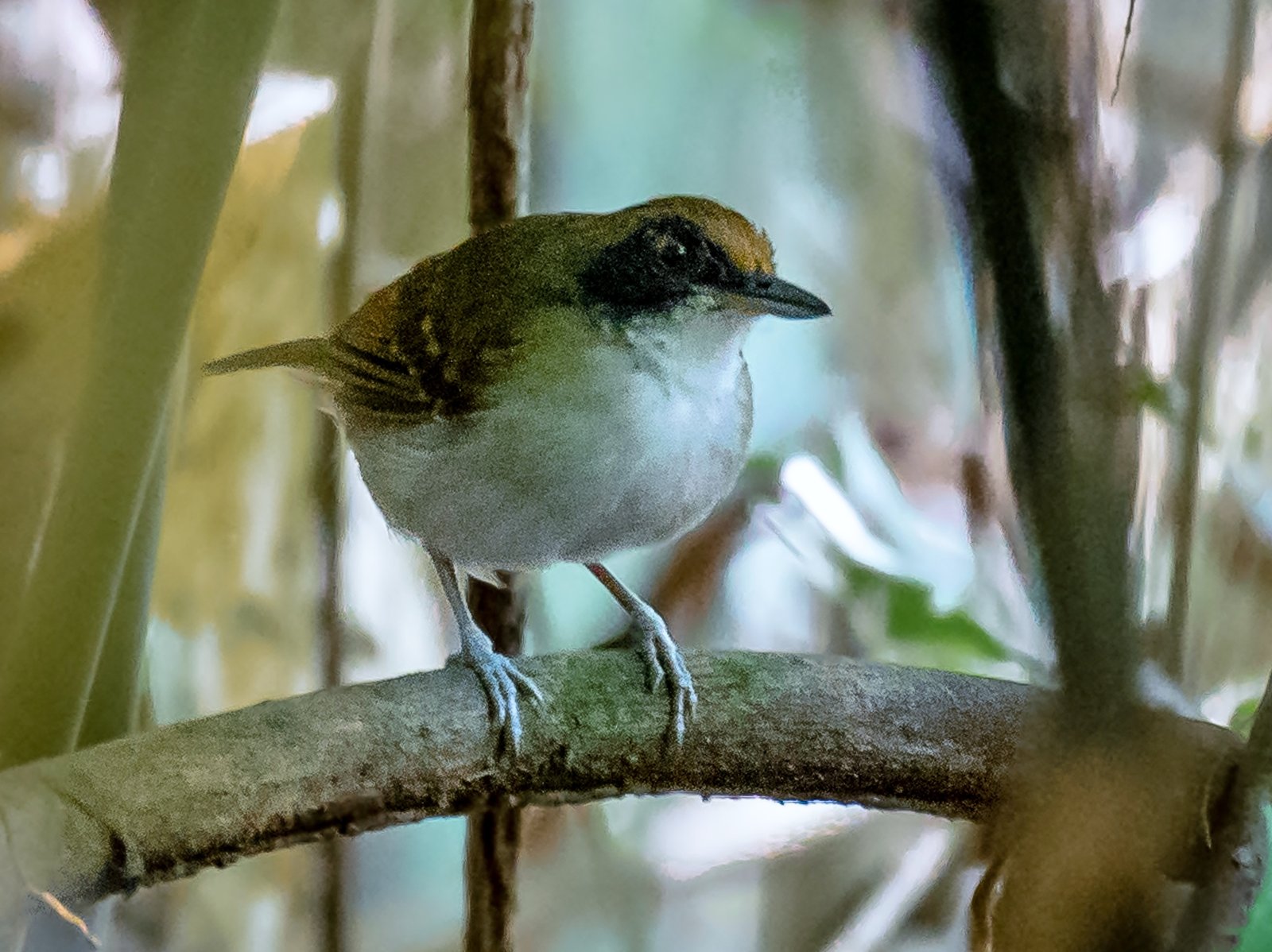
The Ash-breasted Antbird is an antbird of river islands and riverine forest along the Amazon and the lower reaches of its large tributaries. It belongs to the genus Myrmoborus, in which males are grey with a black face and females are brown. Its distribution follows the large lowland rivers almost entirely.
Voice
The song is an even-paced, descending series of slightly hoarse notes, about five per second. The call is a rapid, descending, metallic chatter pt-rr-rr-rr and a soft pew.
Recording: GABRIEL LEITE — CC BY-NC-SA 4.0 · xeno-canto
Identification
13 cm, with a red iris. The male is grey above, with a whitish forehead, a black face and a black throat, and greyish white below. The female is rufous-brown above, with small buff tips to the wing coverts, and has a white throat and whitish underparts with olive flanks.
Confusion species
Black-faced Antbird Myrmoborus myotherinus lives in terra firme forest; the male has white tips to the wing coverts and the female a black mask and buff underparts. Black-tailed Antbird Myrmoborus melanurus is darker slate grey with a black tail and lives in várzea in north-eastern Peru. Black-and-white Antbird Myrmochanes hemileucus shares the river islands, but is black above and pure white below.
Habitat
River islands with somewhat older forest and dense undergrowth, and várzea along the banks of large lowland rivers, below 200 m. It forages in pairs low in dense vegetation for insects and other invertebrates. The nest is an open cup low in the vegetation.
Where the bird is most at home, classified by the vegetation units of the Andes and the west coast.


Range and movements
Colombia: on islands in the Amazon near the border with Peru. Ecuador: only on islands in the lower Napo near the border with Peru. Peru: in Loreto along the Amazon, the Napo and the lower Marañón and Ucayali. Absent from Bolivia and the Galápagos. Outside the guide area along the Amazon in Brazil to its mouth.
- Resident
- dark = core range, pale = thinly spread
How and when to look
Visit river islands in the Amazon near Iquitos by boat, and listen in the early morning for the descending song from the dense undergrowth.
Conservation status
Least Concern. The population is thought to be declining through clearance of islands and riverbanks for farming; changes to the flooding regime caused by dams may affect its habitat.
Scientific name
Myrmoborus lugubris | (Cabanis, 1847)
Cabanis described the species in 1847 as Myrmonax lugubris; because it was later moved to another genus, the author and year stand in brackets. The genus Myrmoborus was introduced in 1860 by Cabanis & Heine. The genus name combines Greek murmos, 'ant', and -boros, 'devouring': ant-devourer. The species name is Latin lugubris, 'mournful', for the sombre grey and black plumage. The specimen the first description was based on came from Probably Pará, Brazil.