All species › Passerines › Antbirds › Black-faced Antbird
Black-faced Antbird | Myrmoborus myotherinus
Zwartmaskermierkruiper | Hormiguero carinegro | Formigueiro-de-cara-preta
The Black-faced Antbird is the most widespread Myrmoborus of the Amazonian lowlands in the guide area. It lives in pairs in the understorey of terra firme forest, especially in dense regrowth in forest gaps. Its song carries from close to the forest floor.
Voice
The song is a countable series of evenly spaced, slightly impure notes that first rise in pitch and strength and then fall, the notes becoming longer. The call is a rattle and a short, abrupt chip.
Recording: Juan Freile — CC BY-NC-SA 4.0 · xeno-canto
Identification
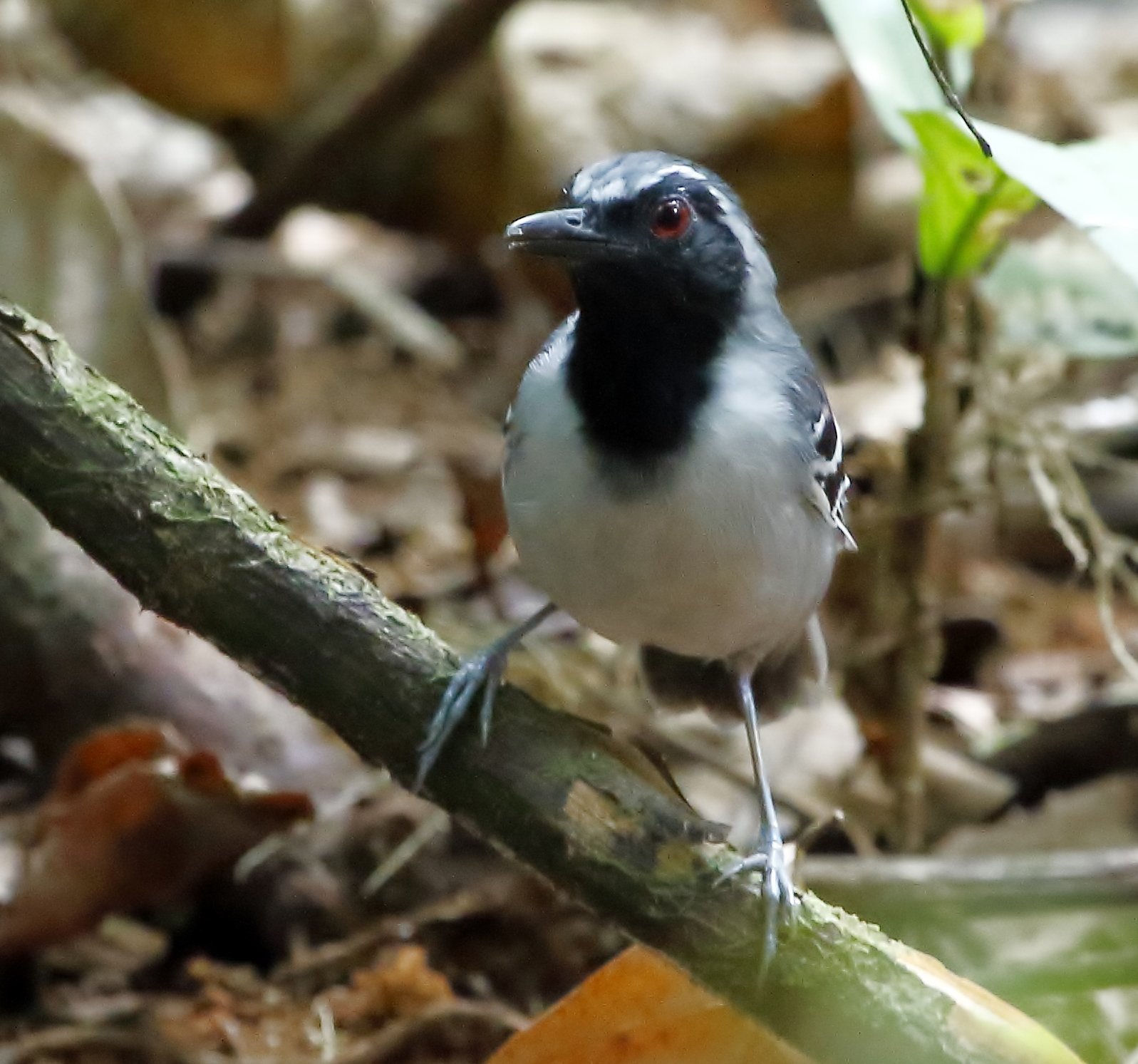
12.5 cm, with a deep red iris. The male is dark blue-grey above, with a small white patch between the scapulars, black wing coverts with white tips, a black face with a pale supercilium, a black throat and pale grey underparts. The female is greyish olive-brown above, with black wing coverts tipped buff, a blackish face, a white throat with small black spots along its lower edge, and buff underparts.
Confusion species
White-browed Antbird Myrmoborus leucophrys has a prominent white (male) or cinnamon (female) supercilium and lives in dense riverside scrub. Ash-breasted Antbird Myrmoborus lugubris lives on river islands and lacks the white tips to the wing coverts. Black-throated Antbird Myrmophylax atrothorax is browner, with a black throat and white spots on the wings, and lives in damp thickets.
Habitat
Understorey of evergreen terra firme forest, also older secondary forest, transitional forest and sometimes seasonally flooded forest; it favours dense regrowth in gaps. Up to about 900 m, locally to 1250 m in Peru. It forages in pairs low above the ground for insects, sometimes at army-ant swarms. The nest is an open cup low near the ground.
Where the bird is most at home, classified by the vegetation units of the Andes and the west coast.


Range and movements
Colombia: in the Amazonian lowlands east of the Andes. Ecuador: in the eastern lowlands, mostly below 700 m. Peru: throughout the Amazonian lowlands and lower foothills. Bolivia: in the north and the lowlands of La Paz, Beni and Cochabamba. Absent from the Galápagos. Outside the guide area in Amazonian Brazil and Venezuela.
- Resident
- dark = core range, pale = thinly spread
How and when to look
Walk trails through terra firme forest at a lodge in the Amazonian lowlands of Ecuador or Peru in the early morning, and watch for pairs in dense regrowth around treefalls.
Conservation status
Least Concern. Common in a very large range with many protected areas; the population is considered stable.
Scientific name
Myrmoborus myotherinus | (Spix, 1825)
Spix described the species in 1825 as Thamnophilus myotherinus; because it was later moved to another genus, the author and year stand in brackets. The genus Myrmoborus was introduced in 1860 by Cabanis & Heine. The genus name combines Greek murmos, 'ant', and -boros, 'devouring': ant-devourer. The species name comes from Greek muiothēras, 'fly-hunter'. The specimen the first description was based on came from Fonte Boa, Amazonas, Brazil.