All species › Passerines › Antbirds › Black-tailed Antbird
Black-tailed Antbird | Myrmoborus melanurus
Zwartstaartmierkruiper | Hormiguero colinegro | Formigueiro-de-rabo-preto
The Black-tailed Antbird has a small range in north-eastern Peru and adjacent Brazil and Colombia. It is tied to seasonally flooded forest along rivers and oxbow lakes. It is the only Myrmoborus with a black tail.
Voice
The song is a moderately paced, accelerating and descending series of slightly burry notes. The call is a sharp chew, sometimes doubled.
Recording: GABRIEL LEITE — CC BY-NC-SA 4.0 · xeno-canto
Identification
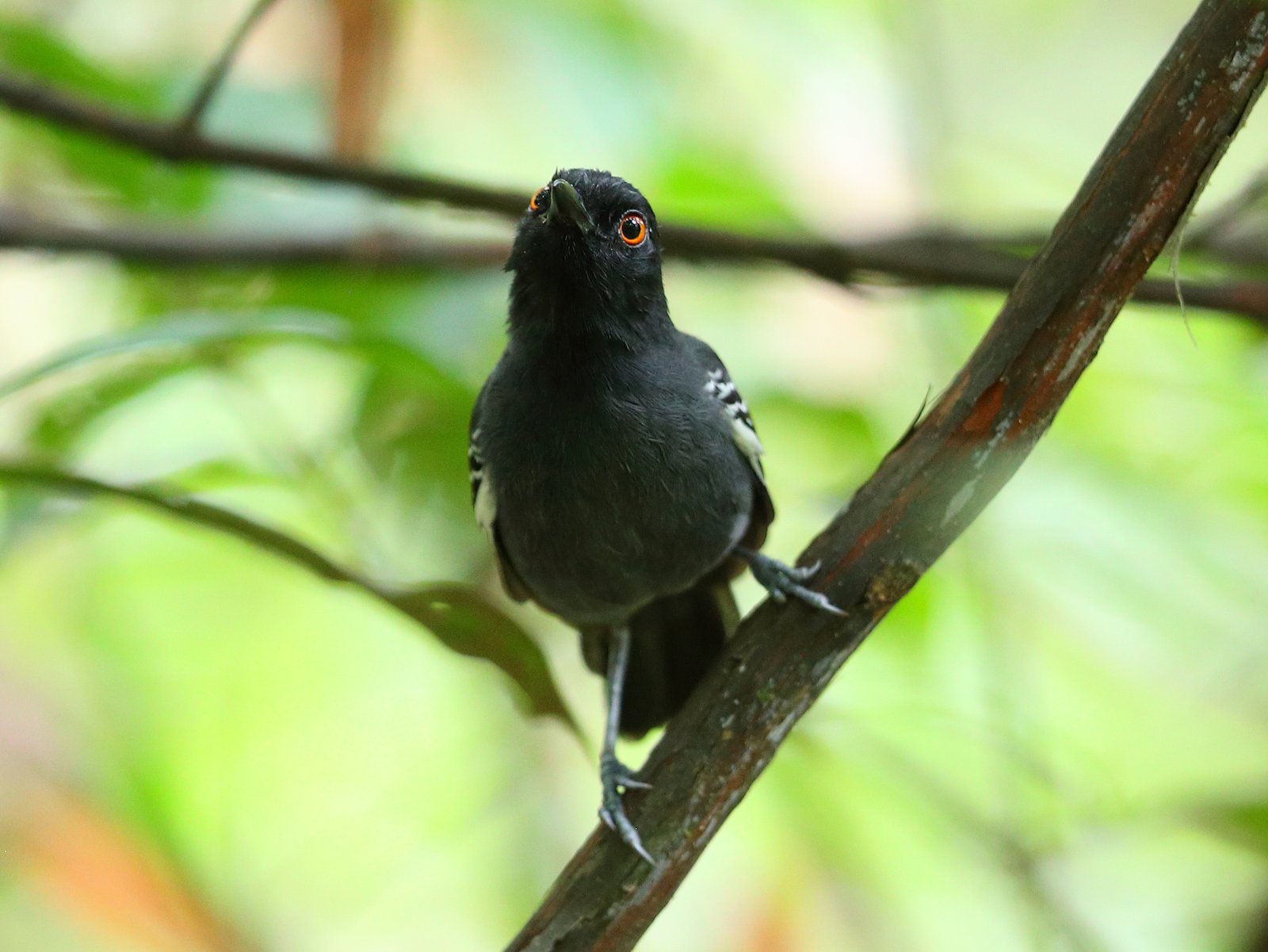
12.5 cm, with a red iris. The male is very dark slate grey, with blackish head, throat and wing coverts, narrow white tips to the coverts and a black tail; a white patch between the scapulars is sometimes visible. The female has a rufous-brown crown, a mid-brown back, a grey face, a white throat and white underparts with a buff breast band and buff flanks.
Confusion species
Ash-breasted Antbird Myrmoborus lugubris is paler grey, with a whitish forehead and greyish white underparts, and lives mainly on river islands. Black-faced Antbird Myrmoborus myotherinus has clear white tips to the wing coverts, pale grey underparts and lives in terra firme. Black-chinned Antbird Hypocnemoides melanopogon is paler grey, with white tail tips.
Habitat
Seasonally flooded várzea forest along rivers and oxbow lakes, in dense vine tangles and other vegetation close to the water, at 100–250 m. It forages in pairs low in dense growth for insects and does not join mixed flocks. Little is known about the nest.
Where the bird is most at home, classified by the vegetation units of the Andes and the west coast.


Range and movements
Peru: in Loreto and northern Ucayali, along the Amazon and the lower Marañón, Ucayali and other large tributaries. Colombia: at most in the far south along the Amazon. Absent from Ecuador, Bolivia and the Galápagos. Outside the guide area in the far west of the Brazilian state of Amazonas.
- Resident
- dark = core range, pale = thinly spread
How and when to look
Search by boat along banks and oxbow lakes with flooded forest around Iquitos or in Pacaya-Samiria, and listen for the accelerating song from dense vine tangles above the water.
Conservation status
Near Threatened. Its range is small and it is tied to a single habitat; the population is thought to be declining through logging, oil extraction and settlement along the large rivers.
Scientific name
Myrmoborus melanurus | (Sclater & Salvin, 1866)
Sclater & Salvin described the species in 1866 as Hypocnemis melanura; because it was later moved to another genus, the author and year stand in brackets. The genus Myrmoborus was introduced in 1860 by Cabanis & Heine. The genus name combines Greek murmos, 'ant', and -boros, 'devouring': ant-devourer. The species name comes from Greek melas, 'black', and -ouros, 'tailed': black-tailed. The specimen the first description was based on came from Cashiboya, Ucayali River, Peru.