All species › Passerines › Antbirds › White-lined Antbird
White-lined Antbird | Myrmoborus lophotes
Witstreepmierkruiper | Hormiguero albilistado | Formigueiro-de-topete
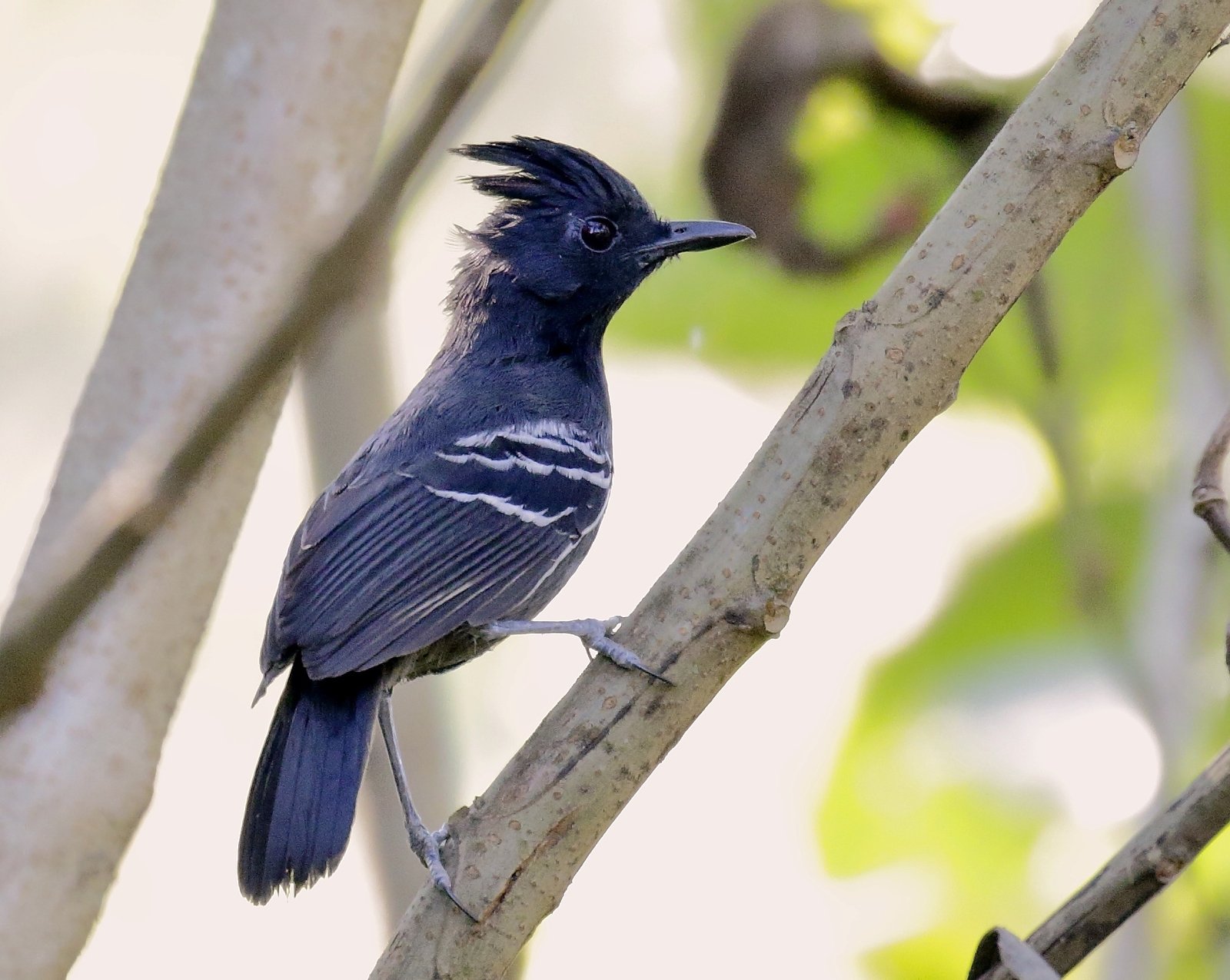
The White-lined Antbird is a crested antbird of south-western Amazonia that lives mainly in dense Guadua bamboo. It was long placed in the genus Percnostola; genetic study showed that it belongs to Myrmoborus. Both sexes have a prominent crest.
Voice
The song is a descending, accelerating series of hollow whistles, with a distinct pause after the first note. The call is a hollow, musical chew, often followed by a growled reeh.
Recording: Jacob Wijpkema — CC BY-NC-SA 4.0 · xeno-canto
Identification
14.5 cm, with a crest. The male is mostly blackish grey, darkest on head and breast, with a white patch between the scapulars, narrow white edges to the outer primaries and white tips to the wing coverts. The female has a cinnamon-rufous crown and crest, reddish yellow-brown upperparts, a greyish face and a white throat and underparts with a grey breast and cinnamon-olive flanks.
Confusion species
Goeldi's Antbird Akletos goeldii shares the bamboo but is larger and has no crest; the male is uniformly black and the female rufous-brown with a grey forecrown. Manu Antbird Cercomacra manu also lives in bamboo but is slimmer, longer-tailed and lacks a crest. Black-faced Antbird Myrmoborus myotherinus is smaller, uncrested, and has a black mask.
Habitat
Floor and understorey of várzea and transitional forest along rivers, mainly in dense Guadua bamboo, also in dense stands of Heliconia and Costus. Mostly below 750 m, locally to about 1350 m. It forages in pairs low in the vegetation for insects.
Where the bird is most at home, classified by the vegetation units of the Andes and the west coast.


Range and movements
Peru: in the south-east, from Ucayali south to Puno, including Madre de Dios and Cusco. Bolivia: in the north-west, in Pando and northern La Paz. Absent from Colombia, Ecuador and the Galápagos. Outside the guide area in far western Acre in Brazil.
- Resident
- dark = core range, pale = thinly spread
How and when to look
Search bamboo stands along rivers in Madre de Dios, for example near Tambopata or around Manu, and listen for the hollow, accelerating song.
Conservation status
Least Concern. Locally common in suitable bamboo; most of its range lies in little-disturbed forest.
Scientific name
Myrmoborus lophotes | (Hellmayr & Seilern-Aspang, 1914) (GBIF: Percnostola lophotes)
Hellmayr & Seilern-Aspang described the species in 1914 as Percnostola lophotes; because it was later moved to another genus, the author and year stand in brackets. The genus Myrmoborus was introduced in 1860 by Cabanis & Heine. The genus name combines Greek murmos, 'ant', and -boros, 'devouring': ant-devourer. The species name comes from Greek lophōtēs, 'crested', for the male's crest. The specimen the first description was based on came from Río San Gabán, Puno, Peru.