All species › Passerines › Antbirds › Southern Chestnut-tailed Antbird
Southern Chestnut-tailed Antbird | Sciaphylax hemimelaena
Zuidelijke kastanjestaartmiervogel | Hormiguero colicastaño sureño | Formigueiro-de-cauda-castanha
The Southern Chestnut-tailed Antbird is a small antbird of the understorey of Amazonian forest south of the Amazon and the Marañón. It lives close to the ground, often in bamboo and at treefalls, and usually gives itself away by its clear, whistled song. It was long treated as one species together with Northern Chestnut-tailed Antbird.
Voice
The song is a rapid series of clear whistles that changes in pitch and tempo and often ends with a lower or harsh note. Calls are short, modulated chirr notes and a dry chak or pit, often in short series.
Recording: JAYRSON ARAUJO DE OLIVEIRA — CC BY-NC-SA 4.0 · xeno-canto
Identification
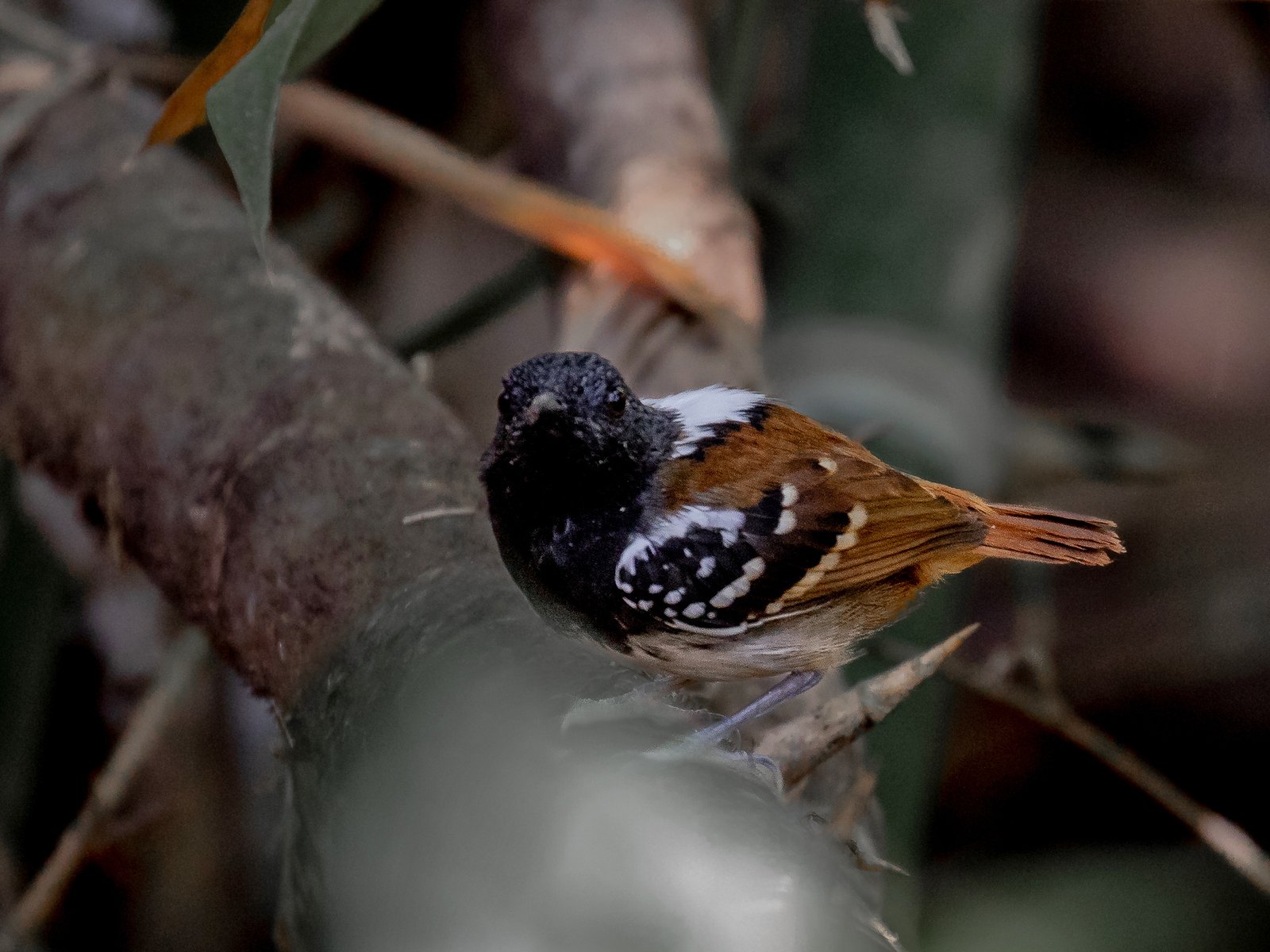
12 cm, with a fairly short tail. The male has a grey head, a black throat and centre of the breast, grey breast sides and a white belly; the back, rump, flanks and tail are chestnut. The wings are dark with rows of white spots on the coverts, and there is a hidden white patch between the scapulars. The female has a brownish-grey head, an orange-brown to ochre throat and breast and a white belly.
Confusion species
Northern Chestnut-tailed Antbird Sciaphylax castanea lives north of the Amazon and the Marañón; the ranges do not meet, and song and plumage differ in detail. Black-throated Antbird Myrmophylax atrothorax lives in dense shrubbery at forest edges and swampy spots; the male is uniformly dark below and lacks the chestnut tail. Black-faced Antbird Myrmoborus myotherinus has a black mask and a grey back, without chestnut tones.
Habitat
The understorey of humid terra firme forest in the lowlands and foothills, often in bamboo, at treefalls and in dense patches of regrowth, also in old secondary forest, mostly below 1350 m. It moves between the forest interior and gaps. It forages in pairs for insects on and just above the ground. The nest is a cup low in dense vegetation.
Where the bird is most at home, classified by the vegetation units of the Andes and the west coast.


Range and movements
Peru: in the Amazonian lowlands and foothills south of the Amazon and the Marañón, mainly in the south-east. Bolivia: in the north, in Pando, La Paz, western Beni, Cochabamba and Santa Cruz. Absent from Colombia, Ecuador and the Galápagos. Outside the guide area in south-western and central Amazonian Brazil.
- Resident
- dark = core range, pale = thinly spread
How and when to look
In terra firme forest and bamboo in south-eastern Peru and northern Bolivia, listen for the clear whistled series close to the ground; the bird often shows on a low branch at the edge of a gap.
Conservation status
Least Concern. Fairly common throughout its range; deforestation reduces the population locally.
Scientific name
Sciaphylax hemimelaena | (Sclater, 1857) (GBIF: Myrmeciza hemimelaena)
Sclater described the species in 1857 as Myrmeciza hemimelaena; because it was later moved to another genus, the author and year stand in brackets. The genus Sciaphylax was introduced in 2013 by Bravo, Isler & Brumfield. The genus name comes from Greek skia, 'shadow', and phulax, 'watcher'. The species name comes from Greek hēmi-, 'half', and melas, 'black'. The specimen the first description was based on came from Mapiri, La Paz, Bolivia.