All species › Passerines › Antbirds › Northern Chestnut-tailed Antbird
Northern Chestnut-tailed Antbird | Sciaphylax castanea
Noordelijke kastanjestaartmiervogel | Hormiguero colicastaño norteño | Formigueiro-de-cauda-castanha-do-norte
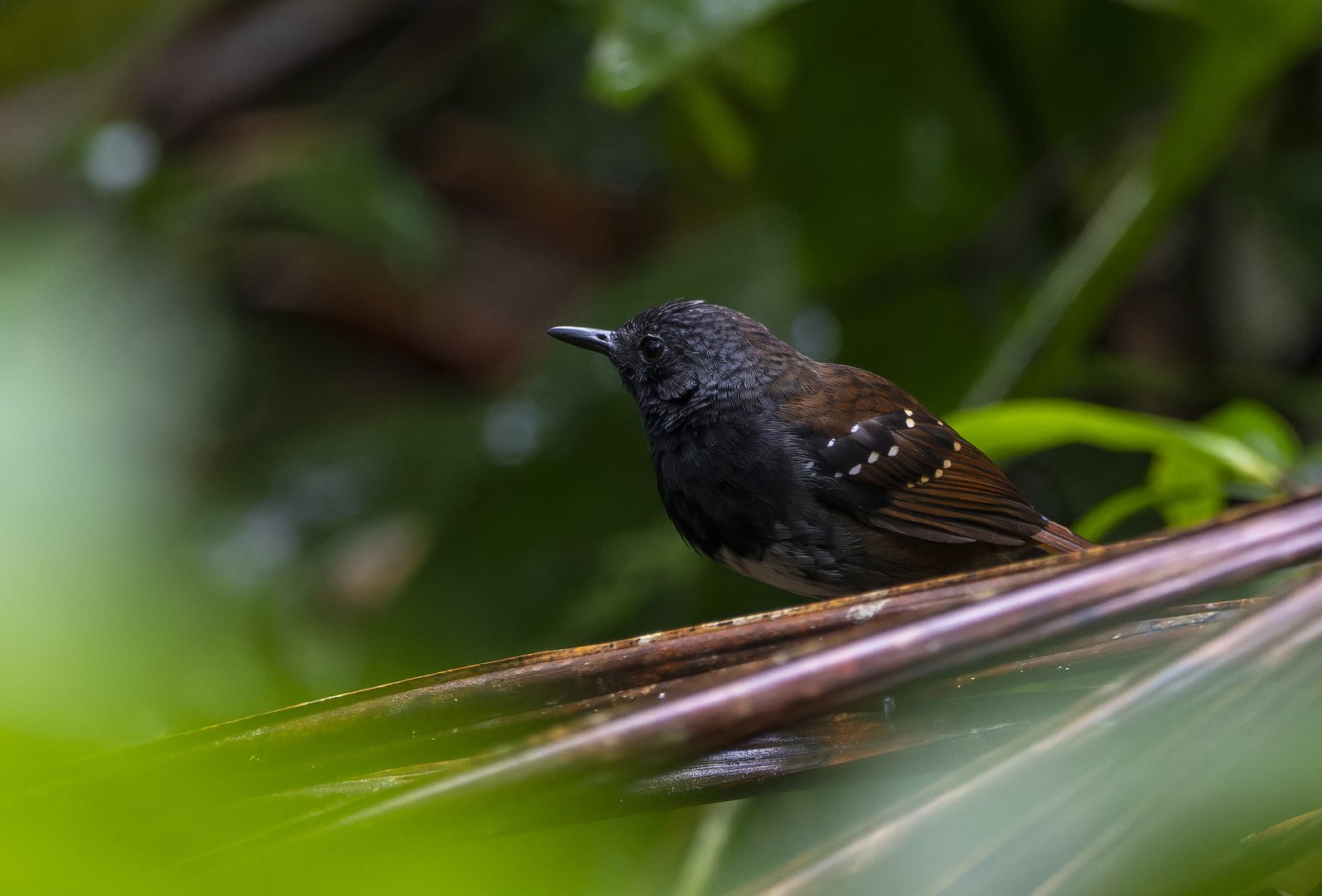
The Northern Chestnut-tailed Antbird is the northern counterpart of Southern Chestnut-tailed Antbird, north of the Amazon and the Marañón. It lives almost exclusively in low, somewhat stunted forest on nutrient-poor sandy soils in the lowlands and foothills. The two were long treated as one species and differ mainly in plumage and song.
Voice
The song is a loud, rising series of whistles that slows and speeds up again, the last one or two notes sometimes lower. Calls are a quiet, descending, throaty rattle and a dry tchit, often in short series.
Recording: GABRIEL LEITE — CC BY-NC-SA 4.0 · xeno-canto
Identification
11–12 cm. The male has a mostly grey head with dark feather centres, a brownish-grey hindcrown and nape, and chestnut upperparts, flight feathers and tail. The throat, upper breast and sides of the belly are black, the centre of the belly white; the dark wing coverts have pale tips and there is a white patch between the scapulars. The female is paler above and mostly orange-brown below, with a white belly.
Confusion species
Southern Chestnut-tailed Antbird Sciaphylax hemimelaena lives south of the Amazon and the Marañón; the ranges do not meet. Black-throated Antbird Myrmophylax atrothorax lives in dense shrubbery at forest edges and swampy spots; the male is uniformly dark below and lacks the chestnut tail. Black-faced Antbird Myrmoborus myotherinus has a black mask and a grey back, without chestnut tones.
Habitat
The understorey and floor of terra firme forest, almost exclusively in low, somewhat stunted forest on nutrient-poor sandy soils. In Colombia between about 125 and 1000 m, in Ecuador mostly below 350 m but locally to 1450 m, in Peru to 1350 m. It forages in pairs for insects on and just above the ground. The nest is a cup low in dense vegetation.
Where the bird is most at home, classified by the vegetation units of the Andes and the west coast.


Range and movements
Colombia: only in the far south, in Putumayo. Ecuador: very locally in the east, south to Zamora-Chinchipe in the south-east. Peru: in the north, in Loreto north of the Amazon and the Marañón and in San Martín. Absent from Bolivia and the Galápagos. Does not occur outside the guide area.
- Resident
- dark = core range, pale = thinly spread
How and when to look
Search low forest on white sand in the eastern lowlands of Ecuador and northern Peru, or in the foothills of Zamora-Chinchipe and San Martín. Listen for the rising whistled series close to the ground.
Conservation status
Least Concern. The species is tied to a specific forest type and therefore local, but occurs largely in little-disturbed areas.
Scientific name
Sciaphylax castanea | (Zimmer, 1932)
Zimmer described the species in 1932 as Myrmeciza hemimelaena castanea; because it was later moved to another genus, the author and year stand in brackets. The genus Sciaphylax was introduced in 2013 by Bravo, Isler & Brumfield. The genus name comes from Greek skia, 'shadow', and phulax, 'watcher'. The species name comes from Latin castaneus, 'chestnut-coloured'. The specimen the first description was based on came from Rio Negro, west of Moyobamba, San Martín, Peru.