All species › Passerines › Antthrushes › Black-faced Antthrush
Black-faced Antthrush | Formicarius analis
Zwartkeelmierlijster | Hormiguero cholino cara negra | Pinto-do-mato-de-cara-preta
The Black-faced Antthrush is the most widespread lowland antthrush, a dumpy, rail-like ground bird that walks through the forest with its tail cocked. It occurs in terra firme forest, floodplain forest and older secondary forest. Its song, a long whistle followed by a few shorter notes, is one of the best-known sounds of the forest floor.
Voice
A clear, slightly drawn-out whistle followed by two to four (sometimes more) shorter, lower notes, tyooo, tyu-tyu-tyu, repeated at intervals. The bird responds to a whistled imitation. The call is a short, sharp chuk.
Recording: Juan Freile — CC BY-NC-SA 4.0 · xeno-canto
Identification
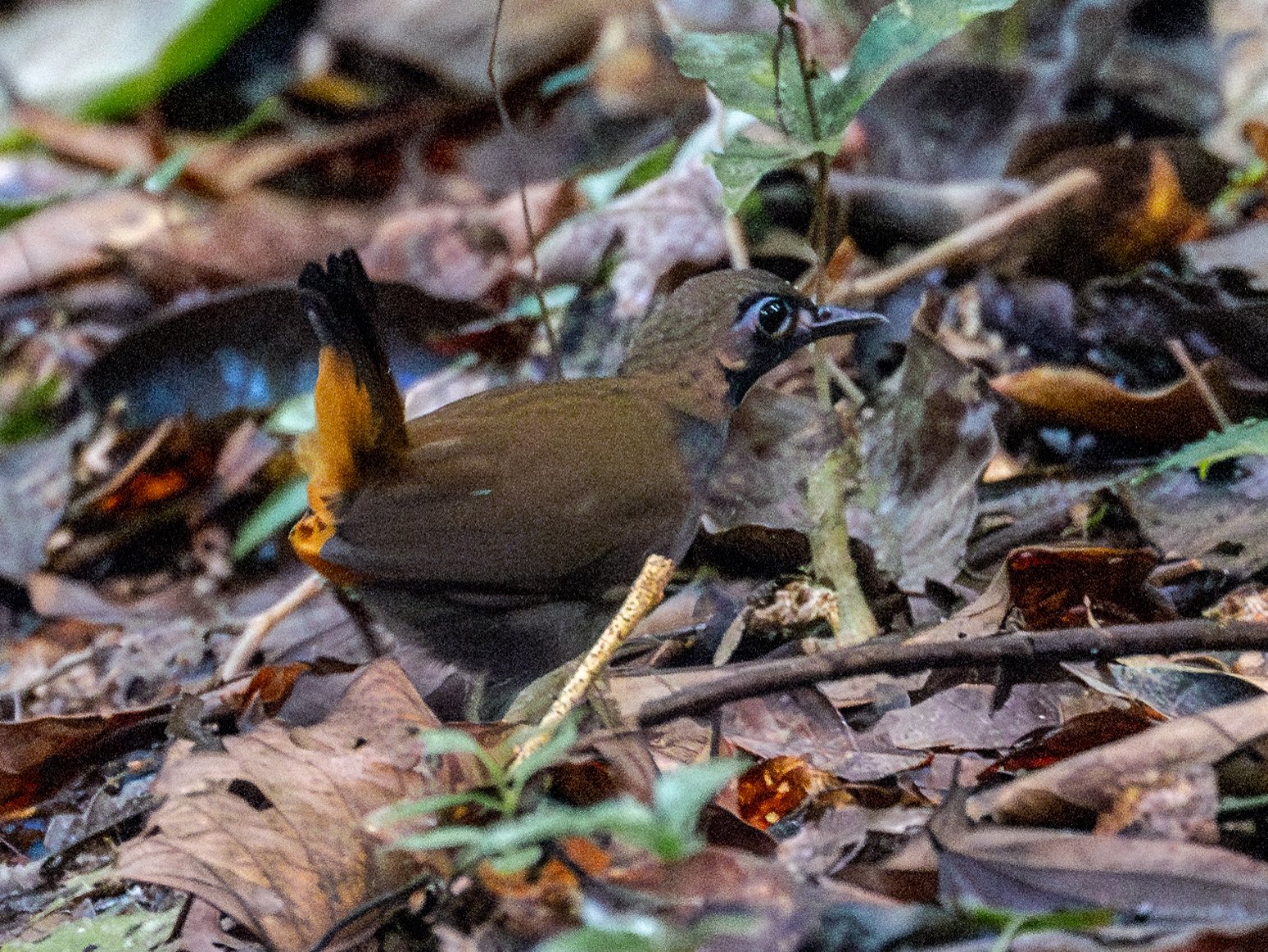
17–19 cm, rotund, with a short, often cocked tail and long legs. Upperparts olive-brown to reddish brown, the tail darker. Face and throat black, with a pale, bluish-white eye-ring; behind the eye and on the side of the neck a rufous to cinnamon patch. Breast and belly grey, the undertail coverts rufous. The sexes are nearly alike. Juveniles are duller, with a paler, mottled throat.
Confusion species
Rufous-capped Antthrush Formicarius colma has a wholly rufous crown and no rufous neck patch. Rufous-fronted Antthrush Formicarius rufifrons of southeastern Peru has a rufous forehead and a greyer, less black face. Black-headed Antthrush Formicarius nigricapillus west of the Andes has the head and breast wholly black. Striated Antthrush Chamaeza nobilis is larger, with streaked underparts.
Habitat
The floor of humid lowland forest, both terra firme and floodplain forest, also older secondary forest and edges with dense undergrowth, up to about 1100 m. It eats insects and other arthropods, occasionally small vertebrates, searched for while walking among the leaves; regularly attends army-ant swarms. The nest is in a cavity in a stump or tree, usually low.
Where the bird is most at home, classified by the vegetation units of the Andes and the west coast.


Range and movements
Colombia: in the lowlands east of the Andes and in the north, in the Caribbean lowlands and the Magdalena valley. Ecuador: in the east. Peru: in the Amazon basin. Bolivia: in the lowlands of the north and centre. Absent from the Galápagos. Outside the guide area from Central America to Venezuela, Trinidad, the Guianas and Amazonian Brazil.
- Resident
- dark = core range, pale = thinly spread
How and when to look
Whistle the song back to a singing bird: it often walks closer and crosses a trail. Watch low along the edge of dense undergrowth.
Conservation status
Least Concern. The species is widespread and tolerates some disturbance of the forest, but disappears where the forest is cleared completely.
Scientific name
Formicarius analis | (d'Orbigny, ACVMD & de Lafresnaye, 1837)
D'Orbigny, ACVMD & de Lafresnaye described the species in 1837 as Myothera analis; because it was later moved to another genus, the author and year stand in brackets. The genus Formicarius was introduced in 1783 by Boddaert. The genus name comes from Latin formicarius, 'of the ants', from formica, 'ant'. The species name comes from Latin analis, 'of the vent', after the rufous undertail coverts. The specimen the first description was based on came from Yuracarés and Chiquitos, Bolivia.