All species › Passerines › Antthrushes › Rufous-capped Antthrush
Rufous-capped Antthrush | Formicarius colma
Roodkapmierlijster | Formicario gorrirrufo | Galinha-do-mato
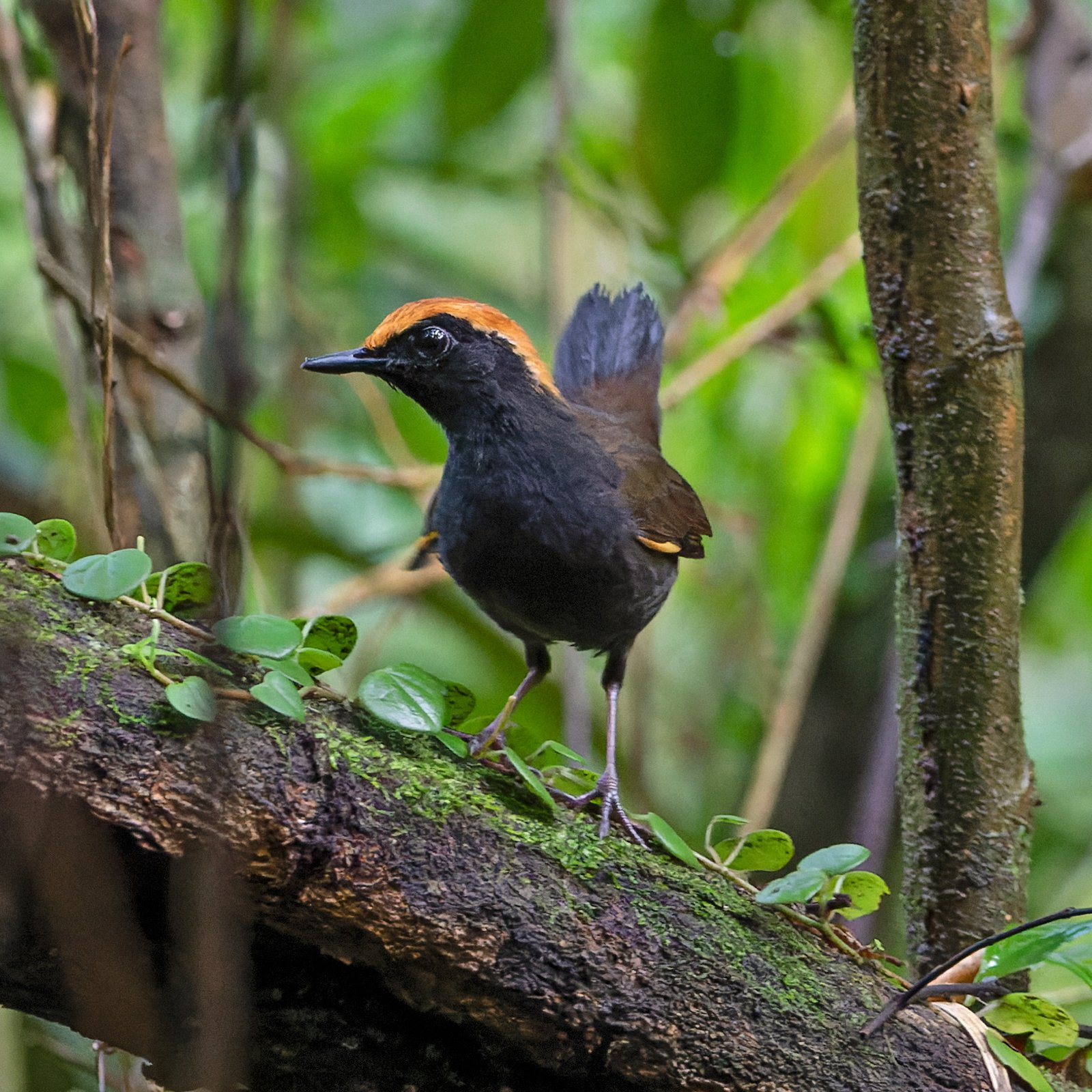
The Rufous-capped Antthrush is a dumpy ground bird of Amazonian forest that walks over the forest floor like a small rail, with its short tail cocked. Of the lowland antthrushes it is the only one with a wholly rufous crown. It lives alone or in pairs and usually first reveals itself by its song.
Voice
A long series of short, hollow whistles, introduced by a slightly longer note; the series accelerates and gradually rises in pitch. The call is a sharp chip.
Recording: Mateus Gonçalves Santos — CC BY-NC-SA 4.0 · xeno-canto
Identification
18 cm, rotund, with a short tail, long legs and a straight black bill. Crown and nape bright rufous, the rest of the upperparts olive-brown. In the male the face, throat and breast are black; in the female the throat is whitish with black flecks. Belly and flanks dark slate-grey. In the form nigrifrons of the western Amazon the forehead is black. Juveniles are duller, with a speckled throat.
Confusion species
Black-faced Antthrush Formicarius analis has an olive-brown crown, a rufous patch on the side of the neck and rufous undertail coverts. Rufous-fronted Antthrush Formicarius rufifrons has only the forehead rufous and a grey face. Striated Antthrush Chamaeza nobilis is larger, with white underparts heavily streaked dark.
Habitat
The floor of humid terra firme rainforest, less in floodplain forest, from the lowlands into the foothills, up to about 1000 m. It walks slowly over the ground, flipping leaves and taking insects and other arthropods; sometimes attends army-ant swarms. The nest is in a cavity in a stump or tree, low above the ground.
Where the bird is most at home, classified by the vegetation units of the Andes and the west coast.


Range and movements
Colombia: in the lowlands east of the Andes. Ecuador: in the east. Peru: in the Amazon basin. Bolivia: in the north. Absent from the Galápagos. Outside the guide area in Venezuela, the Guianas and Amazonian Brazil, and separately in the Atlantic Forest of eastern Brazil.
- Resident
- dark = core range, pale = thinly spread
How and when to look
Listen in terra firme forest in the early morning for the long, rising series. A bird often walks close to a trail; stand still and scan low over the forest floor.
Conservation status
Least Concern. The species is widespread, but disappears where forest is cleared or heavily fragmented.
Scientific name
Formicarius colma | Boddaert, 1783
Boddaert described the species in 1783 and placed it straight away in the genus where it still stands. He introduced the genus Formicarius in that same work. The genus name comes from Latin formicarius, 'of the ants', from formica, 'ant'. The species name goes back to Buffon's name 'Colma', most likely a contraction of French collier, 'necklace', and marque, 'mark'. The specimen the first description was based on came from Cayenne, French Guiana.