All species › Passerines › Antthrushes › Barred Antthrush
Barred Antthrush | Chamaeza mollissima
Gebandeerde mierlijster | Chamaeza barreteada | Tovaca-barrada
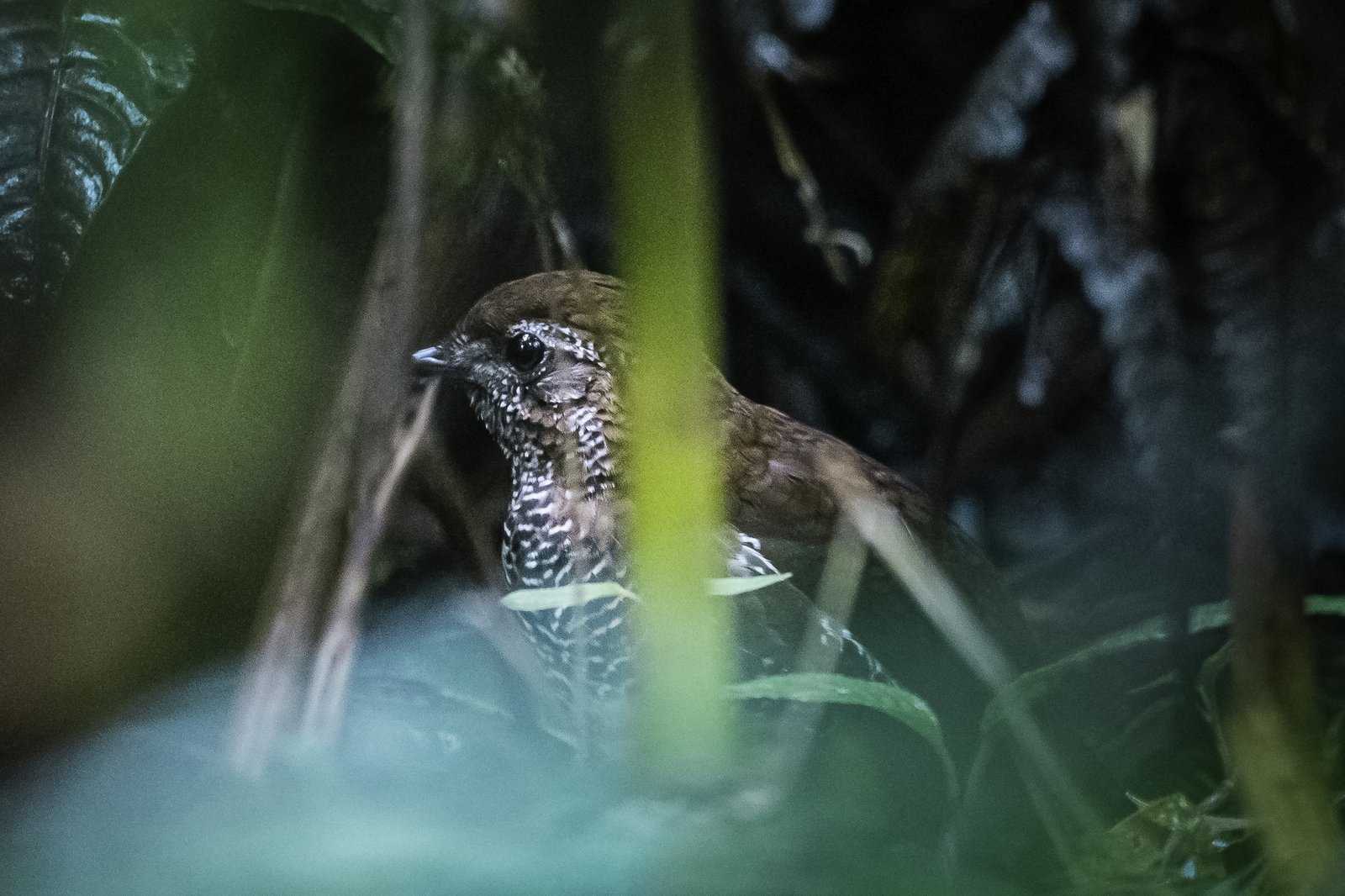
The Barred Antthrush is a dark, densely barred ground bird of high cloud forest in the Andes. It lives hidden on the floor of steep, mossy slopes, often among bamboo. Of the Chamaeza species it lives highest in the mountains.
Voice
A long, fast series of short, hollow notes, coo-coo-coo, gradually rising in pitch and getting louder, often lasting half a minute or more. Sings mainly at dawn and dusk.
Recording: Sergio Adrian Garcia-Murcia — CC BY-NC-SA 4.0 · xeno-canto
Identification
19–20 cm, with a short tail. The upperparts are dark brown. The head, throat and underparts are densely and evenly barred with blackish and buff bars. The white eye stripe of the other Chamaeza species is lacking. The sexes are alike.
Confusion species
Short-tailed Antthrush Chamaeza campanisona and Schwartz's Antthrush Chamaeza turdina are streaked rather than barred below and have a white eye stripe; they usually live lower. Undulated Antpitta Grallaria squamigera is also barred below, but is much larger, with a grey crown and back, stands upright and has almost no tail. Rufous-breasted Antthrush Formicarius rufipectus has a plain rufous breast.
Habitat
The floor of wet cloud forest and upper montane forest, often with dense Chusquea bamboo, roughly between 1800 and 3000 m. It eats insects and other invertebrates from the leaf litter and moss. Little is known about the nest.
Where the bird is most at home, classified by the vegetation units of the Andes and the west coast.


Range and movements
Colombia: mainly in the Central Andes, from Antioquia to Cauca and Nariño, and around the upper Magdalena valley in Huila. Ecuador: along the eastern slope of the Andes, from Sucumbíos to Zamora-Chinchipe. Peru: locally along the eastern slope, from Amazonas and Cajamarca to Cusco and Puno. Bolivia: on the eastern slope in La Paz, Cochabamba and western Santa Cruz. Absent from the Galápagos. Does not occur outside the guide area.
- Resident
- dark = core range, pale = thinly spread
How and when to look
At dawn in wet cloud forest with bamboo, listen for the long, rising series of notes. A singing bird often sits on a fallen log or a low branch; approach slowly and stand patiently.
Conservation status
Least Concern. The species is scarce and local everywhere, but the high cloud forest of the eastern slope is still largely intact in many places.
Scientific name
Chamaeza mollissima | Sclater, 1855
Sclater described the species in 1855 and placed it straight away in the genus where it still stands. The genus Chamaeza was introduced in 1825 by Vigors. The genus name comes from Greek chamai, 'on the ground', and zaō, 'to live', after the ground-dwelling habits. The species name is Latin mollissimus, superlative of mollis, 'soft', after the soft plumage. The specimen the first description was based on came from Bogotá, Colombia.