All species › Passerines › Antthrushes › Schwartz's Antthrush
Schwartz's Antthrush | Chamaeza turdina
Schwartz' mierlijster | Chamaeza de Schwartz | Tovaca-de-schwartz
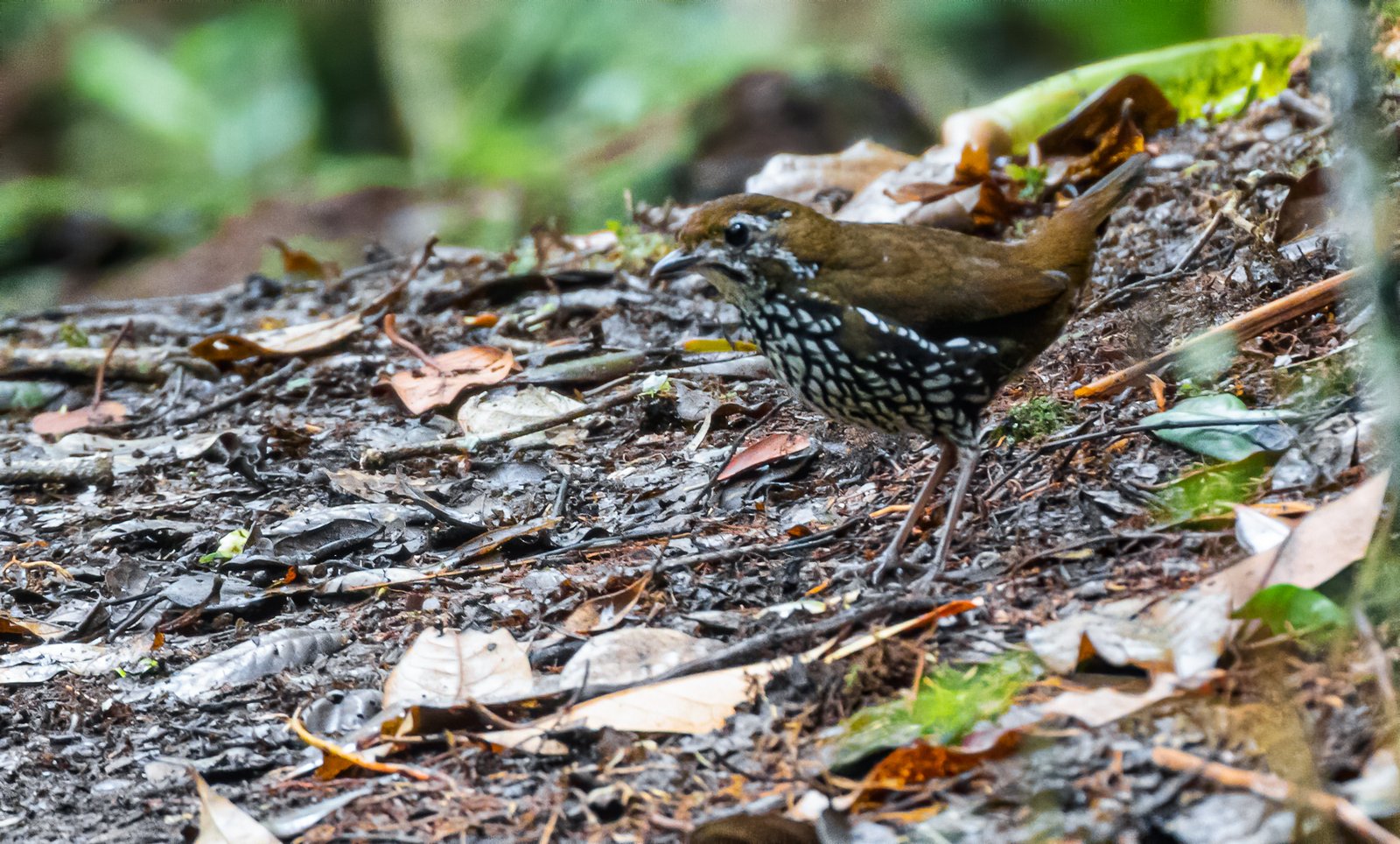
Schwartz's Antthrush is a brown, streaked ground bird of cloud forest in the Andes of Colombia and in the mountains of Venezuela. It was long included in Rufous-tailed Antthrush of southeastern Brazil, but differs from it in song. Its song is a very long, even series of notes that can last up to a minute.
Voice
A very long, even series of short, hollow notes, coo-coo-coo-coo, slowly rising in pitch and lasting up to a minute. Sings mainly at dawn and dusk, from the ground or a low branch.
Recording: David Monroy Rengifo — CC BY-NC-SA 4.0 · xeno-canto
Identification
19–21 cm, with a fairly long tail for an antthrush. The upperparts are warm dark brown, the tail slightly more rufous. A narrow white stripe runs behind the eye. The throat is white; the rest of the underparts is white with dark brown, scale-like streaks that merge into a brown wash on the flanks. The tail has no black band and no pale tip. The sexes are alike.
Confusion species
Short-tailed Antthrush Chamaeza campanisona has a shorter tail with a blackish band and pale tip and buffier underparts; it lives lower on the eastern slope. Barred Antthrush Chamaeza mollissima is densely barred below and usually lives higher. Rufous-tailed Antthrush Chamaeza ruficauda of southeastern Brazil is very similar, but almost certainly does not occur in the guide area.
Habitat
The floor of humid montane forest and cloud forest, roughly between 1300 and 2500 m, often in ravines and on steep slopes with dense undergrowth. It eats insects and other invertebrates from the leaf litter. Little is known about the nest; related species nest in tree cavities.
Where the bird is most at home, classified by the vegetation units of the Andes and the west coast.


Range and movements
In the guide area only in Colombia: in the Central Andes, from Antioquia to Risaralda and Valle del Cauca, and in the Eastern Andes, from Santander and Boyacá to Cundinamarca and the upper Magdalena valley in Huila. Absent from Ecuador, Peru, Bolivia and the Galápagos. Outside the guide area in the coastal mountains and Andes of Venezuela.
- Resident
- dark = core range, pale = thinly spread
How and when to look
At dusk in cloud forest in Huila, Cundinamarca or Risaralda, listen for the long, sustained series of notes. The bird walks across the forest floor with its tail slightly cocked and freezes when disturbed; wait quietly beside a forest trail.
Conservation status
Least Concern. The range is limited and much of the montane forest of the Colombian Andes has been cleared, but the species still occurs regularly in places in the remaining forests.
Scientific name
Chamaeza turdina | Cabanis & Heine, 1860
Cabanis & Heine described the species in 1860 and placed it straight away in the genus where it still stands. The genus Chamaeza was introduced in 1825 by Vigors. The genus name comes from Greek chamai, 'on the ground', and zaō, 'to live', after the ground-dwelling habits. The species name comes from Latin turdus, 'thrush', with -inus, 'resembling': 'thrush-like'. The English name honours Paul A. Schwartz, who first noticed its distinct song. The specimen the first description was based on came from Bogotá, Colombia.