All species › Passerines › Antthrushes › Striated Antthrush
Striated Antthrush | Chamaeza nobilis
Gestreepte mierlijster | Chamaeza noble | Tovaca-estriada
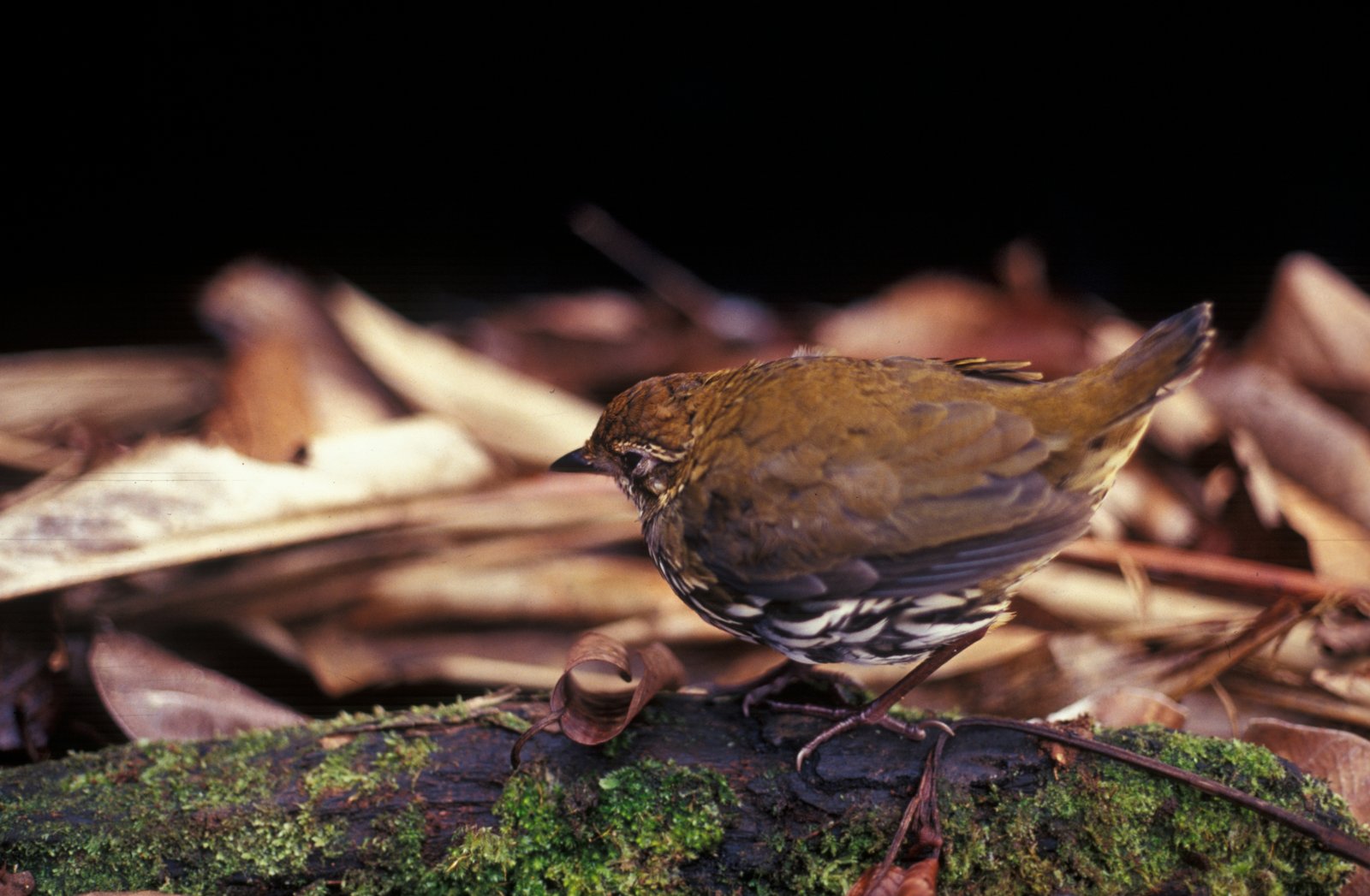
The Striated Antthrush is the largest Chamaeza and the only one that lives in the Amazonian lowlands. It walks with a cocked tail across the floor of tall rainforest, usually staying hidden in the undergrowth. The species is heard far more often than seen.
Voice
A long series of low, hollow notes, hoo-hoo-hoo, slowly rising in pitch and speed and ending abruptly, sometimes with a few lower notes. Lower and fuller than the song of Short-tailed Antthrush. Sings mainly in the early morning and at dusk.
Recording: John V. Moore — CC BY-NC-SA 4.0 · xeno-canto
Identification
22–23 cm, stocky, with a straight bill, long legs and a short tail. The upperparts are dark rufous-brown to olive-brown. A white stripe runs behind the eye, and a white malar stripe frames the dark cheek. The underparts are white, with coarse blackish, scale-like streaks on the breast and flanks and a buff wash on the flanks and undertail coverts. The tail has a blackish band before the pale tip. The sexes are alike.
Confusion species
Short-tailed Antthrush Chamaeza campanisona is smaller and buffier below, with finer streaks, and lives higher, in foothill and montane forest. Thrush-like Antpitta Myrmothera campanisona is smaller, stands upright, has almost no tail and only faint streaks. Black-faced Antthrush Formicarius analis and Rufous-capped Antthrush Formicarius colma have unstreaked, grey to dark underparts.
Habitat
The floor of tall, humid terra firme rainforest in the lowlands and foothills, up to about 900 m. It eats insects and other invertebrates from the leaf litter. Little is known about the nest; related species nest in tree cavities.
Where the bird is most at home, classified by the vegetation units of the Andes and the west coast.


Range and movements
Colombia: in the southeastern Amazon basin, from Meta and Guaviare to Vaupés, Caquetá, Putumayo and Amazonas. Ecuador: in the eastern lowlands. Peru: in the Amazonian lowlands, mainly in the north (Loreto) and the southeast (Madre de Dios). Bolivia: only in the far north (Pando), with very few records. Absent from the Galápagos. Outside the guide area in western Brazil.
- Resident
- dark = core range, pale = thinly spread
How and when to look
In the early morning in tall terra firme forest, listen for the low, rolling series. A singing bird often sits on a fallen log or a low branch and stays in one place for a long time; approach slowly and then stand still.
Conservation status
Least Concern. The range is large, but the species depends on undisturbed tall forest and disappears where it is logged.
Scientific name
Chamaeza nobilis | Gould, 1855
Gould described the species in 1855 and placed it straight away in the genus where it still stands. The genus Chamaeza was introduced in 1825 by Vigors. The genus name comes from Greek chamai, 'on the ground', and zaō, 'to live', after the ground-dwelling habits. The species name comes from Latin nobilis, 'noble, distinguished'. The specimen the first description was based on came from Chamicuros, Loreto, Peru.