All species › Passerines › Antthrushes › Short-tailed Antthrush
Short-tailed Antthrush | Chamaeza campanisona
Kortstaartmierlijster | Chamaeza colicorta | Tovaca-campainha
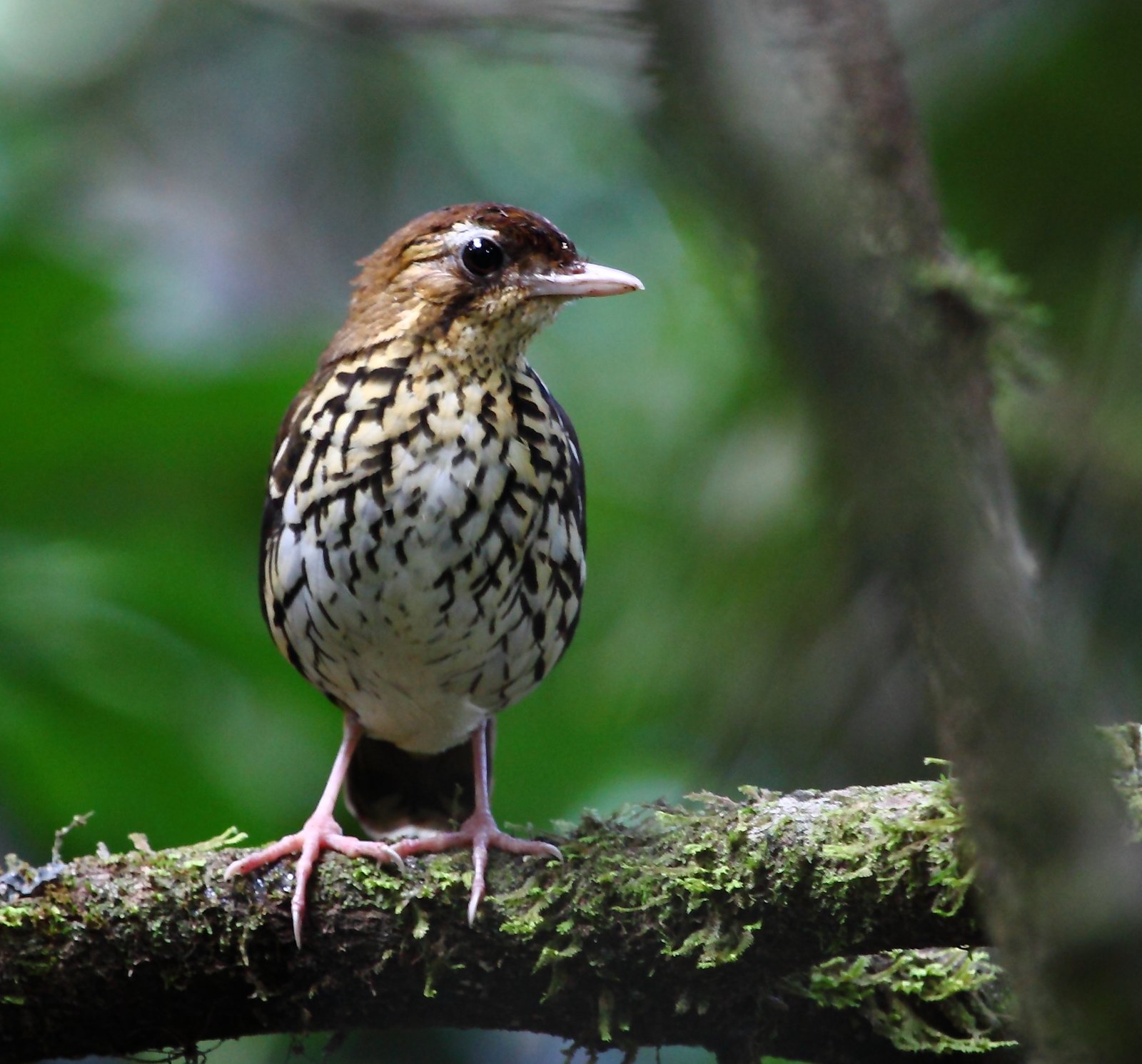
The Short-tailed Antthrush is a thrush-like ground bird of humid forest on the eastern slope of the Andes. It walks with measured steps across the forest floor, its short tail cocked and bobbing rhythmically. Its long, swelling song is a characteristic sound of dawn and dusk in the lower montane forest.
Voice
A long series of short, hollow whistles, coo-coo-coo, gradually becoming louder and faster and ending in a few lower, clucking notes. Sings mainly at dawn and dusk, from the ground or a low branch.
Recording: Mateus Gonçalves Santos — CC BY-NC-SA 4.0 · xeno-canto
Identification
19–20 cm, with a round head, a straight, fairly short bill, sturdy legs and a short tail. The upperparts are olive-brown. A narrow whitish stripe runs behind the eye, and a pale malar stripe separates the brown cheek from the whitish throat. The underparts are pale buff to whitish, with dark brown, teardrop-shaped streaks on the breast and flanks. The tail has a blackish band before the pale ochre tip. The sexes are alike; juveniles are more faintly marked.
Confusion species
Striated Antthrush Chamaeza nobilis is larger and whiter below, with coarser black streaks, and lives in the Amazonian lowlands. Barred Antthrush Chamaeza mollissima is densely barred rather than streaked below and lives higher. Schwartz's Antthrush Chamaeza turdina in Colombia lives higher and has a longer tail without a black band and pale tip. Rufous-breasted Antthrush Formicarius rufipectus has a plain rufous breast without streaks.
Habitat
The floor of humid foothill and lower montane forest with an open understorey, roughly between 800 and 1800 m, locally lower or higher. It eats insects and other invertebrates picked from the leaf litter. It nests in a cavity in a tree trunk or stump.
Where the bird is most at home, classified by the vegetation units of the Andes and the west coast.


Range and movements
Colombia: on the eastern slope of the Eastern Andes, from Arauca and Boyacá south to Putumayo and Nariño. Ecuador: along the entire eastern slope, including the Cordillera del Cóndor. Peru: along the eastern slope from north to south. Bolivia: on the eastern slope and in the Yungas of La Paz, Cochabamba and Santa Cruz. Absent from the Galápagos. Outside the guide area in the mountains of Venezuela and Guyana and in the Atlantic Forest of Brazil, Paraguay and Argentina.
- Resident
- dark = core range, pale = thinly spread
How and when to look
At dawn in foothill forest on the eastern slope, listen for the swelling series of hollow notes. The bird often walks along trails and open patches of forest floor; if you stand still, it sometimes walks calmly past with its tail bobbing.
Conservation status
Least Concern. The range is large; deforestation of the lower slopes causes local declines.
Scientific name
Chamaeza campanisona | (Lichtenstein, 1823)
Lichtenstein described the species in 1823 as Myiothera campanisona; because it was later moved to another genus, the author and year stand in brackets. The genus Chamaeza was introduced in 1825 by Vigors. The genus name comes from Greek chamai, 'on the ground', and zaō, 'to live', after the ground-dwelling habits. The species name comes from Latin campana, 'bell', and sonus, 'sound': 'bell-sounding', after the song. The specimen the first description was based on came from São Paulo, Brazil.