All species › Passerines › Tapaculos › Ocellated Tapaculo
Ocellated Tapaculo | Acropternis orthonyx
Zilverpareltapaculo | Tapaculo ocelado | Macuquinho-ocelado
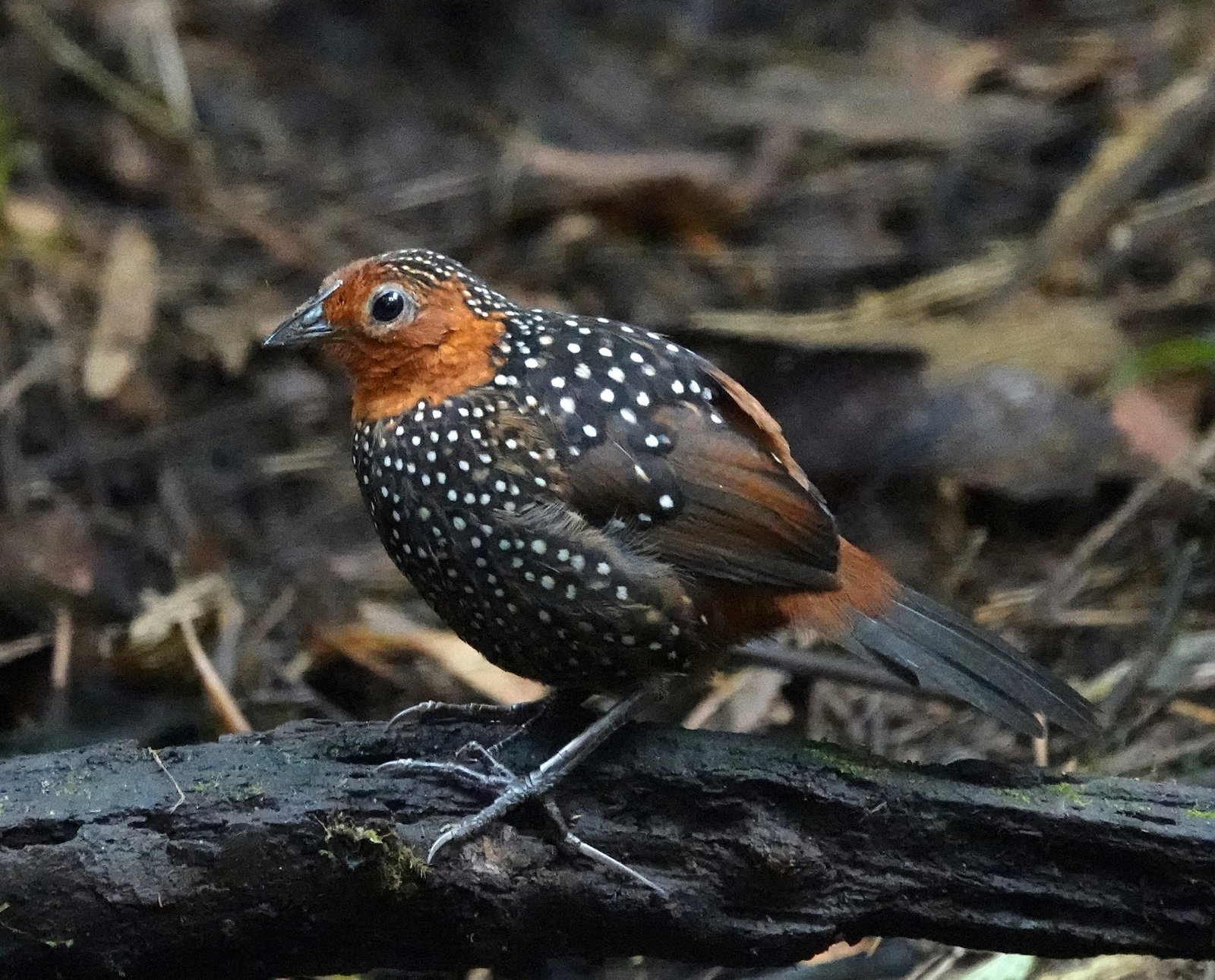
The Ocellated Tapaculo is the largest tapaculo of the northern Andes, with black plumage covered in white, pearl-like spots and a rufous face. It lives in dense bamboo in high montane forest and scratches in the leaf litter with both feet at once, like a towhee or ground finch. Its loud whistle is one of the most frequently heard sounds in its habitat.
Voice
A loud, clear, slightly rising or falling whistle, repeated many times at intervals of a few seconds. It carries far through the forest and is often answered by a second bird.
Recording: Alain Verneau — CC BY-NC-SA 4.0 · xeno-canto
Identification
21–23 cm, bulky and round-bodied, with a medium-length tail and very large feet and claws. The forehead, face and throat are rufous, and the bill is black. The crown, back and underparts are black to greyish black with dense white drop- and pearl-shaped spots, the rump and undertail coverts are rufous. The sexes are alike; young birds are browner with less distinct spots.
Confusion species
The combination of a rufous face and white-spotted black plumage is unique within the family. Undulated Antpitta Grallaria squamigera lives in the same forest, but is larger and tailless-looking, with ochre underparts scalloped black. Barred Antthrush Chamaeza mollissima is brown with fine barring and walks with a slightly cocked tail. Other tapaculos in the same bamboo are much smaller and grey.
Habitat
Dense undergrowth of Chusquea bamboo in humid upper montane forest, cloud forest and elfin forest up to the treeline, roughly between 2300 and 3600 m. It forages on the ground, scratching through moss and leaves with both feet at once for insects, larvae and other invertebrates. Little is known about the nest; it is presumably hidden in a cavity or among bamboo.
Where the bird is most at home, classified by the vegetation units of the Andes and the west coast.


Range and movements
In Colombia in the Eastern and Central Andes and locally in the Western Andes. In Ecuador on both slopes of the Andes. In Peru only in the far north, north and west of the Marañón. Absent from Bolivia and the Galápagos. Outside the guide area in the Andes of Venezuela.
- Resident
- dark = core range, pale = thinly spread
How and when to look
Listen in the early morning in dense bamboo near the treeline for the loud, repeated whistle. The bird sometimes comes to an opening in the bamboo, but usually stays under cover; rustling sounds of scratching feet give it away.
Conservation status
Least Concern. High montane forest is locally cleared and burned for pasture, but the species has a fairly large range and occurs in many protected areas.
Scientific name
Acropternis orthonyx | (de Lafresnaye, 1843)
De Lafresnaye described the species in 1843 as Merulaxis orthonyx; because it was later moved to another genus, the author and year stand in brackets. The genus Acropternis was introduced in 1860 by Cabanis & Heine. The genus name comes from Greek akros, 'ending in a point', and pternē, 'heel'. Cabanis and Heine (1859) chose it for the unusual form of the hind toe. The species name comes from Greek orthos, 'straight', and onux, 'claw', after the long, straight hind claw. The specimen the first description was based on came from Colombia.