All species › Passerines › Tapaculos › Crested Gallito
Crested Gallito | Rhinocrypta lanceolata
Kuifgallito | Gallito copetón | Galito-de-topete
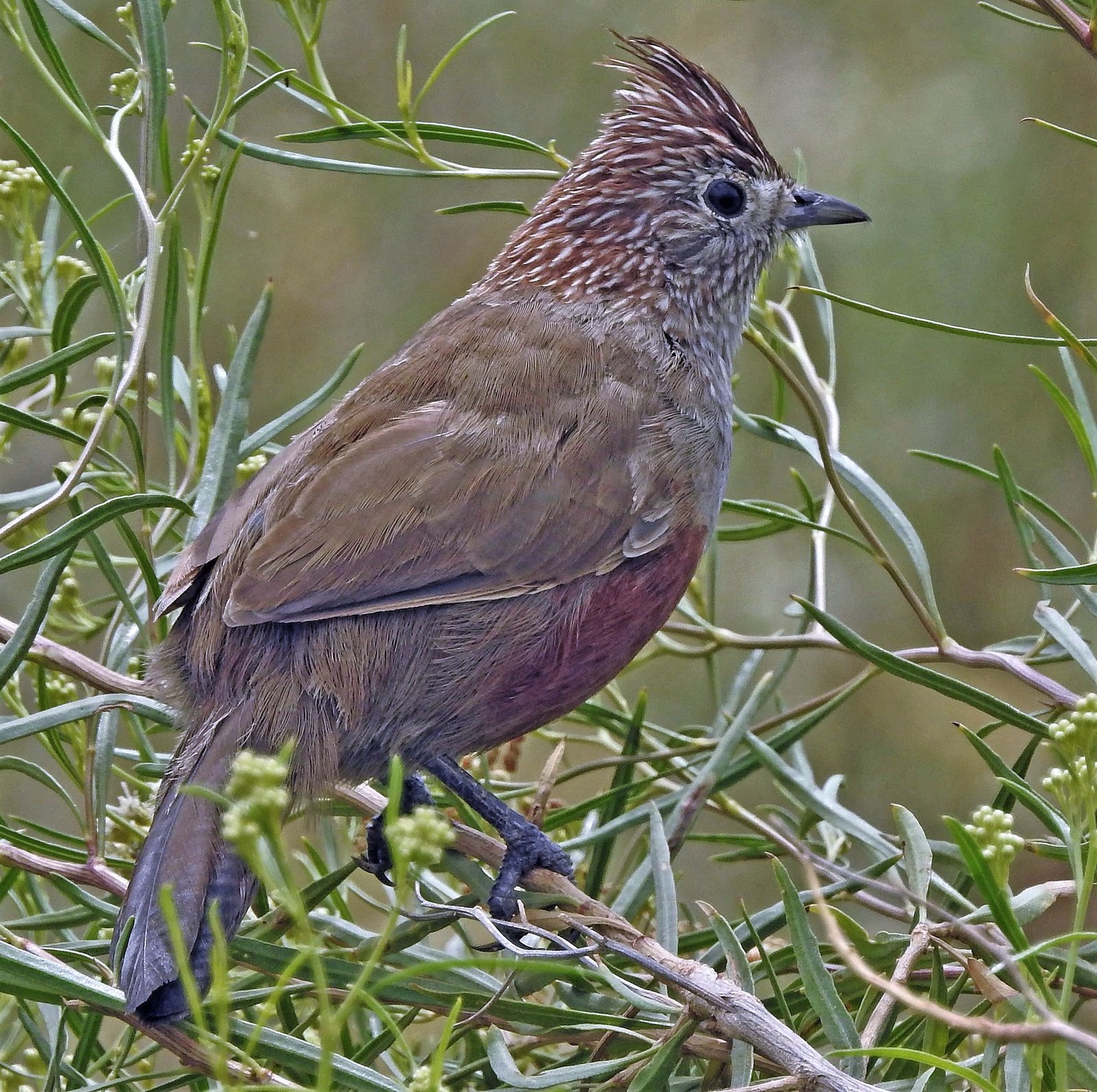
The Crested Gallito is a tapaculo of dry Chaco scrub, with a crest of pale, lance-shaped feathers and a long tail that is often held upright. It runs quickly over the ground between thorn bushes and seldom flies. In the guide area it occurs only in south-eastern Bolivia.
Voice
Loud, harsh and chirping calls and a series of loud, even notes, chok-chok-chok, given from the thicket. Pairs often call together.
Recording: Edgar Romero — CC BY-NC-SA 4.0 · xeno-canto
Identification
21–22 cm, with a long, often cocked tail, strong legs and a short, straight bill. The head and crest are greyish brown with fine white streaks. The back is olive-brown, the tail darker. The throat and breast are greyish white, the flanks bright rufous, the undertail coverts dark. The sexes are alike.
Confusion species
Lark-like Brushrunner Coryphistera alaudina also has a crest and walks on the ground, but is smaller, streaked brown above and below and has a shorter tail. Olive-crowned Crescentchest Melanopareia maximiliani is smaller, with a black collar, rufous underparts and no crest. Brown Cacholote Pseudoseisura lophotes is crested, but larger, uniformly rufous-brown and more arboreal.
Habitat
Dry Chaco woodland and thorn scrub with a dense shrub layer and open patches of bare ground, in the lowlands and low foothills. It runs between the bushes, searching the ground for insects, spiders and seeds. The nest is a domed structure of grass and twigs low in a thorn bush.
Where the bird is most at home, classified by the vegetation units of the Andes and the west coast.

Range and movements
In Bolivia only in the Chaco of the south-east, in the departments of Santa Cruz, Chuquisaca and Tarija. Absent from Colombia, Ecuador, Peru and the Galápagos. Outside the guide area in the Chaco of western Paraguay and in northern and central Argentina.
- Resident
- dark = core range, pale = thinly spread
How and when to look
Walk in the early morning along tracks through Chaco scrub and listen for the harsh calls. The bird often runs across a track or crosses an open patch and sometimes perches briefly on a low branch.
Conservation status
Least Concern. Chaco woodland is being cleared on a large scale for farming and ranching, but the species also occurs in degraded scrub.
Scientific name
Rhinocrypta lanceolata | (Geoffroy Saint-Hilaire, 1832)
Geoffroy Saint-Hilaire described the species in 1832 as Rhinomya lanceolata; because it was later moved to another genus, the author and year stand in brackets. The genus Rhinocrypta was introduced in 1840 by Gray. The genus name comes from Greek rhis (rhinos), 'nostrils', and kruptos, 'hidden', after the nostrils covered by a flap. The species name comes from Latin lanceolatus, 'lanceolate, spear-shaped', after the lance-shaped feathers of crest and neck. The specimen the first description was based on came from Río Negro, Patagonia, Argentina.