All species › Passerines › Tapaculos › Spillmann's Tapaculo
Spillmann's Tapaculo | Scytalopus spillmanni
Spillmanns tapaculo | Churrín de Spillmann | Macuquinho-de-spillmann
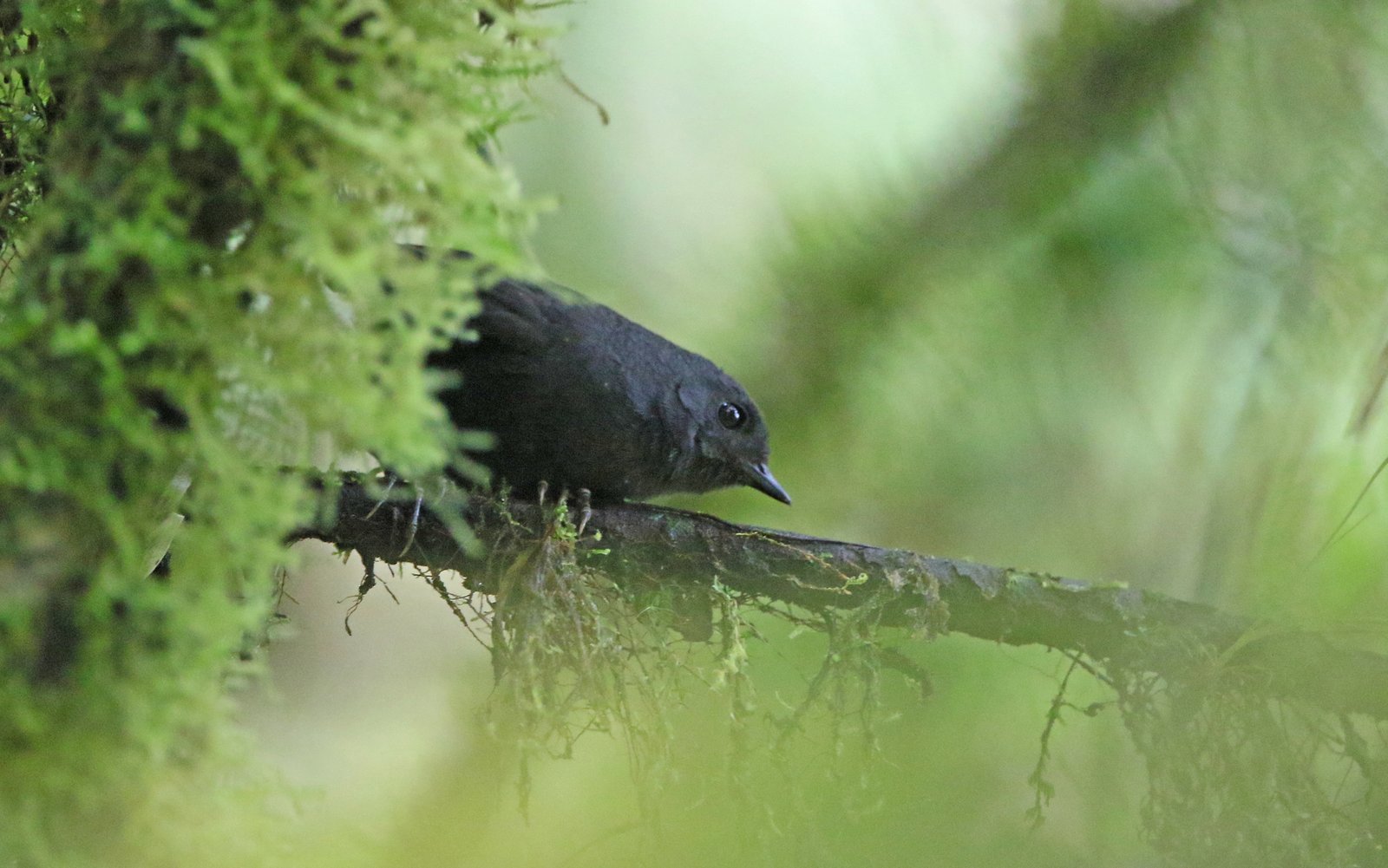
Spillmann's Tapaculo is a dark grey tapaculo of the undergrowth of humid montane forest in Colombia and Ecuador. It was formerly treated as a subspecies of Brown-rumped Tapaculo, but is treated as a separate species on the basis of its song. Together with Chusquea Tapaculo further south it forms a pair of closely related species.
Voice
The song is a trill lasting ten to twenty seconds that increases in volume and sometimes in pitch. Males and females also have various calls.
Recording: Carlos Delgado JUMABITA — CC BY-NC-SA 4.0 · xeno-canto
Identification
12 cm, round, with a short tail and a thin bill. The male is blackish grey above with a dark brown rump and paler grey below, with tawny to cinnamon flanks and undertail. Some females resemble the male; most are heavily washed brown above and have an orange-tinged lower belly. Juveniles are brown above and dusky below, with barring.
Confusion species
Chusquea Tapaculo Scytalopus parkeri, further south, is very similar but has a short, descending song. Paramo Tapaculo Scytalopus opacus lives higher, around the treeline. Blackish Tapaculo Scytalopus latrans is almost entirely blackish and usually lives lower and more at forest edges. Pale-bellied Tapaculo Scytalopus griseicollis in the Eastern Andes of Colombia lives mainly in scrub and is paler below. In tapaculos the song is the main identification feature.
Habitat
Undergrowth of humid montane forest, especially where Chusquea bamboo grows, mostly between 1900 and 3200 m, locally to 3500 m and in western Napo to 3700 m. It forages on and just above the ground for small arthropods. Little is known about its breeding.
Where the bird is most at home, classified by the vegetation units of the Andes and the west coast.


Range and movements
In Colombia in all three Andean ranges. In Ecuador in the Andes south to about Cotopaxi on the western slope and Morona-Santiago on the eastern slope. Absent from Peru, Bolivia and the Galápagos. Does not occur outside the guide area.
- Resident
- dark = core range, pale = thinly spread
How and when to look
In the early morning, listen in the montane forest of Yanacocha or Guango in Ecuador, or Río Blanco near Manizales in Colombia, for the long, swelling trill from bamboo and dense undergrowth. Wait quietly near a gap in the vegetation.
Conservation status
Least Concern. The species has a large range and is locally common.
Scientific name
Scytalopus spillmanni | Stresemann, 1937
Stresemann described the species in 1937 and placed it straight away in the genus where it still stands. The genus Scytalopus was introduced in 1837 by Gould. The genus name combines Greek skutalē or skutalon, 'stick', with pous, 'foot'. The species name spillmanni honours Franz Spillmann (1901–1988), Austrian palaeontologist and zoologist resident in Ecuador and Peru. The specimen the first description was based on came from Iliniza volcano, Ecuador.