All species › Passerines › Tapaculos › Chusquea Tapaculo
Chusquea Tapaculo | Scytalopus parkeri
Parkers tapaculo | Churrín de Chusquea | Macuquinho-de-chusquea
The Chusquea Tapaculo is a grey tapaculo of Chusquea bamboo thickets in the upper montane forest of southern Ecuador and the far north of Peru. It was described in 1997 and its scientific name honours the American ornithologist Ted Parker. Together with Spillmann's Tapaculo it forms a pair of closely related species that replace each other geographically.
Voice
The male's song is a series of ten to twelve notes that first descend in pitch and then level off. Also short, sharp calls.
Recording: Leonardo Ordóñez-Delgado — CC BY-NC-SA 3.0 · xeno-canto
Identification
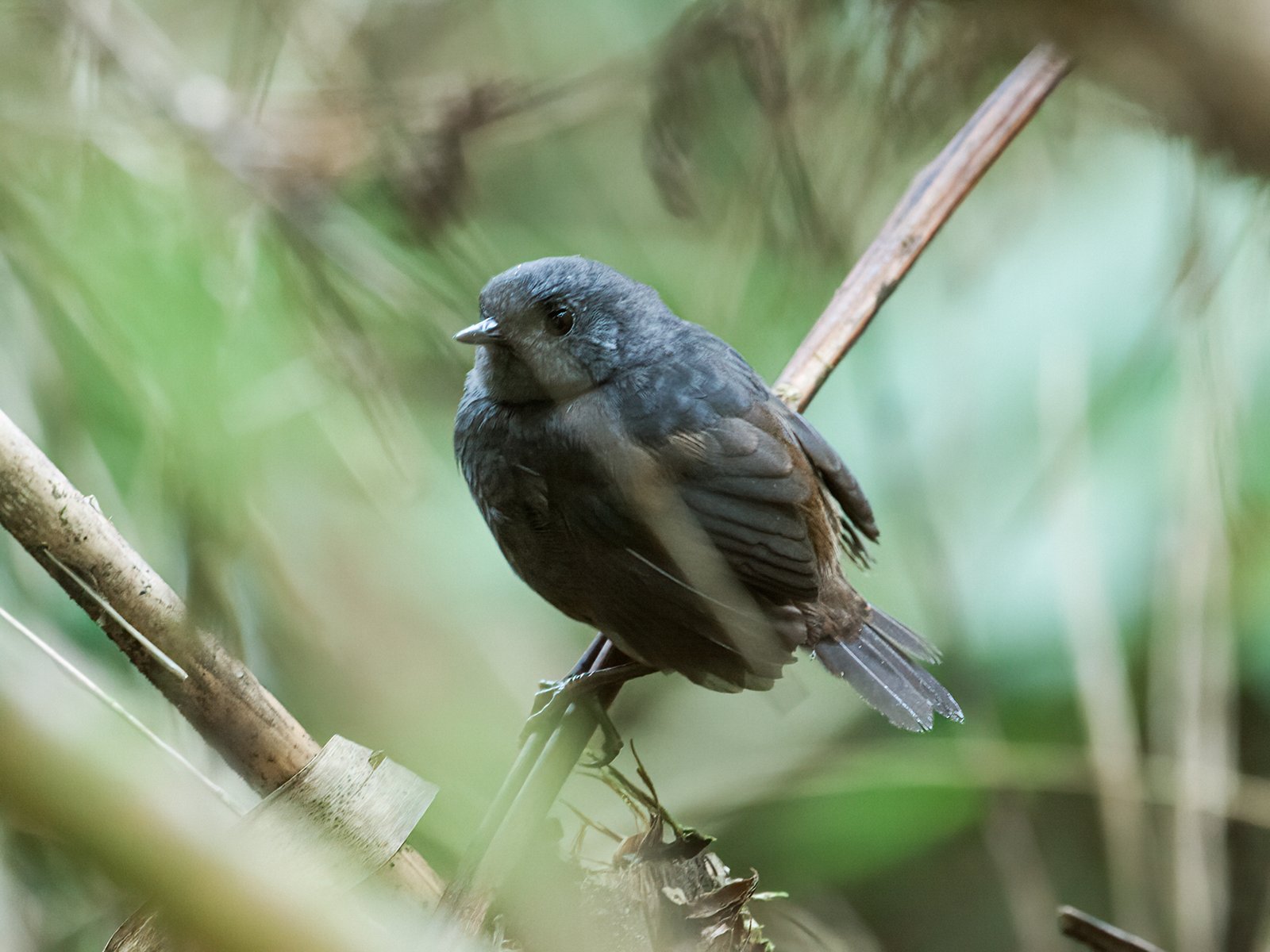
12 cm, round, with a short tail and a thin bill. The male is dark grey above and paler grey below, with a brown lower back and rump; the lower belly is yellowish, and the flanks and undertail are yellowish to cinnamon with blackish barring. The female resembles the male. Juveniles are light brown above with blackish barring and dark below with pale barring.
Confusion species
Spillmann's Tapaculo Scytalopus spillmanni, further north, is very similar but has a long, swelling trill. Paramo Tapaculo Scytalopus opacus and Loja Tapaculo Scytalopus androstictus live higher, around the treeline; the male Loja Tapaculo has a white wing spot. Blackish Tapaculo Scytalopus latrans is almost entirely blackish and usually lives lower. Ash-colored Tapaculo Myornis senilis lives in the same bamboo but has a clearly longer tail. In tapaculos the song is the main identification feature.
Habitat
Chusquea bamboo thickets and the adjacent undergrowth in humid upper montane forest, in Ecuador roughly between 2250 and 3350 m, in Peru up to about 2900 m. It forages on and just above the ground for small arthropods. Little is known about its breeding.
Where the bird is most at home, classified by the vegetation units of the Andes and the west coast.


Range and movements
In Ecuador in the south, from the Eastern Andes and the Chilla mountains south through Loja and Zamora-Chinchipe to the Cordillera del Cóndor. In Peru only in the far north, in Piura and Cajamarca. Absent from Colombia, Bolivia and the Galápagos. Does not occur outside the guide area.
- Resident
- dark = core range, pale = thinly spread
How and when to look
In Podocarpus National Park (Cajanuma) or the Tapichalaca reserve, look for dense bamboo thickets in the montane forest and listen in the early morning for the descending song. The bird moves low through the bamboo; wait quietly near a gap.
Conservation status
Least Concern. A large part of the range lies within protected areas.
Scientific name
Scytalopus parkeri | Krabbe & Schulenberg, 1997
Krabbe & Schulenberg described the species in 1997 and placed it straight away in the genus where it still stands. The genus Scytalopus was introduced in 1837 by Gould. The genus name combines Greek skutalē or skutalon, 'stick', with pous, 'foot'. The species name parkeri honours Theodore A. (Ted) Parker III (1953–1993), American ornithologist and expert on Neotropical bird sounds, who died in a plane crash in Ecuador. The specimen the first description was based on came from San Lucas, Loja, Ecuador.