All species › Passerines › Tapaculos › Perija Tapaculo
Perija Tapaculo | Scytalopus perijanus
Perijátapaculo | Churrín del Perijá | Macuquinho-de-perijá
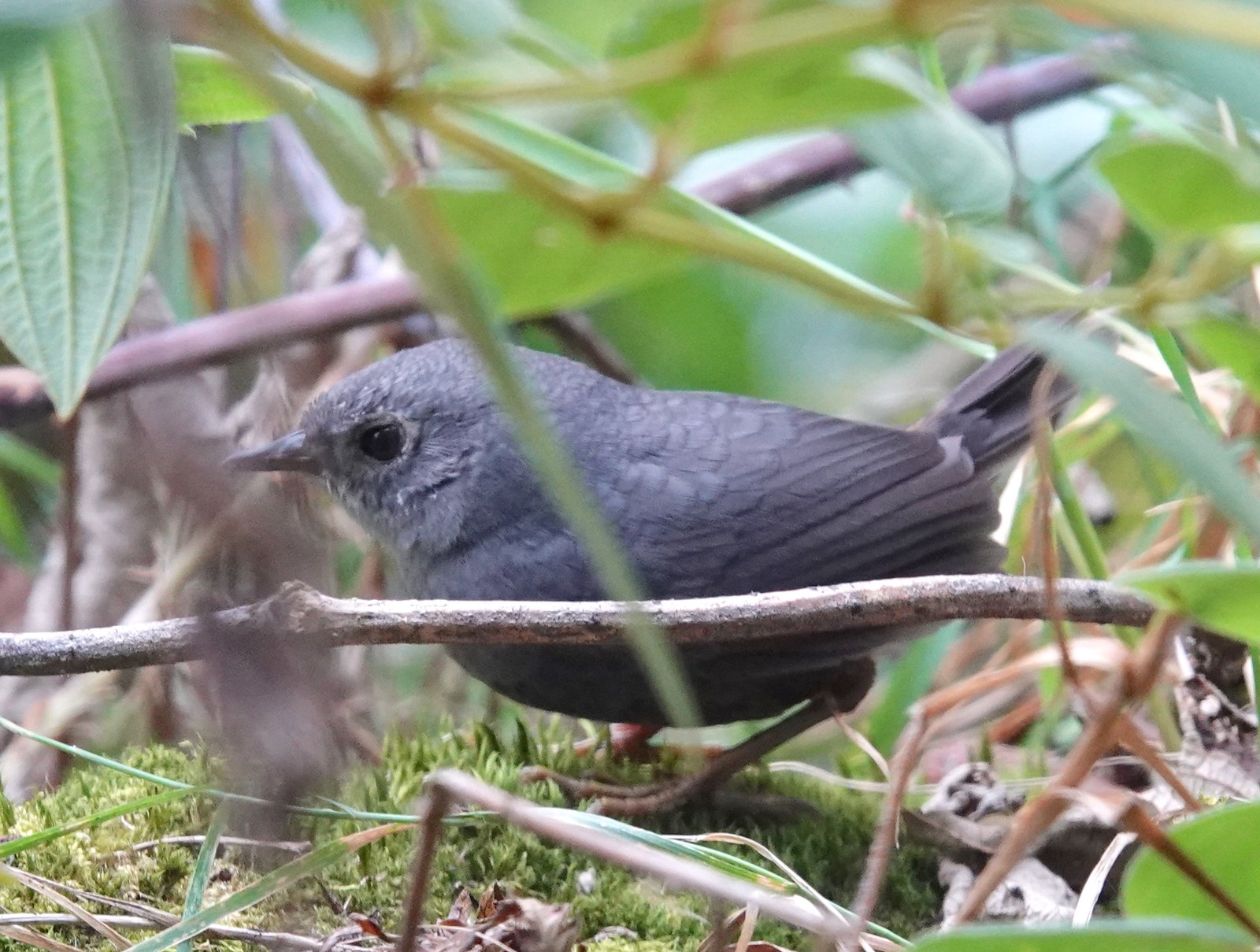
The Perija Tapaculo is a grey tapaculo found only in the Serranía del Perijá on the border of Colombia and Venezuela. Specimens had been in collections since 1941, but the species was only described in 2015, partly on the basis of its song. It lives in humid montane forest and scrub up to the páramo.
Voice
The song is a short, fast churr of about twelve notes, repeated in series of a few to several dozen at intervals of half a second to three seconds. When excited a series of accelerating churrs. The call is short and fast.
Recording: Iván Lau — CC BY-NC-SA 4.0 · xeno-canto
Identification
11 cm, round, with a short tail and a thin bill. The male has a grey crown, head and back, with a variable, sometimes barely visible brown nape patch; the throat is darker grey and the lower belly and flanks are buff. The female resembles the male but has a more obvious, rufous nape patch and a paler lower breast with a pinkish-buff wash. Juveniles are more yellowish and more sharply barred black.
Confusion species
Pale-bellied Tapaculo Scytalopus griseicollis of the Eastern Andes has more brown above and a slower, lower-pitched trill. White-crowned Tapaculo Scytalopus atratus lives on the lower slopes of the Perijá and has a white crown patch, darker upperparts and a paler throat. Spillmann's Tapaculo Scytalopus spillmanni and Blackish Tapaculo Scytalopus latrans of the Andes are darker. In tapaculos the song is the main identification feature.
Habitat
Humid montane forest, elfin forest, subpáramo and shrubbery up to the páramo at the treeline, between about 1600 and 3200 m. It also uses forest edges, dense thickets, tall secondary forest and forest fragments. It forages on and just above the ground for small arthropods. Little is known about its breeding.
Where the bird is most at home, classified by the vegetation units of the Andes and the west coast.


Range and movements
In Colombia only in the Serranía del Perijá in Cesar and La Guajira, on the border with Venezuela; possibly also further south in the Serranía de los Motilones. Absent from Ecuador, Peru, Bolivia and the Galápagos. Outside the guide area on the Venezuelan side of the Perijá.
- Resident
- dark = core range, pale = thinly spread
How and when to look
In the early morning, listen in the upper parts of the Perijá above Manaure (Cesar) for the short churrs from dense shrubbery along forest edges. The bird stays low in the vegetation; wait quietly near a gap.
Conservation status
Near Threatened. The range is small and fragmented; clearance for farming and cattle degrades the habitat. The authors who described it considered it possibly threatened.
Scientific name
Scytalopus perijanus | Avendaño, Cuervo, López-Ordóñez, Gutiérrez-Pinto, Cortés D & Cadena, 2015
Avendaño, Cuervo, López-Ordóñez, Gutiérrez-Pinto, Cortés D & Cadena described the species in 2015 and placed it straight away in the genus where it still stands. The genus Scytalopus was introduced in 1837 by Gould. The genus name combines Greek skutalē or skutalon, 'stick', with pous, 'foot'. The species name perijanus refers to the Serranía del Perijá on the border of Colombia and Venezuela; this is not necessarily the type locality. The specimen the first description was based on came from Vereda El Cinco, Manaure, Cesar, Colombia.