All species › Passerines › Tapaculos › Brown-rumped Tapaculo
Brown-rumped Tapaculo | Scytalopus latebricola
Bruinstuittapaculo | Churrín ratona | Macuquinho-de-uropígio-marrom
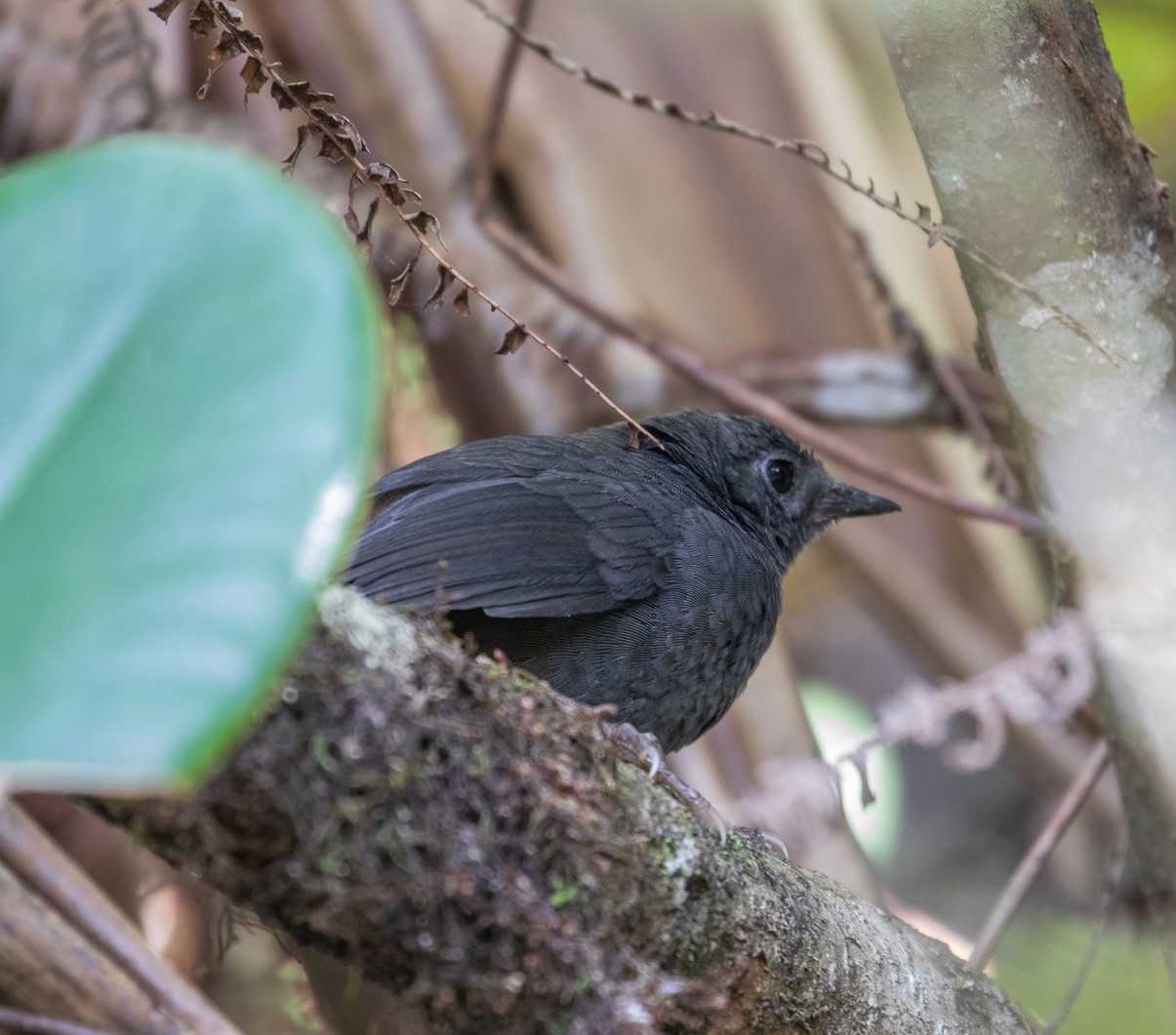
The Brown-rumped Tapaculo is a dark grey tapaculo with a brown rump and rufous flanks, found only in the Sierra Nevada de Santa Marta in northern Colombia. It lives on and just above the ground in the dense undergrowth of upper montane forest. Spillmann's Tapaculo and some Venezuelan tapaculos were formerly included in this species.
Voice
As in related tapaculos, the song consists of series of short, rapidly repeated notes from dense vegetation. Also short, sharp calls. The song has been little described in detail.
Recording: Iván Lau — CC BY-NC-SA 4.0 · xeno-canto
Identification
11–12 cm, round, with a short tail and a thin bill. The upperparts are dark brownish grey, with a warm brown rump. The throat, breast and belly are a paler shade of the same colour. The flanks and lower belly are bright rufous-chestnut, sometimes with blackish barring. The sexes are alike. Juveniles are brown and barred.
Confusion species
Santa Marta Tapaculo Scytalopus sanctaemartae, the only other Scytalopus in the Sierra Nevada, lives lower in the mountains, mostly below about 2000 m, and has a white crown patch. Spillmann's Tapaculo Scytalopus spillmanni of the Andes is very similar, but does not occur in the Sierra Nevada. In tapaculos the song is the main identification feature.
Habitat
Dense undergrowth of humid montane forest and tall secondary forest, also shrubbery at forest edges and at the edge of the páramo, between about 2000 and 3600 m. It forages mainly on the ground, but sometimes climbs vine-covered trunks. Its food is presumably small arthropods. Little is known about its breeding.
Where the bird is most at home, classified by the vegetation units of the Andes and the west coast.


Range and movements
Only in Colombia, in the Sierra Nevada de Santa Marta. Absent from Ecuador, Peru, Bolivia and the Galápagos. Does not occur outside the guide area.
- Resident
- dark = core range, pale = thinly spread
How and when to look
In the early morning, follow the road from Minca to the San Lorenzo ridge and listen in its upper part, above about 2000 m, for the song from dense undergrowth. Wait quietly at an opening in the shrubbery along the road.
Conservation status
Near Threatened. The range is small and fragmented; deforestation and fire degrade the habitat, but the population appears stable.
Scientific name
Scytalopus latebricola | Bangs, 1899
Bangs described the species in 1899 and placed it straight away in the genus where it still stands. The genus Scytalopus was introduced in 1837 by Gould. The genus name combines Greek skutalē or skutalon, 'stick', with pous, 'foot'. The species name comes from Latin latebricola, from latebra, 'hiding place', and -cola, 'dweller': dwelling in hiding places, after its secretive life in dense cover. The specimen the first description was based on came from Páramo de Chiruqua, Sierra Nevada de Santa Marta, Colombia.