All species › Passerines › Tapaculos › Pale-bellied Tapaculo
Pale-bellied Tapaculo | Scytalopus griseicollis
Matorraltapaculo | Churrín de matorral | Macuquinho-de-barriga-clara
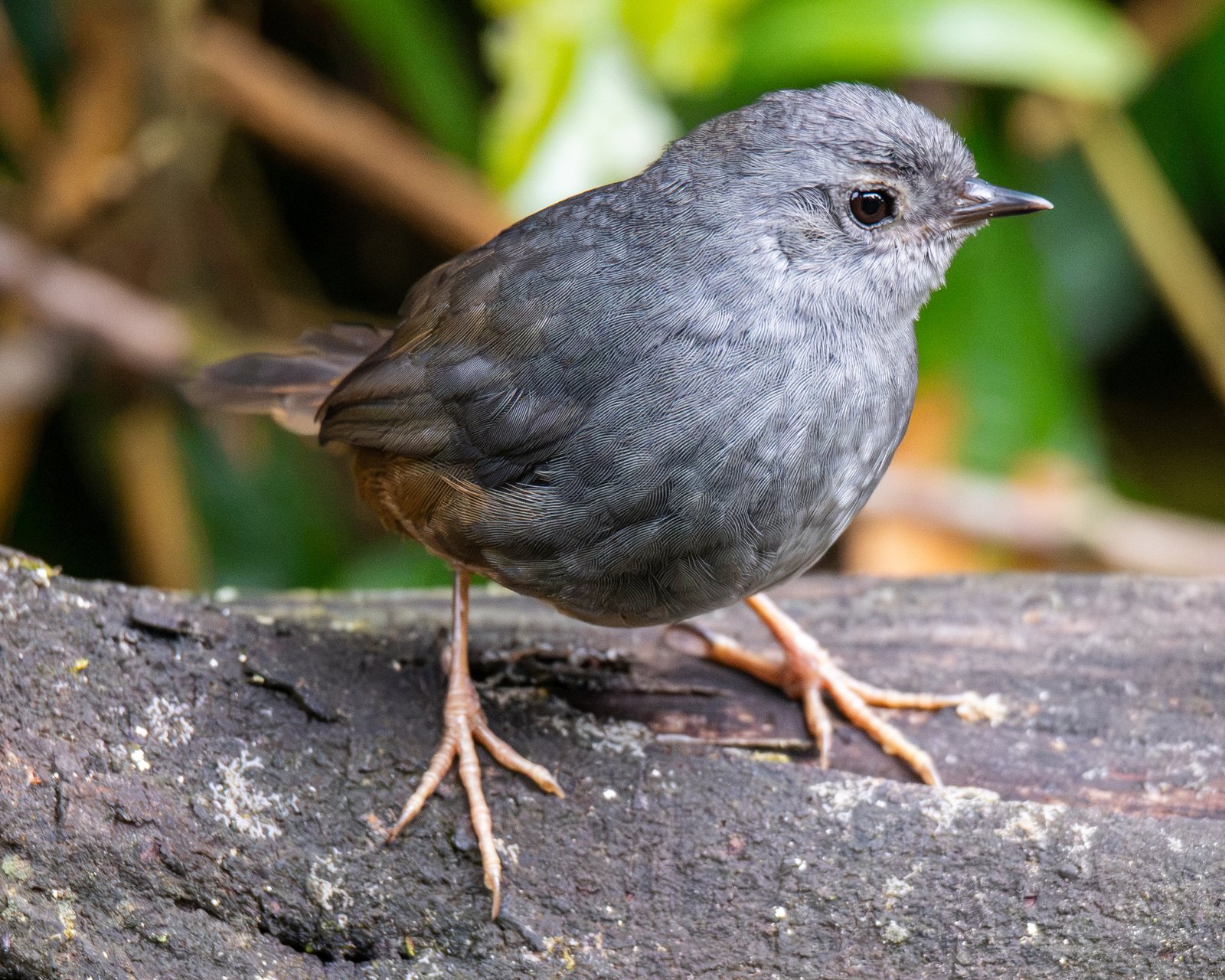
The Pale-bellied Tapaculo is a small, grey, pale-bellied tapaculo of high-elevation scrub in the Eastern Andes of Colombia. It lives mainly in low shrubbery of páramo and elfin forest and tolerates disturbed and fragmented habitat better than many relatives. It was formerly included in Magellanic Tapaculo.
Voice
The song is a trill, sometimes preceded by a single note; it differs somewhat between subspecies. The alarm call is also a short trill.
Recording: Andres Angulo Rubiano — CC BY-NC-SA 4.0 · xeno-canto
Identification
10–11.5 cm, round, with a short tail and a thin bill. Mostly grey and clearly paler below, with greyish-brown back and wings and an orange-brown rump, flanks and undertail, usually barred dark. The subspecies gilesi in Santander has a darker back and slate-grey underparts; morenoi in the north has a brown mantle. Females are usually somewhat browner than males. Juveniles are brown and barred.
Confusion species
Spillmann's Tapaculo Scytalopus spillmanni usually lives lower, inside montane forest, is darker grey and has a long, swelling trill. Blackish Tapaculo Scytalopus latrans is almost entirely blackish and usually lives lower. White-crowned Tapaculo Scytalopus atratus lives lower and has a white crown patch. Perija Tapaculo Scytalopus perijanus, only in the Serranía del Perijá, is duller grey, with less brown above, and sings faster and higher. In tapaculos the song is the main identification feature.
Habitat
Low shrubbery in páramo and elfin forest, scrub at forest edges and locally bamboo (Chusquea); rarely inside closed montane and oak forest. Mostly between 2000 and 3900 m. It tolerates disturbed and fragmented scrub. It forages on and just above the ground for small arthropods. Little is known about its breeding.
Where the bird is most at home, classified by the vegetation units of the Andes and the west coast.


Range and movements
Only in Colombia, in the Eastern Andes from Cundinamarca and Boyacá north through Santander to Norte de Santander. Absent from Ecuador, Peru, Bolivia and the Galápagos. Outside the guide area just across the border in western Venezuela.
- Resident
- dark = core range, pale = thinly spread
How and when to look
In the early morning, listen in the páramo and scrub above Bogotá, for example in Chingaza, for the trill from low shrubbery. The bird sometimes appears briefly at the edge of a shrub; wait quietly near a gap.
Conservation status
Least Concern. The species tolerates disturbed habitat, but the subspecies gilesi has a small range and the habitat of morenoi is heavily fragmented and degraded.
Scientific name
Scytalopus griseicollis | (de Lafresnaye, 1840)
De Lafresnaye described the species in 1840 as Merulaxis grisei-collis; because it was later moved to another genus, the author and year stand in brackets. The genus Scytalopus was introduced in 1837 by Gould. The genus name combines Greek skutalē or skutalon, 'stick', with pous, 'foot'. The species name comes from Latin griseicollis, from medieval Latin griseus, 'grey', and collum, 'neck': grey-necked. The specimen the first description was based on came from Bogotá, Colombia.