All species › Passerines › Tapaculos › El Oro Tapaculo
El Oro Tapaculo | Scytalopus robbinsi
Robbins' tapaculo | Churrín de El Oro | Macuquinho-de-el-oro
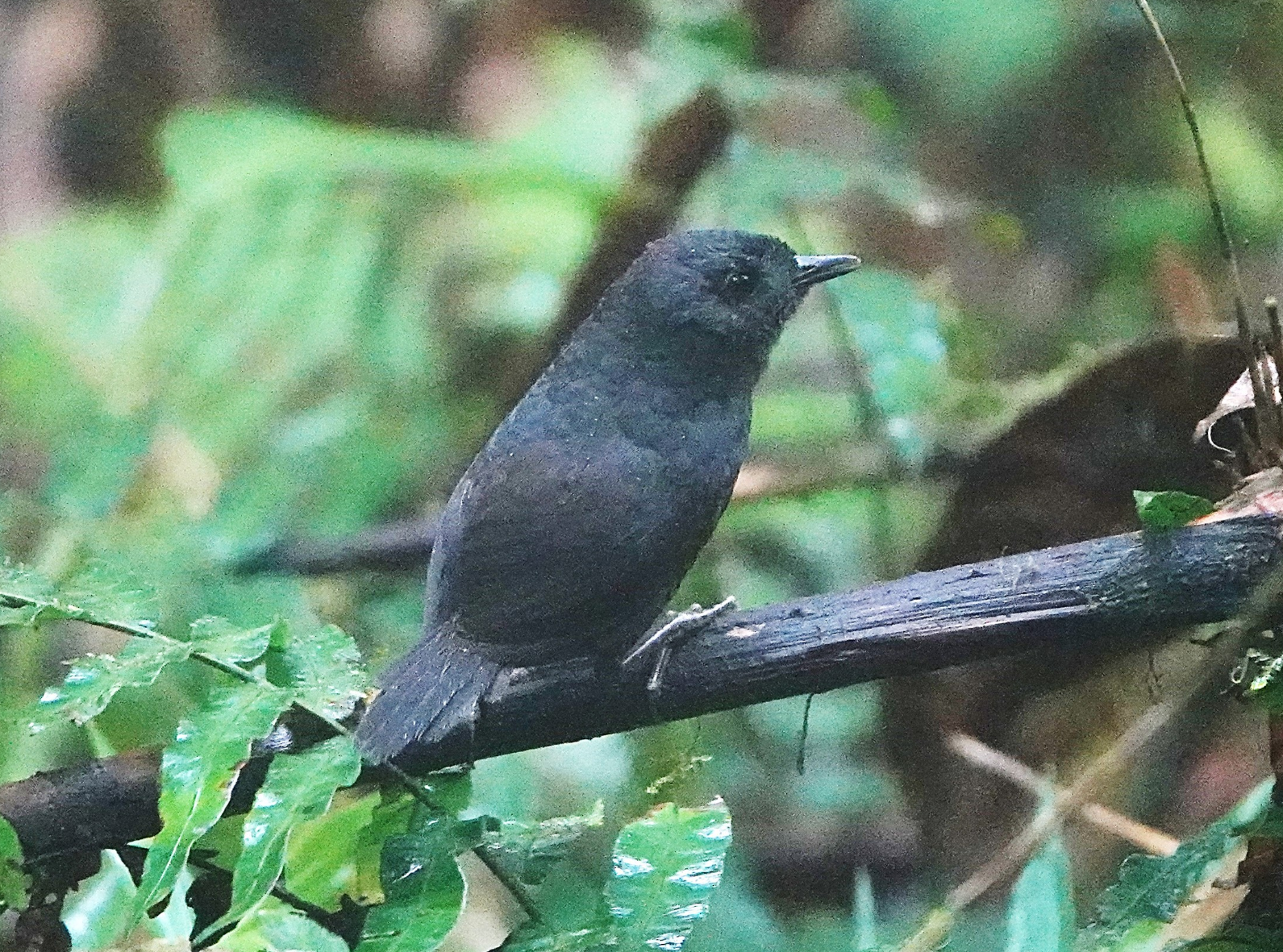
The El Oro Tapaculo is a small, grey tapaculo found only on the western slope of the Andes in south-western Ecuador. It was described in 1997 and its scientific name honours the American ornithologist Mark Robbins. The species lives in a narrow elevational belt of humid forest, much of which has been cleared.
Voice
The song is a series of double notes repeated evenly for up to about a minute, usually from dense undergrowth. Also short, sharp calls.
Recording: Juan Freile — CC BY-NC-SA 4.0 · xeno-canto
Identification
11 cm, round, with a short tail, short wings and, for a tapaculo, a fairly heavy black bill. The male is mostly grey, with a brown nape and rump and brown, dark-barred flanks; the tail is blackish. The female resembles the male but is browner below. Juveniles, as in related tapaculos, are presumably brown and barred.
Confusion species
Choco Tapaculo Scytalopus chocoensis lives further north, in north-western Ecuador and western Colombia, and has a different song. Narino Tapaculo Scytalopus vicinior also lives further north and usually higher. Blackish Tapaculo Scytalopus latrans is almost entirely blackish and usually lives higher in the mountains. In tapaculos the song is the main identification feature.
Habitat
Dense undergrowth of humid foothill and montane forest, also in ravines and at forest edges, roughly between 700 and 1250 m. It forages on or just above the ground, among leaf litter, roots and moss, for small arthropods. Little is known about its breeding.
Where the bird is most at home, classified by the vegetation units of the Andes and the west coast.


Range and movements
Only in Ecuador, on the western slope of the Andes in the south-west: in El Oro and Azuay and locally in adjacent Cañar and Guayas. Absent from Colombia, Peru, Bolivia and the Galápagos. Does not occur outside the guide area.
- Resident
- dark = core range, pale = thinly spread
How and when to look
In the early morning, listen in the Buenaventura reserve near Piñas (El Oro) for the song from dense undergrowth in ravines and along forest trails. The bird stays low in the vegetation; wait quietly near a gap in the undergrowth.
Conservation status
Endangered. The range is small and forest at this elevation has largely been cleared for pasture and farming; the population is small and declining. Part of the habitat lies within a protected area.
Scientific name
Scytalopus robbinsi | Krabbe & Schulenberg, 1997
Krabbe & Schulenberg described the species in 1997 and placed it straight away in the genus where it still stands. The genus Scytalopus was introduced in 1837 by Gould. The genus name combines Greek skutalē or skutalon, 'stick', with pous, 'foot'. The species name robbinsi honours Mark Blair Robbins (b. 1954), American ornithologist, collector and systematist, Collections Manager of the Division of Ornithology at the University of Kansas. The specimen the first description was based on came from Piñas, El Oro, Ecuador.