All species › Passerines › Tapaculos › Tatama Tapaculo
Tatama Tapaculo | Scytalopus alvarezlopezi
Tatamátapaculo | Churrín de Tatamá | Macuquinho-de-tatamá
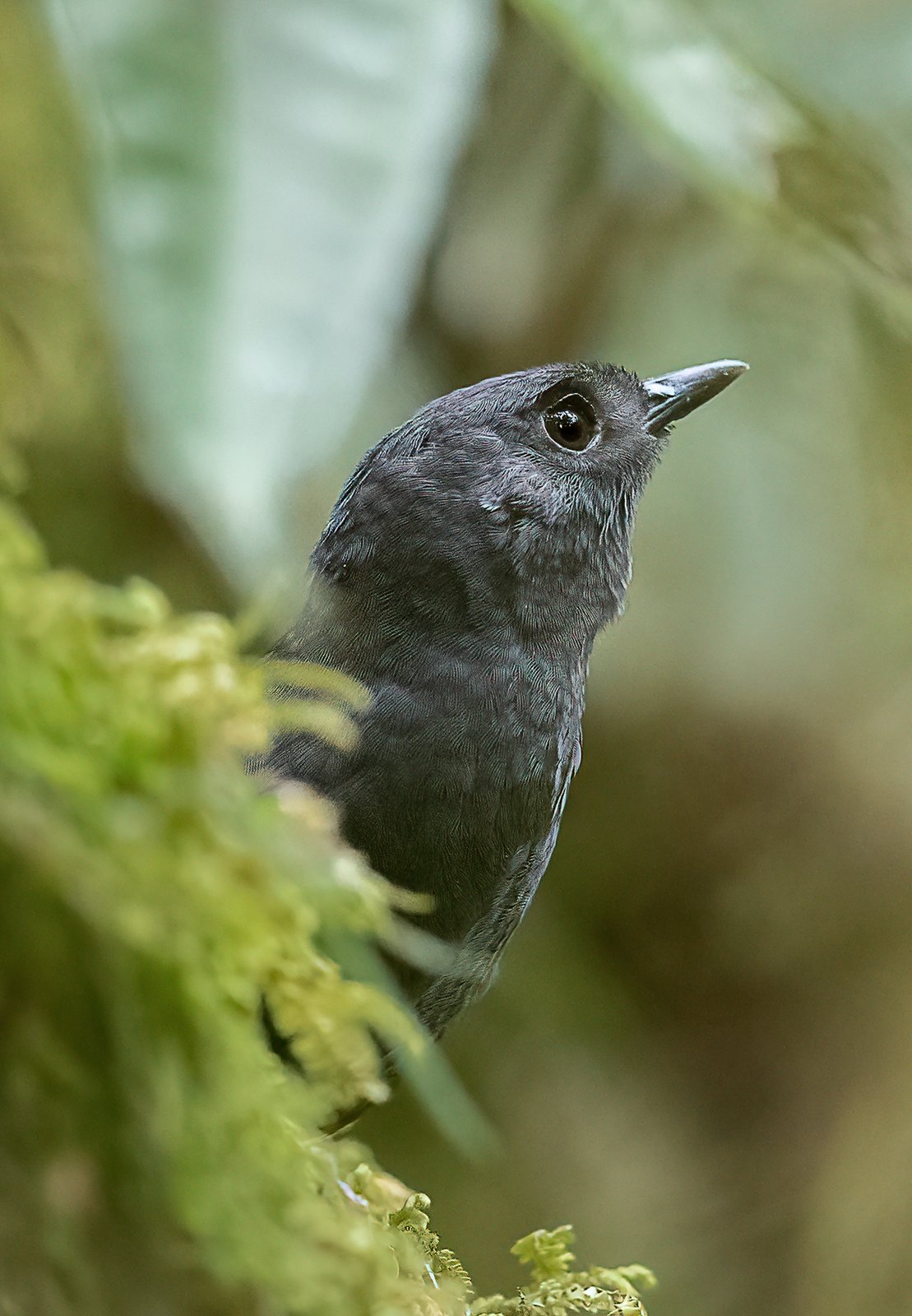
The Tatama Tapaculo is an almost black tapaculo of cloud forest in the Western Andes of Colombia. For a long time it was known only from sound recordings and was not described until 2017, named after Cerro Tatamá. It lives only in the dense undergrowth of primary forest.
Voice
The song is a long, mechanical-sounding series of short, flat, frog-like phrases of seven to nine almost identical notes each; the series can continue for a minute and a half or longer. Also short calls.
Recording: Brian Cox — CC BY-NC-SA 4.0 · xeno-canto
Identification
12 cm, round, with a short tail, short wings and fairly long legs. The plumage is almost entirely blackish, greyish black below, with a faintly dark brown rump and faint bars on the flanks and lower belly. Females are probably washed browner; juveniles are brown with dark bars.
Confusion species
Narino Tapaculo Scytalopus vicinior is greyer, with obvious brown, barred rear flanks, and sings differently. Spillmann's Tapaculo Scytalopus spillmanni lives higher and is greyer, with brown flanks. Choco Tapaculo Scytalopus chocoensis lives lower. Blackish Tapaculo Scytalopus latrans is very similar, but has a different song. In tapaculos the song is the main identification feature.
Habitat
Dense undergrowth of primary cloud forest, mainly on the western slope roughly between 1300 and 1750 m, and up to about 2200 m on the eastern side of some ridges. Secondary forest is avoided. It forages on or just above the ground for small arthropods. Little is known about its breeding.
Where the bird is most at home, classified by the vegetation units of the Andes and the west coast.


Range and movements
Only in Colombia: in the Western Andes, mainly on the western slope in Chocó, Risaralda and Antioquia, with Cerro Tatamá as the core area; locally also over the ridge on the eastern side. Absent from Ecuador, Peru, Bolivia and the Galápagos. Does not occur outside the guide area.
- Resident
- dark = core range, pale = thinly spread
How and when to look
The best-known site is the road to Cerro Montezuma in Tatamá National Park in Risaralda. In the morning, listen at middle elevations for the long, mechanical series from the undergrowth.
Conservation status
Near Threatened. The range is small and the species appears to live in a few separate subpopulations; population size and trend are poorly known. Part of its habitat lies within Tatamá National Park.
Scientific name
Scytalopus alvarezlopezi | Stiles, Laverde-R & Cadena, 2017
Stiles, Laverde-R & Cadena described the species in 2017 and placed it straight away in the genus where it still stands. The genus Scytalopus was introduced in 1837 by Gould. The genus name combines Greek skutalē or skutalon, 'stick', with pous, 'foot'. The species name alvarezlopezi honours Humberto Álvarez-López, Colombian ornithologist, professor of ornithology at the Universidad del Valle in Cali for nearly four decades and founder of Colombia's first local ornithological society. The specimen the first description was based on came from Alto de Pisones, Mistrató, Risaralda, Colombia.