All species › Birds of prey › Kites, Old World vultures, eagles and hawks › Black-faced Hawk
Black-faced Hawk | Leucopternis melanops
Zwartmaskerbuizerd | Gavilán carinegro | Gavião-de-cara-preta
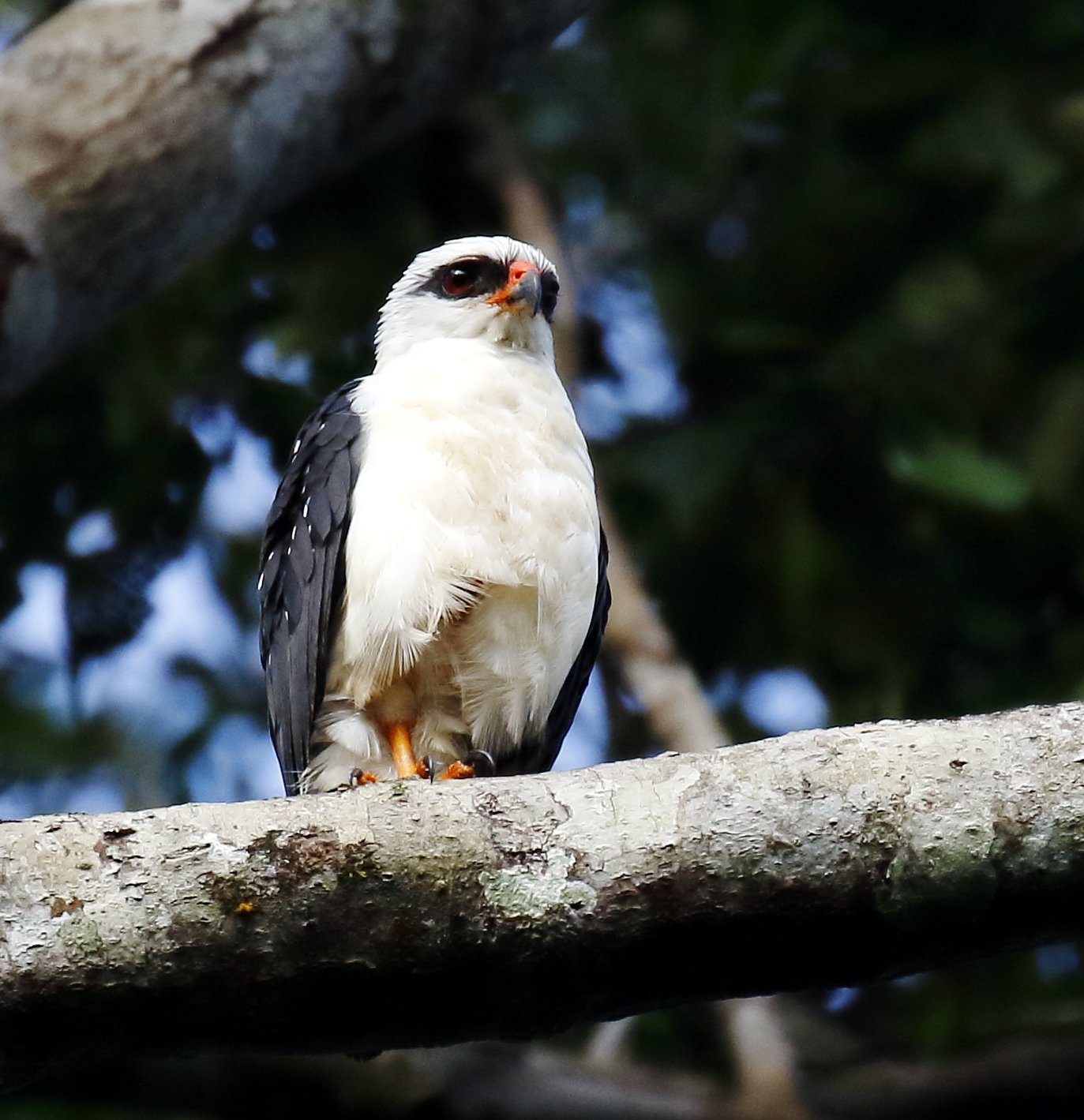
The Black-faced Hawk is a small black-and-white forest hawk of Amazonia north of the Amazon. It has a white, finely streaked head with a black mask and an orange cere. South of the river it is replaced by the very similar White-browed Hawk.
Voice
A high, thin, descending whistle, keeeeeuw, often repeated from the canopy or in flight.
Recording: Felipe Arantes — CC BY-NC-SA 4.0 · xeno-canto
Identification
35–40 cm. Head, neck and underparts are white; crown and neck are finely streaked black. A black mask runs from the bill through the eye. Back and wings are black with small white spots. The tail is black with a single narrow white band in the middle and a white tip. Cere and legs are orange. In flight the underwings are white with dark tips. The sexes are alike; juveniles resemble adults but are browner above and more heavily streaked on the head.
Confusion species
White-browed Hawk Leucopternis kuhli lives south of the Amazon; it has a grey crown with a white supercilium and lacks the streaks on head and neck. White Hawk Pseudastur albicollis is much larger, with a white tail with a broad black band. Black-and-white Hawk-Eagle Spizaetus melanoleucus is larger, with a short black crest and a long, barred tail.
Habitat
Humid lowland forest on terra firme and in várzea, often near rivers and lakes, and at forest edges; up to about 600 m, locally higher. It hunts from a perch in the mid-levels, taking snakes, lizards, frogs and small birds. Little is known about the nest.
Where the bird is most at home, classified by the vegetation units of the Andes and the west coast.


Range and movements
In Colombia in Amazonia in the south-east and east. In Ecuador in the eastern lowlands. In Peru in the north-east, north of the Amazon and the Marañón. Not in Bolivia. Outside the guide area in southern Venezuela, the Guianas and northern Brazilian Amazonia.
- Resident
- dark = core range, pale = thinly spread
How and when to look
In Amazonian forest in Ecuador or north-eastern Peru, watch for a small black-and-white raptor sitting quietly on a branch below the canopy; the descending whistle often gives its presence away.
Conservation status
Least Concern. Widespread but scarce everywhere and at low densities; dependent on continuous forest.
Scientific name
Leucopternis melanops | (Latham, 1790)
Latham described the species in 1790 as Falco melanops; because it was later moved to another genus, the author and year stand in brackets. The genus Leucopternis was introduced in 1847 by Kaup. The genus name comes from Greek leukos, 'white', and pternis, a kind of hawk known to the ancient Greeks. The species name comes from Greek melas, 'black', and ōps, 'face'. The specimen the first description was based on came from Cayenne, French Guiana.