All species › Birds of prey › Kites, Old World vultures, eagles and hawks › Semiplumbeous Hawk
Semiplumbeous Hawk | Leucopternis semiplumbeus
Kleine bonte buizerd | Gavilán semiplomizo | Gavião-semiplúmbeo
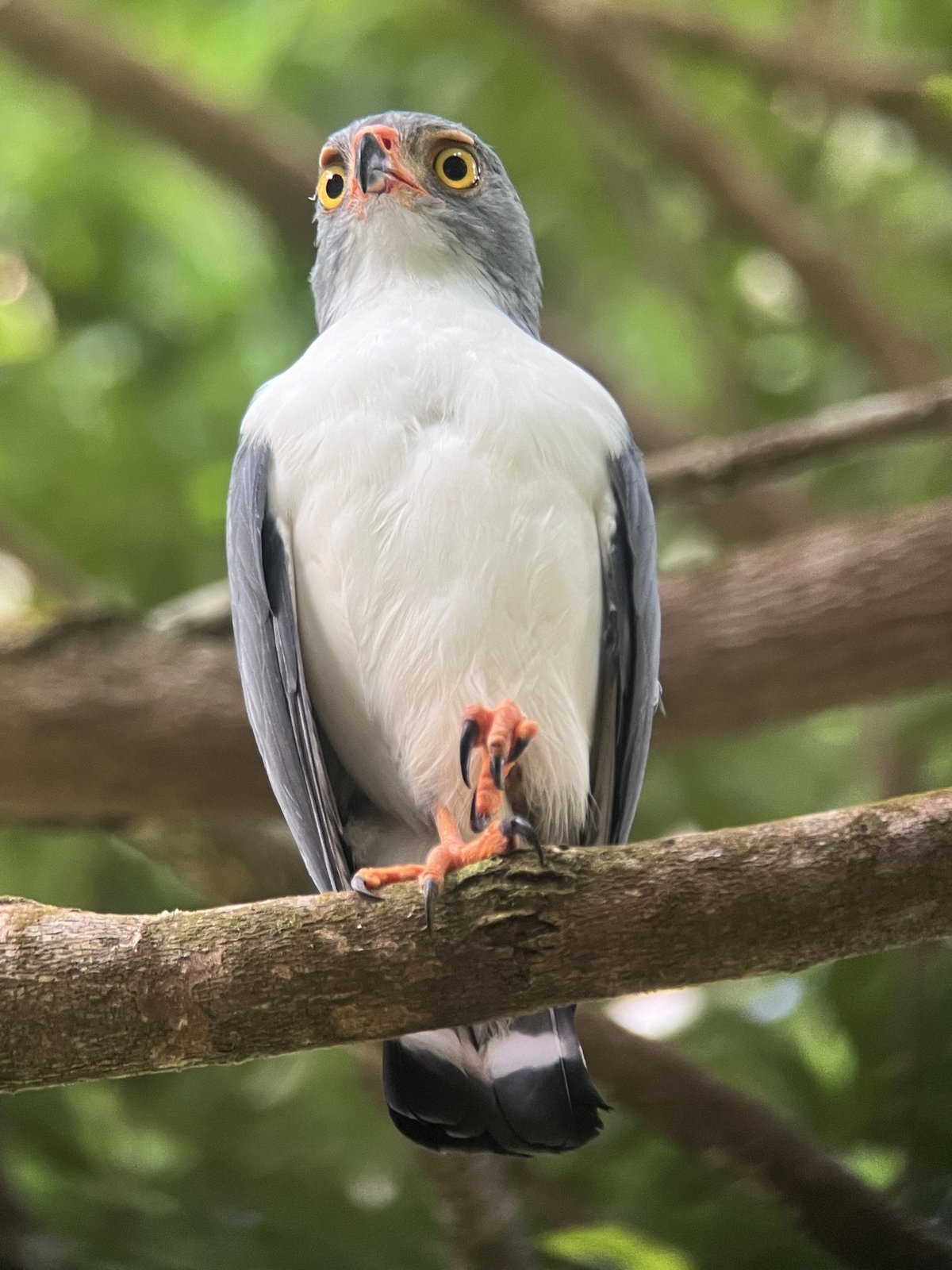
The Semiplumbeous Hawk is a compact forest hawk of the Chocó: slate grey above, pure white below, with an orange cere, orange legs and an orange-yellow eye. It sits motionless for long periods in the mid-levels and canopy of humid lowland forest and often reveals itself by its call.
Voice
A high, plaintive, drawn-out whistle, wheeeeeer, often repeated for long periods from the canopy; also a series of shorter whistles.
Recording: Patrick ODonnell — CC BY-NC-SA 4.0 · xeno-canto
Identification
31–36 cm. Short- and broad-winged, with a fairly short tail. Head, back and wings are slate grey, the underparts pure white. Cere and legs are orange, the eye orange-yellow. The tail is black with a single narrow white band in the middle and a narrow white tip. In flight the underwings are white with dark tips to the primaries. The sexes are alike. Juveniles have fine dark streaks on the head and breast and pale fringes to the upperpart feathers.
Confusion species
White Hawk Pseudastur albicollis is much larger, with a white head and a white tail with a black band. Barred Hawk Morphnarchus princeps is larger, with a dark breast and a finely barred belly, and lives higher on the slopes. Black-and-white Hawk-Eagle Spizaetus melanoleucus has a white head with a black mask and a long, barred tail. Plumbeous Kite Ictinia plumbea is all grey, with long, pointed wings.
Habitat
Humid, tall lowland forest and old secondary forest, also at forest edges and along rivers, from sea level to about 1000 m. It hunts from a perch in the mid-levels, taking lizards, snakes, frogs, small birds and large insects. The nest is a stick nest high in a tree.
Where the bird is most at home, classified by the vegetation units of the Andes and the west coast.


Range and movements
In Colombia in the Pacific lowlands, the north-west and the northern Magdalena Valley. In Ecuador in the north-western lowlands, mainly in Esmeraldas and north-western Pichincha. Not in Peru or Bolivia. Outside the guide area from Honduras through Central America to Panama.
- Resident
- dark = core range, pale = thinly spread
How and when to look
Listen in the morning in Chocó forest for the drawn-out whistle; the bird often sits motionless on a branch below the canopy or at a forest edge along a river or road.
Conservation status
Least Concern, but dependent on lowland forest; deforestation in the Chocó and western Ecuador is causing local declines.
Scientific name
Leucopternis semiplumbeus | Lawrence, 1861
Lawrence described the species in 1861 and placed it straight away in the genus where it still stands. The genus Leucopternis was introduced in 1847 by Kaup. The genus name comes from Greek leukos, 'white', and pternis, a kind of hawk known to the ancient Greeks. The species name comes from Latin semi-, 'half', and plumbeus, 'lead-grey'. The specimen the first description was based on came from Caribbean slope, Panama.