All species › Passerines › Tyrant flycatchers and allies › Black-fronted Ground Tyrant
Black-fronted Ground Tyrant | Muscisaxicola frontalis
Zwartkruingrondtiran | Dormilona frentinegra | Dormilona-de-testa-preta
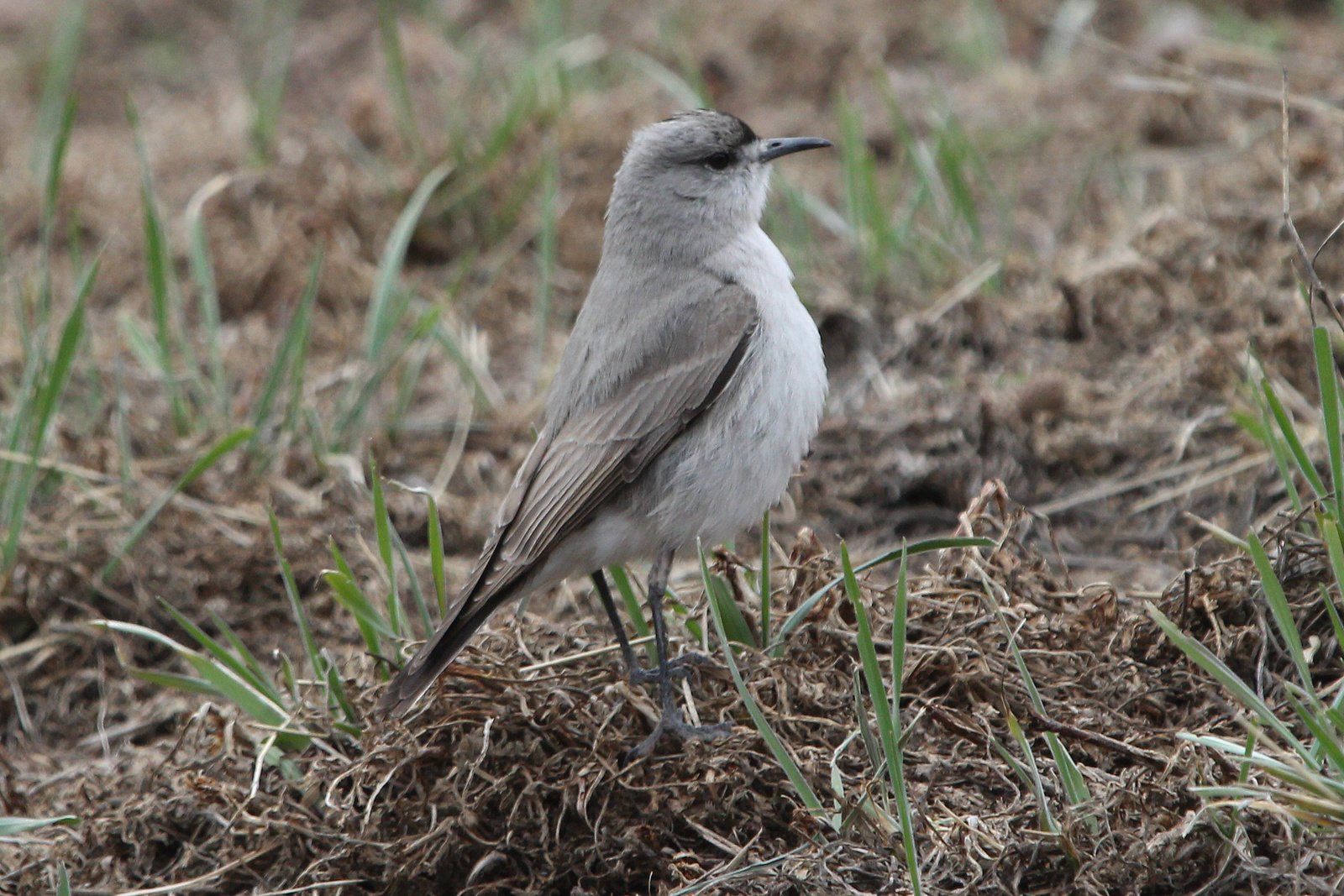
The Black-fronted Ground Tyrant breeds high in the Andes of Chile and Argentina and migrates to the puna of Bolivia and southern Peru in the austral winter. It is a grey ground tyrant with a narrow black stripe from the forehead onto the crown. In winter quarters it often lives in groups with other ground tyrants.
Voice
Mostly silent in winter quarters; gives a short, soft call, roughly tik or tseep.
No recording with a suitable Creative Commons licence is available for this species yet.
Identification
17–18 cm. The upperparts are plain grey to brownish grey. A narrow black stripe runs from the base of the bill over the forehead to the forecrown, with white lores below it. The underparts are pale grey, the belly almost white. The wings are brownish grey with pale edges to the flight feathers. The tail is black with white outer edges. The sexes are alike.
Confusion species
White-fronted Ground Tyrant Muscisaxicola albifrons is much larger, with a white forehead and white edges to the inner flight feathers. Cinereous Ground Tyrant Muscisaxicola cinereus is smaller and paler, without the black crown stripe. White-browed Ground Tyrant Muscisaxicola albilora has a distinct white supercilium and a rufous wash on the hindcrown. Cinnamon-bellied Ground Tyrant Muscisaxicola capistratus has a rufous crown patch and a cinnamon belly.
Habitat
In the guide area in the puna and on the altiplano, on open, sparsely vegetated or bare ground, scree, along bofedales and lake shores, mostly between 3500 and 4800 m. It walks on the ground and picks up insects or sallies briefly after them. It breeds only outside the guide area; the nest is in a rock crevice.
Where the bird is most at home, classified by the vegetation units of the Andes and the west coast.


Range and movements
Peru: as a winter visitor in the puna of the south, mainly in Puno, Arequipa, Moquegua and Tacna, in smaller numbers further north. Bolivia: as a winter visitor on the altiplano and in the high Andes, from La Paz to Potosí. Absent from Colombia, Ecuador and the Galápagos. Outside the guide area the species breeds in the high Andes of central Chile and western Argentina.
- Summer visitor (c. Apr–Sep)
- Winter visitor (c. Oct–Mar)
- Passage (Mar–Apr, Oct–Nov)
- dark = core range, pale = thinly spread
How and when to look
Between April and October, search the high puna near bofedales and lakes for groups of ground tyrants; this species stands out by its plain grey plumage and the black stripe on the forehead.
Conservation status
Least Concern. The species is widespread and no major threats are known.
Scientific name
Muscisaxicola frontalis | (Burmeister, 1860)
Burmeister described the species in 1860 as Ptyonura frontalis; because it was later moved to another genus, the author and year stand in brackets. The genus Muscisaxicola was introduced in 1837 by D'Orbigny, ACVMD & de Lafresnaye. The genus name is a blend of the genera Muscicapa (flycatchers) and Saxicola (stonechats and whinchats). The species name comes from Latin frontalis, 'of the forehead', for the black forehead. The specimen the first description was based on came from Sierra de Mendoza, Argentina.