All species › Passerines › Tyrant flycatchers and allies › Cinnamon-bellied Ground Tyrant
Cinnamon-bellied Ground Tyrant | Muscisaxicola capistratus
Teugelgrondtiran | Dormilona canela | Dormilona-de-barriga-canela
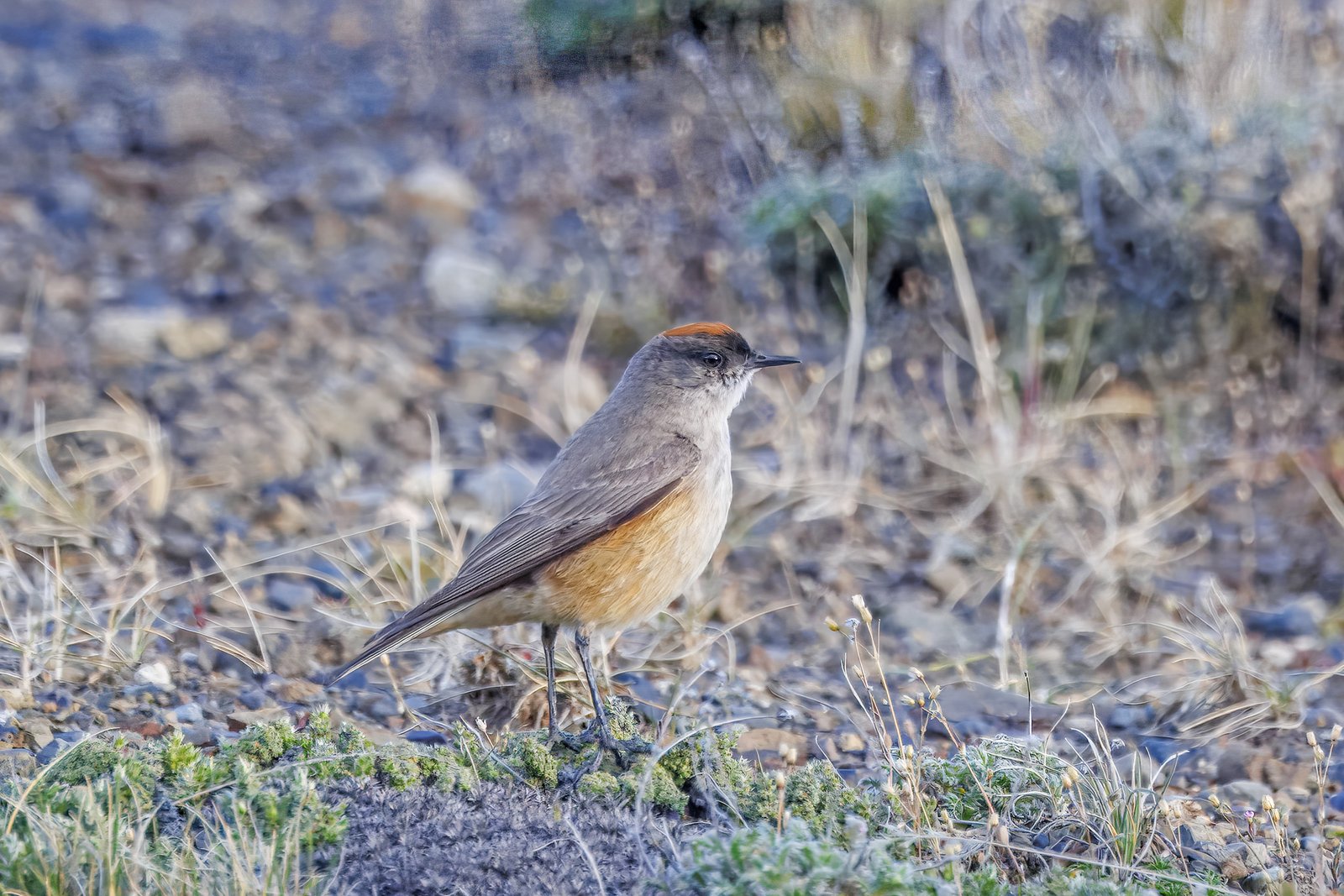
The Cinnamon-bellied Ground Tyrant breeds in Patagonia and Tierra del Fuego and migrates north to the puna in the austral winter. In the guide area it is therefore a winter visitor to the high plateaus of southern Peru and Bolivia. It is one of the few ground tyrants with a clearly cinnamon belly.
Voice
Mostly silent in winter quarters; gives a soft, high call, roughly tseep.
Recording: Bernabe Lopez-Lanus — CC BY-NC-SA 3.0 · xeno-canto
Identification
16–17 cm. The upperparts are greyish brown, with a rufous crown patch bordered in front by a black frontal stripe. The lores and a short stripe above the eye are white, and the throat is white. The breast is grey, and the belly, flanks and undertail coverts are cinnamon. The tail is black with white outer edges. The sexes are alike; in winter the crown patch is duller.
Confusion species
Rufous-naped Ground Tyrant Muscisaxicola rufivertex has a rufous patch on the hindcrown, but a white belly and no black forehead. Puna Ground Tyrant Muscisaxicola juninensis is browner, with a faint cinnamon patch on the hindcrown, and lacks the cinnamon belly. Ochre-naped Ground Tyrant Muscisaxicola flavinucha is larger, with an ochre-yellow nape patch and a white belly.
Habitat
In the guide area in the puna and on the altiplano, on short grass, bare ground, bofedales and lake shores, mostly between 3500 and 4500 m. It walks on the ground and picks up insects, often in loose groups, sometimes with other ground tyrants. It breeds only outside the guide area; the nest is in a cavity among stones.
Where the bird is most at home, classified by the vegetation units of the Andes and the west coast.


Range and movements
Peru: as a winter visitor in the puna of the south, mainly in Puno, Cusco and Arequipa, scarcer further north. Bolivia: as a winter visitor on the altiplano and in the high Andes of La Paz, Oruro and Potosí. Absent from Colombia, Ecuador and the Galápagos. Outside the guide area the species breeds in southern Chile and Argentina, south to Tierra del Fuego.
- Summer visitor (c. Apr–Sep)
- dark = core range, pale = thinly spread
How and when to look
Between April and October, search the puna around lakes and bofedales for groups of ground tyrants and look for birds with a cinnamon belly and a black forehead.
Conservation status
Least Concern. The species is widespread and no major threats are known.
Scientific name
Muscisaxicola capistratus | (Burmeister, 1860)
Burmeister described the species in 1860 as Ptyonura capistrata; because it was later moved to another genus, the author and year stand in brackets. The genus Muscisaxicola was introduced in 1837 by D'Orbigny, ACVMD & de Lafresnaye. The genus name is a blend of the genera Muscicapa (flycatchers) and Saxicola (stonechats and whinchats). The species name comes from Latin capistratus, 'haltered, bridled', for the head markings. The specimen the first description was based on came from Sierra de Mendoza, Argentina.