All species › Passerines › Tyrant flycatchers and allies › Paramo Ground Tyrant
Paramo Ground Tyrant | Muscisaxicola alpinus
Rotsgrondtiran | Dormilona del páramo | Dormilona-do-páramo
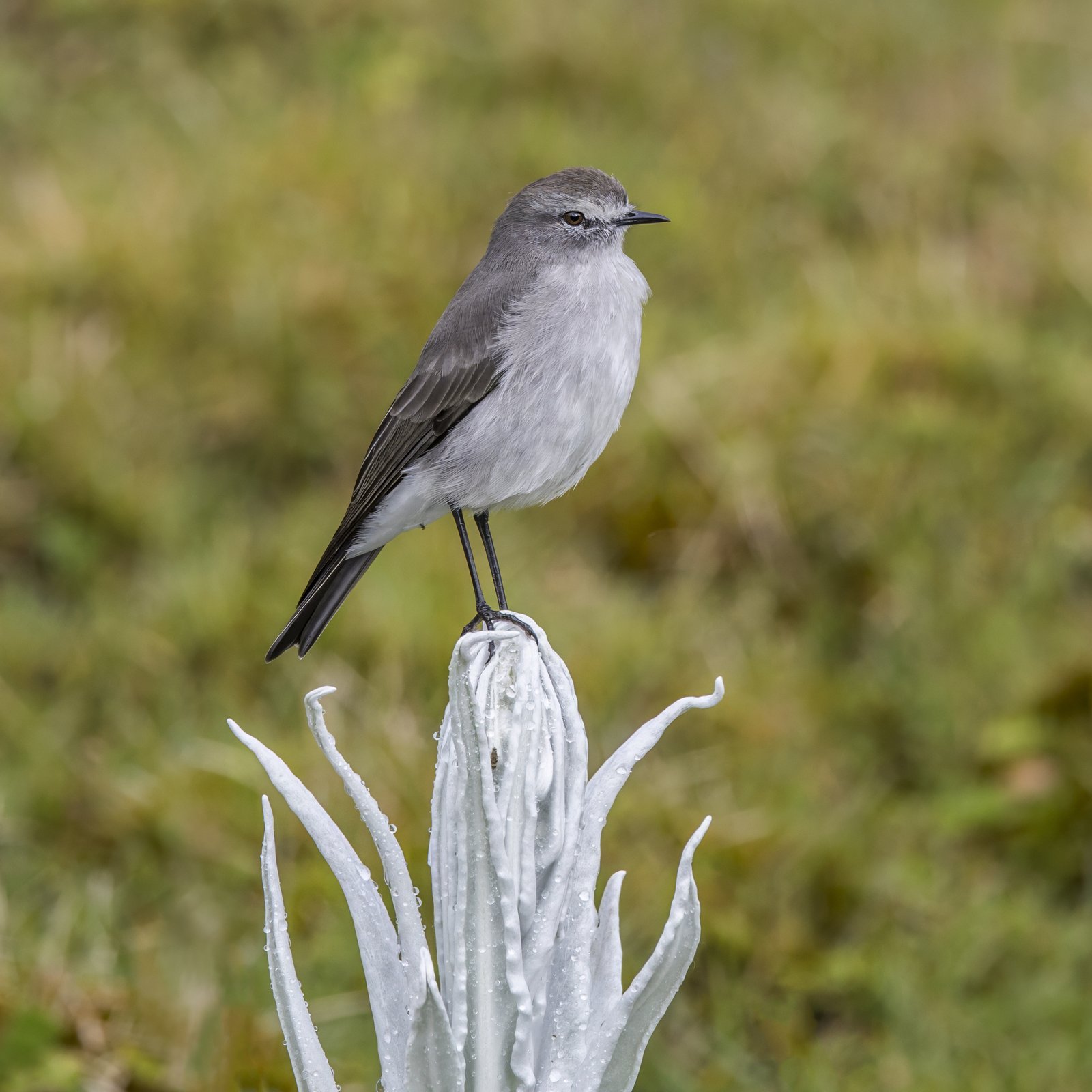
The Paramo Ground Tyrant is the ground tyrant of the páramo of Colombia and Ecuador. It lives high above the treeline among grass tussocks, rocks and bare ground and runs in short dashes, alternating with pauses in an upright stance. It is the only ground tyrant that occurs year-round in the northern part of the guide area.
Voice
Mostly silent. It gives a soft, high call, roughly tseek, especially when flushed; the song consists of short, thin notes.
Recording: John V. Moore — CC BY-NC-SA 4.0 · xeno-canto
Identification
18–19 cm, a large, long-legged ground tyrant with an upright stance. The upperparts are greyish brown, the crown slightly warmer brown. A short white supercilium runs from the bill to above the eye. The underparts are dull white, greyish on the breast. The wings are brown with pale edges to the greater coverts. The tail is black with narrow white outer edges. The bill and legs are black. The sexes are alike.
Confusion species
Spot-billed Ground Tyrant Muscisaxicola maculirostris is smaller, browner and warmer buff below, with a pale base to the lower mandible, and usually lives lower, on dry slopes. Taczanowski's Ground Tyrant Muscisaxicola griseus is very similar, but greyer, and lives further south, in Peru and Bolivia. Paramo Pipit Anthus bogotensis is streaked and lacks the black tail.
Habitat
Open páramo with grass tussocks, bare ground and rocks, scree below the snowline and the edges of small bogs and mountain lakes, mostly between 3500 and 4600 m. It walks on the ground, hops onto a stone and picks insects from the ground or sallies briefly after them. The nest is in a crevice between rocks or in a hole in a bank.
Where the bird is most at home, classified by the vegetation units of the Andes and the west coast.


Range and movements
Colombia: in the Central and Eastern Andes, locally in the páramo of the south. Ecuador: in the páramo along both ranges over the whole length of the country. Absent from Peru, Bolivia and the Galápagos. The species does not occur outside the guide area.
- Resident
- dark = core range, pale = thinly spread
How and when to look
Visit the high páramo above 3800 m, for example on the slopes of the large volcanoes in Ecuador or the high páramo in Colombia. Look for birds running over bare patches and road verges and stopping abruptly.
Conservation status
Least Concern. The species lives in an area with little cultivation, but fires and grazing in the páramo can alter its habitat locally.
Scientific name
Muscisaxicola alpinus | (Jardine, 1849)
Jardine described the species in 1849 as Taenioptera alpina; because it was later moved to another genus, the author and year stand in brackets. The genus Muscisaxicola was introduced in 1837 by D'Orbigny, ACVMD & de Lafresnaye. The genus name is a blend of the genera Muscicapa (flycatchers) and Saxicola (stonechats and whinchats). The species name comes from Latin alpinus, 'alpine, of high mountains'. The specimen the first description was based on came from Quito, Ecuador.