All species › Passerines › Tyrant flycatchers and allies › White-browed Ground Tyrant
White-browed Ground Tyrant | Muscisaxicola albilora
Witbrauwgrondtiran | Dormilona cejiblanca | Dormilona-de-sobrancelha-branca
White-browed Ground Tyrant is a ground tyrant with a long white supercilium and a rufous tinge on the hindcrown. It breeds in the Andes of Chile and Argentina and moves north in the austral winter as far as Peru, Bolivia and Ecuador. Of the ground tyrants it reaches farthest north as a winter visitor.
Voice
Usually silent in the guide area. Gives a soft tsit.
Recording: Cristian Pinto — CC BY-NC-SA 4.0 · xeno-canto
Identification
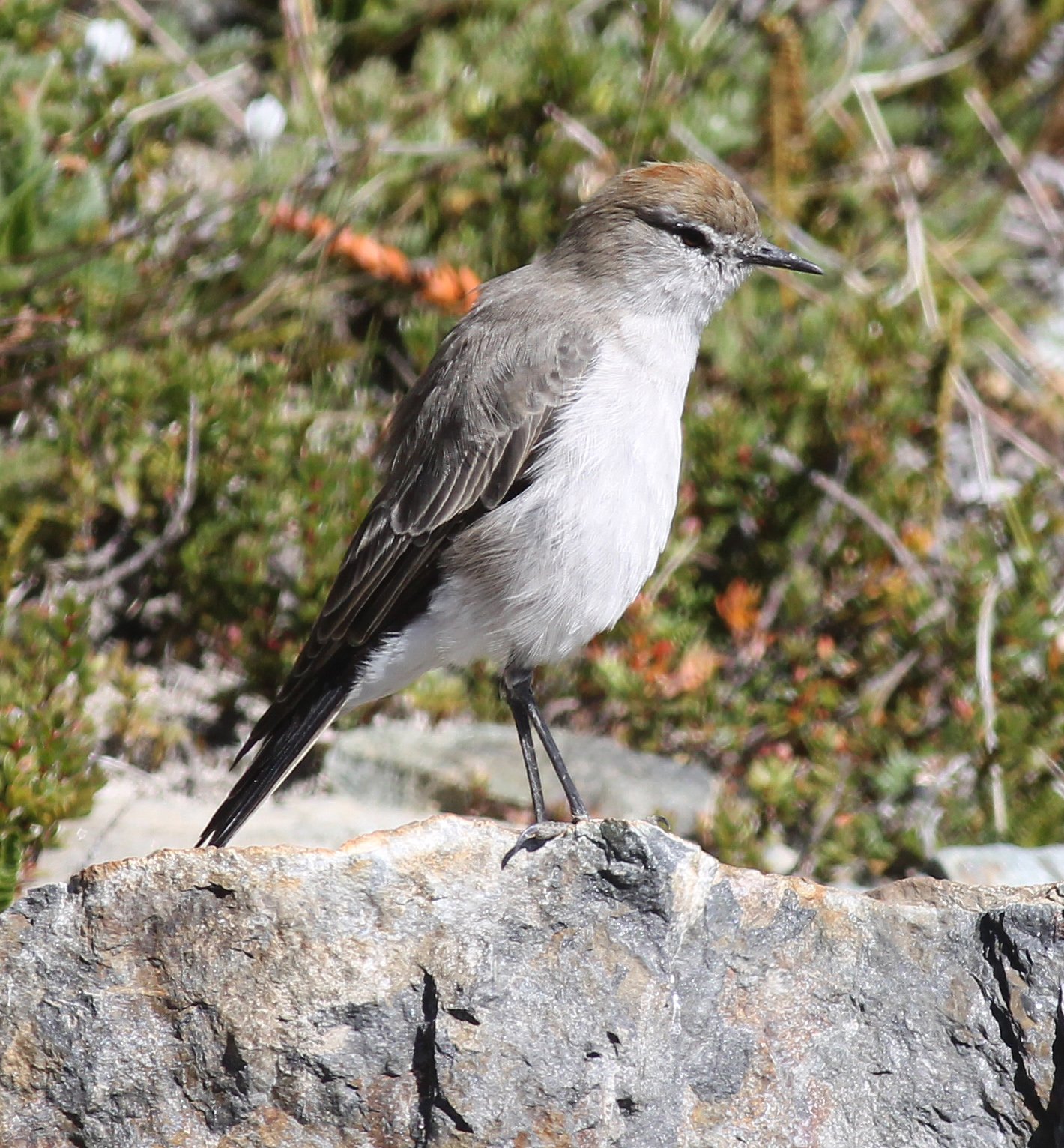
16–17 cm, upright, with long black legs. The upperparts are brown to greyish brown; the crown is brown with a rufous tinge towards the back. A long, narrow white supercilium runs from the bill to well behind the eye. The underparts are greyish white, slightly greyer on the breast. The tail is black with white outer edges. The sexes are alike.
Confusion species
Rufous-naped Ground Tyrant Muscisaxicola rufivertex is greyer, with a sharply defined, bright rufous nape patch and only a short white stripe in front of the eye. Puna Ground Tyrant Muscisaxicola juninensis lacks a long supercilium. Paramo Ground Tyrant Muscisaxicola alpinus is larger and greyer, with a short white loral stripe, and is the common ground tyrant in the páramo of Ecuador and Colombia.
Habitat
In the guide area mainly bofedales, wet grassland, the shores of lakes and streams and short-grazed puna and páramo, mostly between 3000 and 4500 m. It runs over the ground and catches insects, often in small groups and with other ground tyrants. It breeds outside the guide area.
Where the bird is most at home, classified by the vegetation units of the Andes and the west coast.


Range and movements
Peru: winter visitor in the Andes, mainly in the south and centre, north to Cajamarca. Bolivia: winter visitor in the Andes in the west. Ecuador: scarce winter visitor in the highlands of the south and centre. Colombia: only a few records in the south. Absent from the Galápagos. Outside the guide area the species breeds in the Andes of Chile and Argentina.
- Summer visitor (c. Apr–Sep)
- Passage (Mar–Apr, Oct–Nov)
- dark = core range, pale = thinly spread
How and when to look
Search from May to September along bofedales and wet, short-grazed grassland above 3500 m in southern and central Peru for brown ground tyrants with a long white supercilium.
Conservation status
Least Concern. The species has a large range in the Andes.
Scientific name
Muscisaxicola albilora | de Lafresnaye, 1855
De Lafresnaye described the species in 1855 and placed it straight away in the genus where it still stands. The genus Muscisaxicola was introduced in 1837 by D'Orbigny, ACVMD & de Lafresnaye. The genus name is a blend of the genera Muscicapa (flycatchers) and Saxicola (stonechats and whinchats). The species name comes from Latin albus, 'white', and lorum, 'lore' (the area between eye and bill). The specimen the first description was based on came from Santiago, Chile.