All species › Passerines › Tyrant flycatchers and allies › Dark-faced Ground Tyrant
Dark-faced Ground Tyrant | Muscisaxicola maclovianus
Maskergrondtiran | Dormilona carinegruzca | Dormilona-de-cara-escura
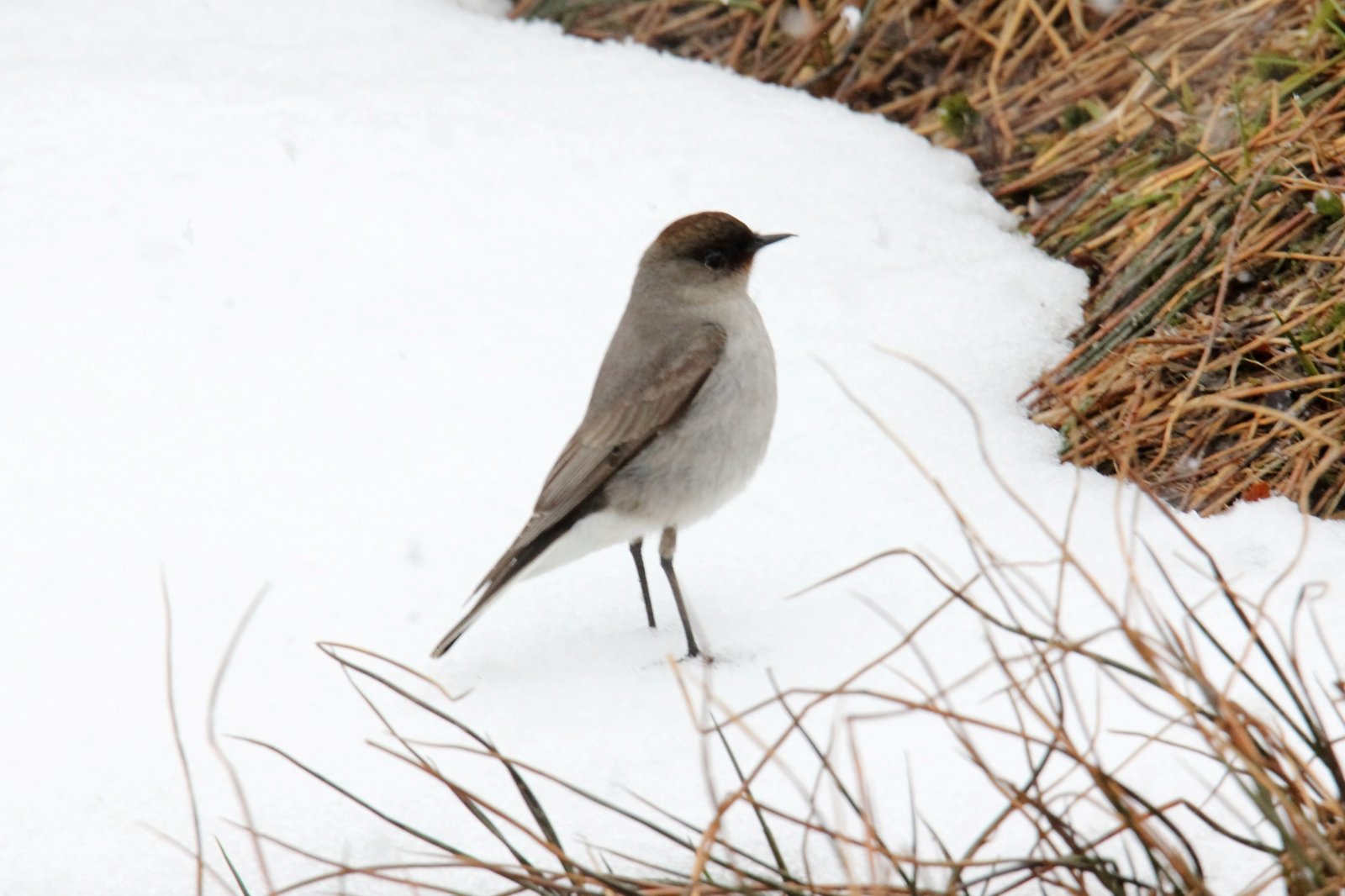
Dark-faced Ground Tyrant is the darkest ground tyrant, with a blackish face and a brown crown. It breeds in southern Chile and Argentina and on the Falkland Islands. In the austral winter some birds move north along the Pacific coast as far as Peru, where it is the only ground tyrant that appears in the coastal lowlands.
Voice
Usually silent outside the breeding season. Gives a soft tsit.
Recording: Dante Buzzetti — CC BY-NC-SA 4.0 · xeno-canto
Identification
15–16 cm, more compact and shorter-legged than the ground tyrants of the high Andes. The face and forehead are blackish, the crown dark chestnut-brown. The back is dark greyish brown, the underparts grey, paler towards the belly. The tail is black with narrow white outer edges. The sexes are alike.
Confusion species
Little Ground Tyrant Syrtidicola fluviatilis is smaller and sandier brown, with a pale face, and lives on river sandbars in the Amazonian lowlands. Short-tailed Field Tyrant Muscigralla brevicauda is smaller, with a very short tail, long pale legs and a rufous rump. Other ground tyrants, such as White-browed Ground Tyrant Muscisaxicola albilora, have a pale face and live in the high Andes.
Habitat
In the guide area in open country in the coastal lowlands: ploughed and fallow fields, pastures, sandy beaches, rocky shores and lomas, from sea level to a few hundred metres. It runs over bare ground and catches insects. It breeds outside the guide area.
Where the bird is most at home, classified by the vegetation units of the Andes and the west coast.


Range and movements
Peru: in the austral winter along the coast from Tacna and Arequipa north to the Lima area and locally farther north. Bolivia: no regular occurrence. Only a few records are known from Ecuador. Absent from Colombia and the Galápagos. Outside the guide area the species breeds in southern Chile and Argentina, Tierra del Fuego and the Falkland Islands.
- Summer visitor (c. Apr–Sep)
- Passage (Mar–Apr, Oct–Nov)
- dark = core range, pale = thinly spread
How and when to look
Search from May to September on fallow fields and beach flats along the coast of southern Peru, for example at Mejía in Arequipa, for dark birds running over bare ground.
Conservation status
Least Concern. The species has a large breeding range in southern South America.
Scientific name
Muscisaxicola maclovianus | (Garnot, 1826)
Garnot described the species in 1826 as Sylvia macloviana; because it was later moved to another genus, the author and year stand in brackets. The genus Muscisaxicola was introduced in 1837 by D'Orbigny, ACVMD & de Lafresnaye. The genus name is a blend of the genera Muscicapa (flycatchers) and Saxicola (stonechats and whinchats). The species name comes from Maclovia, the Latin name for the Falkland Islands (French Îles Malouines, after Saint-Malo). The specimen the first description was based on came from Falkland Islands.